


Authorship, review and evidence boundary
- Technical review
- East Baoyu Engineering Editorial Team
- Reviewed
- 2026-07-29
- Scope
- General engineering and procurement guidance. This article is not a project-specific design, capacity statement, certificate, warranty, code interpretation or contract requirement.
Evidence basis: Official and public references identified in the article, together with original editorial diagrams. Project values and release decisions require qualified review under the applicable project responsibilities.
Read the Editorial PolicyA useful solar mounting project input sheet does not end with one “complete” checkbox. It separates three decisions: what a supplier may quote with stated assumptions, what information is controlled enough for the defined engineering review, and what must remain on hold because an input is missing or contradictory. That separation matters because a budgetary quotation, a preliminary interface review and a fabrication release do not require the same evidence and do not authorize the same action.
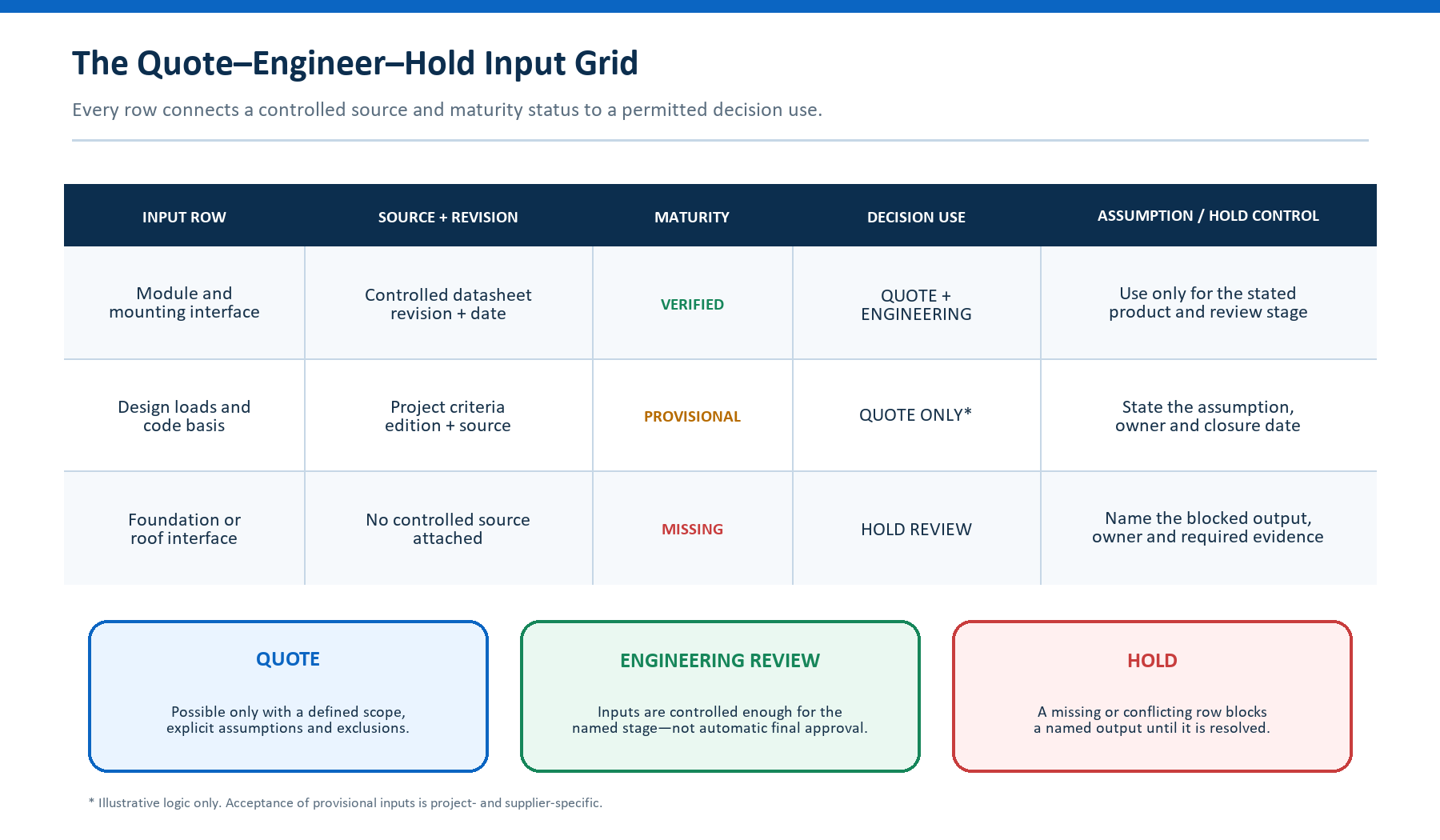
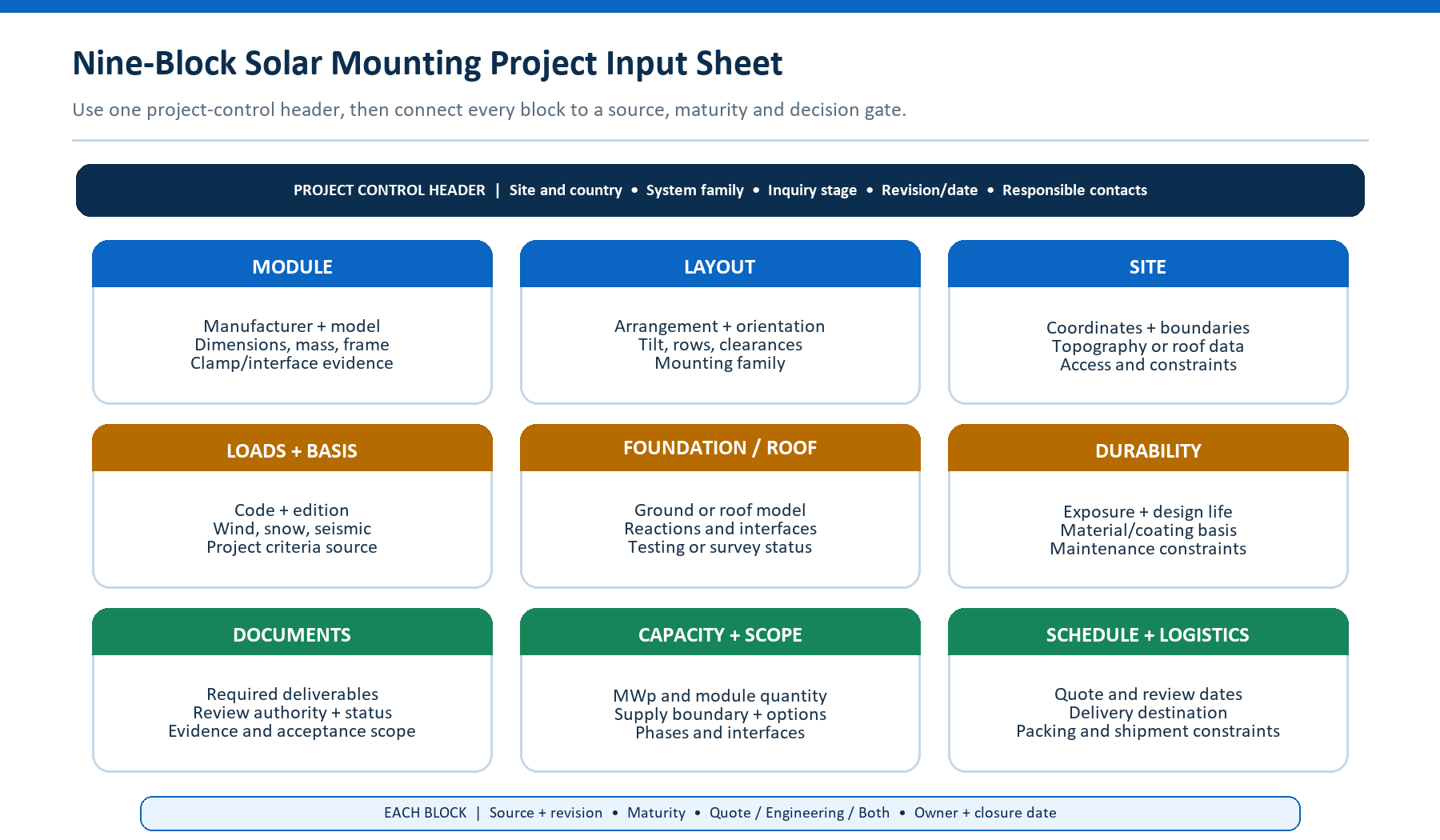
Use one row for every material input. Record the value, source and revision, maturity, decision use, owner and closure date. Then group the rows into module, layout, site, loads, foundation or roof interface, durability, documents, project capacity or quantity, and schedule or logistics. The resulting Quote–Engineer–Hold grid is an intake and coordination tool—not a design calculation, certificate, contract interpretation or automatic approval. The applicable project documents, jurisdiction, adopted code and edition, review stage and responsible authorities remain controlling.
1. Separate the three decisions before collecting data
Start by naming the requested output. “Please review and quote” is too broad unless the buyer identifies whether the request is a budgetary comparison, a firm commercial offer, a feasibility discussion, a preliminary engineering review, a tender design check or another project-defined stage. The output name determines which assumptions are permitted, which interfaces need controlled evidence and which missing item blocks progress.
| Decision | What the input sheet must reveal | Boundary to state |
|---|---|---|
| Quotation | Scope, quantities or capacity, product family, destination, schedule and named technical assumptions | Price validity, exclusions and unresolved inputs remain commercial/project specific |
| Engineering review | Controlled module, layout, site, basis, loads, support interface and durability information for the named stage | Review is not final design approval or authorization to fabricate |
| Hold | Missing, conflicting or unapproved input plus the exact output affected | Owner, required evidence and target closure date must be visible |
Do not use a quotation assumption as though it were an engineering input. Conversely, do not delay every budget discussion until final-design evidence exists. The controlled route is to expose the assumption, restrict its permitted use and identify what must replace it before the next gate. The project and supplier decide whether a provisional row is acceptable for a particular quotation; the sheet records that decision instead of hiding it.
2. Build a project-control header first
A technically detailed form can still fail if its identity is ambiguous. Put a project-control header above the nine input blocks. The header should stay stable while the form revision changes, and every attachment should be traceable to the same inquiry. Where the buyer and supplier use different document numbers, map both identities rather than replacing one.
| Header field | Buyer entry | Control note |
|---|---|---|
| Project / inquiry identity | Project name, buyer reference and supplier inquiry reference | Do not use an email subject as the only identity |
| Site and jurisdiction | Country, location, coordinates or controlled boundary file | State whether coordinates are final, provisional or approximate |
| Requested system and stage | Fixed, tracking or flexible; quote/review stage | Do not infer a product route from capacity alone |
| Responsible contacts | Commercial, engineering and document-control owners | Identify who may answer and who may approve |
| Form revision / date | Revision, issue date and superseded revision | Transmit attachments under the same issue record |
| Confidentiality route | Approved file-transfer path and restrictions | Do not place sensitive files in an unapproved channel |
Also state the expected answer: quotation only, quotation plus clarification list, engineering comment, evidence-availability confirmation or a combined response. A review team can then return one controlled outcome instead of several incompatible answers from sales, engineering and quality functions.
3. Apply four controls to every input row
Each row needs more than a value. First, identify the source and revision: datasheet, drawing, survey, project criteria, geotechnical report, roof assessment, specification, schedule or buyer instruction. Second, assign a maturity status. Third, identify whether the row may be used for quotation, engineering review or both. Fourth, record the assumption or hold owner and closure date. These four controls prevent a copied number from losing its engineering identity as the inquiry moves between systems.
| Maturity | Meaning in this template | Required treatment |
|---|---|---|
| Verified | Checked against the stated controlled source for the stated use | Retain source, revision, checked date and scope |
| Provisional | Known only as an assumption, preliminary issue or unapproved value | Restrict use; name owner and closure date |
| Missing | No usable controlled input has been supplied | Name the output placed on hold and the evidence required |
| N/A | Not applicable to the stated system, scope or stage | Record a reason and any project-required approval |
“Verified” is deliberately narrow. It does not mean certified, independently checked or approved for every downstream action. It means the row was checked against the named source within the stated scope. A module dimension verified against one datasheet revision cannot silently be applied to a different model or drawing issue.
4. Copy-ready nine-block solar mounting input template
The following blocks cover the buyer task without pretending that one checklist governs every project. Add, remove or expand rows to match the contract, system type and review stage. Keep the detailed source files outside the table, but link each table row to a controlled filename, revision and date.
| Block | Buyer entry prompts | Attach or reference | Typical gate question |
|---|---|---|---|
| 1. Module | Manufacturer/model; dimensions; mass; frame; clamp zones; permitted loads/interfaces | Current datasheet, installation manual and controlled drawings | Is the exact module interface known for this stage? |
| 2. Layout | Array arrangement; orientation; tilt; rows; tables; clearances; fixed/tracking/flexible route | Layout, single-line context where relevant and geometry issue | Can quantity and geometry be reconciled? |
| 3. Site | Country; boundary; coordinates; terrain/roof condition; access; drainage/obstructions | Survey, roof information, photos with rights and site constraints | Is the site source controlled and suitable for its intended use? |
| 4. Loads + basis | Adopted code/edition; risk or reliability basis; wind, snow, seismic and other criteria | Project design criteria and authorized hazard/load sources | Are definitions and units attached to every value? |
| 5. Foundation / roof | Ground model, foundation route or roof system; reactions; interfaces; investigation/testing status | Geotechnical/roof assessment, interface drawings and available test plan | Which support decision is possible and which remains held? |
| 6. Durability | Exposure; design life; materials; coating/finish; maintenance and repair constraints | Project durability specification and environment evidence | Is the corrosion route defined for the stated environment and life? |
| 7. Documents | Required drawings, calculations, certificates, ITP/MDR scope, language, format and review authority | Document list, evidence requirements and status definitions | What must be submitted, reviewed and accepted? |
| 8. Capacity + scope | MWp; module count; phases; supply boundary; options; exclusions and interfaces | Quantity schedule, scope matrix and commercial request | Do capacity, module count and supplied components reconcile? |
| 9. Schedule + logistics | Quote date; review need-by; production/delivery target; destination; packing and shipping constraints | Milestone schedule, destination and logistics instruction | Which dates are requirements and which are assumptions? |
5. Treat module and layout data as controlled interfaces
Module power class is not enough to define a mounting interface. Record the exact model, overall dimensions, thickness, mass, frame construction, mounting zones or holes, permitted orientation and any module-specific installation limitations shown in controlled documents. Do not copy geometry from a similar family. Route detailed checks to the module-interface review rather than expanding the inquiry form into a complete module specification.
The public scope of IEC 61215-1-1:2021 concerns design qualification of crystalline-silicon modules and explicitly says its test results are not a quantitative prediction of module lifetime. The project input sheet should therefore record the exact module evidence and intended use; it should not turn a qualification reference into a project mounting approval or service-life claim.
Reconcile the module count, layout issue and stated project capacity. If the energy model, civil layout and procurement quantity use different revisions, mark the conflict instead of choosing the value that best fits the quotation. A difference may be legitimate—phasing, spares, exclusions or multiple module types—but it needs an owner and explanation.
6. Keep site, loads and support evidence attached to their basis
Site and load values must retain their definition. Record the location source, adopted code and edition, units, risk or reliability basis, terrain/exposure basis, soil class where applicable and the authority that issued the project criteria. A speed, snow value or seismic parameter without that identity is not ready for responsible engineering use.
For an ASCE route, the ASCE Hazard Tool asks for the site, selected standard edition, risk category, soil class where relevant, units and hazard types. Its terms of use also warn that local requirements may vary and that tool output does not replace competent professional judgment. Record the report and input choices; do not paste one result into the sheet as an unqualified approved load.
For a Eurocode route, the JRC describes EN 1991 as covering actions including wind and snow, and EN 1997 as covering geotechnical design and ground investigation/testing. The applicable national implementation and National Annex context must also be identified where relevant. The input sheet records the route; it does not select project parameters or calculate reactions.
The foundation or roof block should point to the controlled support information available at this stage: geotechnical model and investigation status for ground systems, or roof material, geometry, condition, capacity assessment and interface constraints for rooftop systems. Separate existing evidence from a planned investigation. If reactions are preliminary, state who issued them and which structural model revision they represent.
7. Decide what may support a quotation
A quotation gate should answer whether the requested commercial scope can be described and priced under a controlled set of assumptions. At minimum for the particular inquiry—not as a universal rule—the supplier needs enough identity to distinguish the product family, scope boundary, quantity or capacity, destination and schedule, plus enough technical context to state what is included, excluded or provisional. Missing technical data may require a budget range, option, clarification or hold rather than a false firm basis.
List every commercial assumption beside the affected scope or price basis.
Do not convert a provisional engineering input into a guaranteed product parameter.
Show whether freight, packing, duties, site work, installation or testing is inside the request.
Record quote validity and schedule basis only through the authorized commercial review.
Capacity should be reconciled with module count and phase, but it should not be the only quantity field. Procurement needs the component and service boundary: posts, piles, rails, purlins, clamps, fasteners, drives or controls where applicable, design/documentation scope, spares, packing and optional items. The final list depends on the selected system and contract.
8. Decide what may enter engineering review
Engineering review requires a named stage and permitted use. A preliminary layout review may accept provisional module quantity while holding final member design. A connection-interface review may proceed with a controlled reaction set while the broader civil layout remains under development. The sheet should show these boundaries row by row instead of labelling the whole package “engineering complete.”
IEC 62548-1:2023 publishes PV-array design requirements and notes revised mounting-structure requirements; IEC also lists a 2025 amendment. If a project adopts this route, record the exact edition, amendments and licensed project requirements. The public product pages do not supply project loads, member sizes or approval for a particular mounting system.
Before a row supports engineering review, confirm that the source matches the product, site and revision; definitions and units are complete; dependent interfaces are visible; and open assumptions have an owner. Do not use the intake sheet as a substitute for the calculation package, design basis, drawing register, comment log or final release record.
9. Maintain one assumption and hold log
Do not bury assumptions in email threads or colour alone. Use one log linked to the input-row ID. An assumption may allow a named quotation or review step to continue, but it must carry an owner, source, affected output, closure evidence and due date. A hold states the exact decision that cannot proceed. When the evidence arrives, close the item through a controlled revision rather than editing the old issue silently.
| Item | Minimum fields | Close only when |
|---|---|---|
| Assumption | Input-row ID; assumed value/basis; reason; permitted use; owner; due date; affected scope | A controlled replacement source is issued or the project accepts the assumption for the stated use |
| Hold | Input-row ID; missing/conflicting evidence; blocked output; owner; escalation; due date | The required evidence is checked and the named output is formally released for its stated stage |
| Clarification | Question; requested party; answer needed; related files; response date; disposition | The answer is incorporated into a controlled row or rejected with reason |
The logic aligns with the planning purpose described on ISO's public page for ISO 10005:2018: establishing, reviewing, accepting, applying and revising quality plans for a project or contract. ISO states that the document provides guidance and does not specify requirements. Use the project's own procedures and approval roles.
10. Package source files without losing revision control
Transmit the form with an attachment register. Use controlled filenames, document numbers where available, revision, issue date, originator and purpose. Distinguish buyer-supplied, supplier-supplied and third-party material. If an attachment is superseded, retain the audit trail and mark it superseded; do not overwrite the file under the same identity.
| Attachment field | Why it matters |
|---|---|
| File / document identity | Prevents a value from being detached from its source |
| Revision and issue date | Shows which issue supported the quotation or review |
| Originator and authority | Distinguishes information supplied from information approved |
| Input-row references | Shows which entries must change when the source changes |
| Confidentiality / distribution | Protects customer, export-controlled and personal information |
| Status and permitted use | Prevents a preliminary file from becoming a fabrication basis |
Avoid sending unrelated archives. A smaller controlled package is easier to review than a folder of unidentified drawings and screenshots. If a source cannot be shared, record its existence, custodian, access route and the specific value it supports. That allows the review team to request evidence without implying that unavailable material was checked.
The receiving team should return the same form revision with a controlled response rather than rebuilding the buyer's information in an unrelated spreadsheet. For every changed row, show whether the supplier accepted the source for the stated use, added a clarification, introduced a quotation assumption or placed a named review output on hold. Keep buyer data and supplier interpretation in separate fields so the original input remains visible. If a supplier proposes a different module arrangement, support interface, material route or scope boundary, record it as a proposal with its own source and revision; do not overwrite the buyer's requirement. The returned issue should also identify the attachments reviewed, the status date and the next responsible party. This closed-loop exchange turns the input sheet into a traceable decision record while preserving the distinction between information received, assumptions made and decisions authorized.
11. Common intake failures and corrective actions
| Failure | Why it misleads | Corrective action |
|---|---|---|
| One complete/incomplete flag | Hides which decision each row can support | Use Quote, Engineering Review, Both or Hold |
| Module power only | Does not define geometry, mass or mounting interface | Attach the exact controlled module package |
| Load values without definitions | Units, edition, location and reliability basis can differ | Attach the authorized basis and full value identity |
| Capacity without quantity/scope | Cannot reconcile components, phases or exclusions | Add module count, scope matrix and phase |
| Provisional files called approved | Transfers an unauthorized status downstream | Use explicit maturity and permitted-use fields |
| Screenshots without source identity | Cannot be checked or updated reliably | Reference the original controlled document |
| No owner for missing data | The hold persists without a closure route | Assign owner, evidence required and date |
| Every attachment marked evidence | Presence does not prove relevance, currency or acceptance | Record what each source proves and does not prove |
12. Worked status example without fabricated project data
The example below demonstrates status logic only. It contains no customer, load, price, quantity, certificate or project value. Replace every illustrative entry with the project's controlled information before use.
| Generic row | Source state | Maturity | Decision use | Recorded control |
|---|---|---|---|---|
| Module interface | Exact controlled datasheet is attached | Verified | Quote + engineering review | Restrict use to the named model/revision |
| Design-load basis | Preliminary project criteria is attached | Provisional | Quotation only if accepted | Name assumption owner and replacement date |
| Foundation / roof input | No controlled source is available | Missing | Hold engineering review | Name blocked output and required evidence |
| Non-applicable system feature | Reason is stated for the selected mounting route | N/A | No use | Record reason and project-required approval |
13. What to send East Baoyu
For an initial solar mounting inquiry, send the project-control header and the information available now: module package, layout, site or roof information, design basis and available loads, foundation or roof interface status, durability requirements, requested documents, capacity and quantity, scope boundary, destination and required dates. Mark provisional and missing entries clearly. Do not send confidential, export-controlled or sensitive personal documents until an appropriate transfer route is agreed.
Use East Baoyu's Solar Mounting Systems, Evidence Center and Contact pages to frame the request. Ask which evidence is currently available for the exact product and project scope; do not assume that a certificate, report or approved design exists because it appears on an input checklist.
Request the relevant evidence pack
Send the controlled input sheet and attachment register. The appropriate supplier-side response should identify the information that can support quotation, the inputs suitable for the stated review stage, the evidence that is available for the proposed scope and the items that remain provisional or on hold.

Questions? Chat with East Baoyu on WhatsApp. Chat with the East Baoyu team about capacity, pricing, configuration and available product videos.
Open WhatsApp: +86 130 1228 3281
| Contact | Official detail |
|---|---|
| info@eastbaoyu.com | |
| Phone | +86 22 28352066 |
| +86 130 1228 3281 | |
| Website | https://eastbaoyu.com/contact/ |
Email the input package: info@eastbaoyu.com
Frequently asked questions
What is the difference between quotation inputs and engineering-review inputs?
Quotation inputs define the commercial scope and the assumptions under which a supplier may price or propose options. Engineering-review inputs must be controlled enough for the named technical stage and permitted use. A quotation assumption is not automatically an engineering basis.
Can a supplier quote when some solar mounting inputs are missing?
Possibly, but only through the supplier's authorized commercial route and with explicit assumptions, exclusions, options or holds. Missing information must not be converted into an unqualified technical or delivery commitment.
Does a completed project input sheet authorize engineering or fabrication?
No. The sheet supports intake and triage. The project-defined calculation, drawing, review, approval and release records still control engineering and fabrication.
What should be attached for the PV module?
Attach the exact current module datasheet and the controlled installation or interface information relevant to the mounting system. Include the model, revision/date and the source of dimensions, mass, frame and mounting-zone data.
How should provisional wind, snow or seismic inputs be handled?
Keep the complete definition, source and units attached; label the row Provisional; restrict its permitted use; and name the person and date for replacement. Do not present a hazard-tool result or copied value as an approved project load.
Is the Q–E–H grid an international standard?
No. It is an editorial coordination method created for this guide. The project contract, jurisdiction, adopted codes, procedures and responsible authorities define the real requirements.
Related East Baoyu resources
Solar Mounting Systems | Engineering Articles
Evidence Center | Contact East Baoyu
Solar Mounting Design Input Checklist | Module Datasheet Inputs for Mounting Design
Topographic Survey Requirements | Geotechnical and Structural Inputs
Project Document Register | Project Acceptance and Manufacturing Data Records
Steel Fabrication ITP | Research & Methods
References and scope notes
Official public sources were checked on 28 July 2026 and are paraphrased only within their public scope. The paid IEC and EN standard texts were not reproduced. Project teams must verify the licensed standards, amendments, national implementation, project criteria, contract, review stage and named authorities. ASCE tool output is not treated as an approved project load. ISO 10005 is cited as guidance, not as a mandatory checklist. This article is an intake template, not engineering advice, a design approval, a certificate of conformity or a commercial commitment.
IEC 62548-1:2023 | IEC 62548-1:2023/AMD1:2025
IEC 61215-1-1:2021 | ASCE Hazard Tool
ASCE Hazard Tool Terms | JRC Eurocode 1
JRC Eurocode 7 | JRC National Standards
ISO 10005:2018 | SAM Photovoltaic Models
References, disclosure and change record
References and further verification
- https://webstore.iec.ch/en/publication/61346
- https://www.asce.org/publications-and-news/asce-hazard-tool/about/
- https://www.asce.org/publications-and-news/asce-hazard-tool/terms/
- https://eurocodes.jrc.ec.europa.eu/EN-Eurocodes/eurocode-1-actions-structures
- https://eurocodes.jrc.ec.europa.eu/EN-Eurocodes/eurocode-7-geotechnical-design
- https://eurocodes.jrc.ec.europa.eu/en-eurocodes-implementation/national-standards
- https://webstore.iec.ch/en/publication/64171
- https://webstore.iec.ch/en/publication/98955
- https://www.iso.org/standard/70398.html
- https://eastbaoyu.com/solar-mounting/
- https://eastbaoyu.com/evidence-center/
- https://eastbaoyu.com/contact/
- https://wa.me/8613012283281
- https://wa.me/8613012283281?text=Hello%20East%20Baoyu%2C%20I%20would%20like%20to%20discuss%20a%20solar%20mounting%20project%20input%20sheet.
- https://eastbaoyu.com/articles/
- https://eastbaoyu.com/solar-mounting-design-input-checklist-epc-procurement/
- https://eastbaoyu.com/module-datasheet-inputs-needed-solar-mounting-design/
- https://eastbaoyu.com/topographic-survey-requirements-ground-mount-solar-structures/
- https://eastbaoyu.com/combining-geotechnical-structural-inputs-solar-mounting/
- https://eastbaoyu.com/project-document-register-manufactured-steel-solar-components/
- https://eastbaoyu.com/project-acceptance-and-manufacturing-data-records/
- https://eastbaoyu.com/steel-fabrication-itp-mtc-wps-ndt-coating/
- https://eastbaoyu.com/research-methods/
Disclosure: East Baoyu manufactures and supplies products discussed on this website. Structured drafting tools may assist research and editing, but technical claims, project inputs and release decisions require qualified review under the applicable project responsibilities.
Version 1.0: Initial scheduled publication in the East Baoyu engineering knowledge-base batch.
View the public Content Change Log · Corrections: info@baolaipipes.com