
Authorship, review and evidence boundary
- Technical review
- East Baoyu Engineering Editorial Team
- Reviewed
- 2026-09-06
- Scope
- General engineering and procurement guidance. This article is not a project-specific design, capacity statement, certificate, warranty, code interpretation or contract requirement.
Evidence basis: Official and public references identified in the article. Project values and release decisions require qualified review under the applicable project responsibilities.
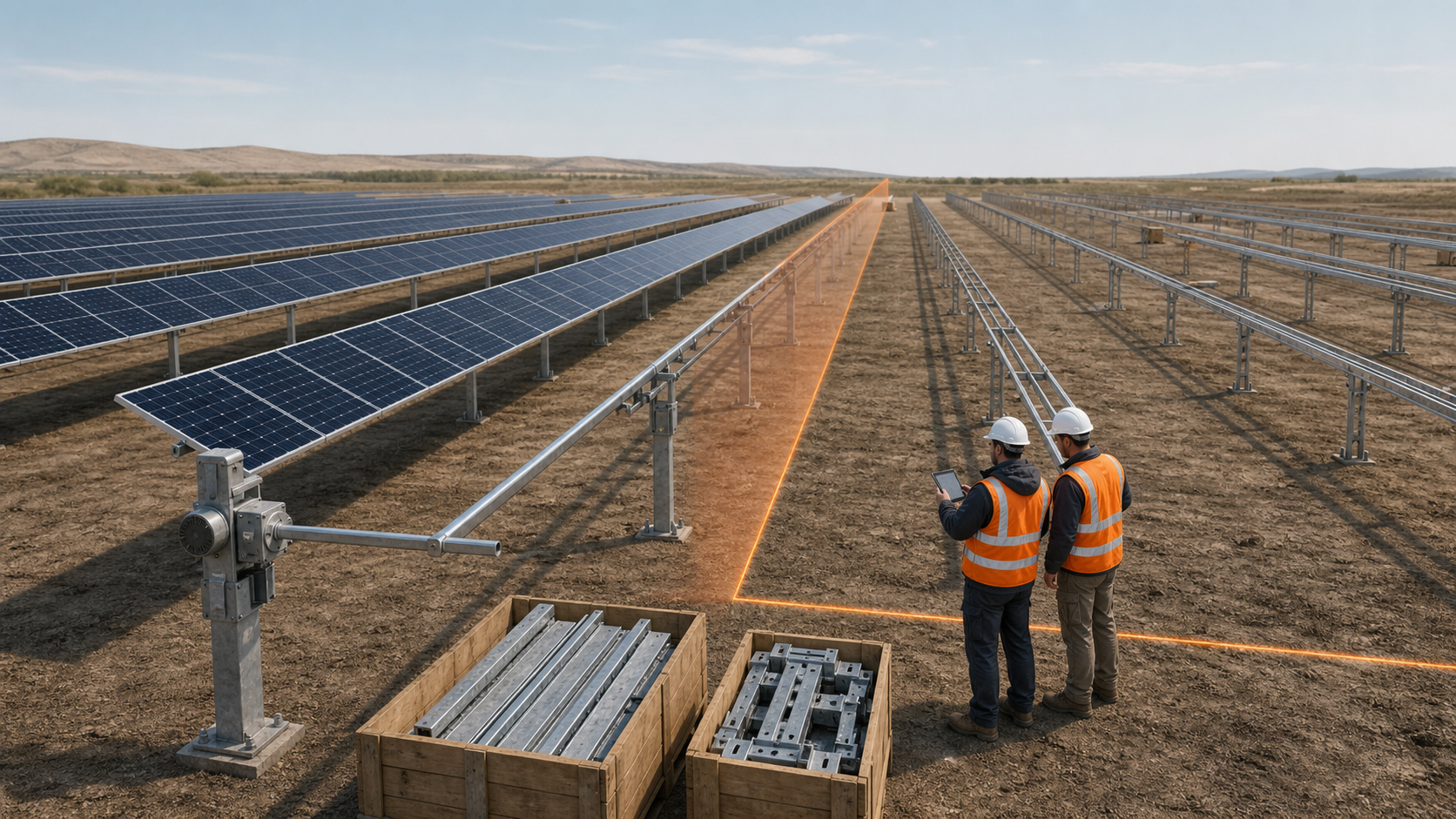
Read the Editorial PolicyA solar tracker installation change is controlled only when the project can name the last accepted configuration, the first affected material or row, and the evidence that must be reopened. A revised drawing, substitute component, foundation correction, tool change, firmware update or field workaround can invalidate more than the place where it was discovered. The response is not to retest every row automatically or to accept a successful movement as proof. Stop at a defined cut-in boundary, classify which interfaces and claims changed, trace the affected population in both directions, and select a proportionate requalification route. This guide helps EPC, QA and commissioning teams make that decision without replacing the approved design, tracker manual, project inspection plan or contractual release authority. The featured image is an AI-generated concept of that boundary, not a project or acceptance record.
Freeze the Last Released Tracker Configuration
Change control starts from a known accepted state. “Use the latest drawing” is not enough because tracker installation depends on a coordinated set of physical and digital configuration items. The set may include the row-family definition, foundation schedule, bearing and torque-tube details, drive and controller identities, module interface, fastener schedule, cable and bonding route, approved field corrections, installation procedure, inspection plan, firmware, parameter set and commissioning script.
Record the configuration that actually governed the released work, not only the documents that now appear in the project portal. A later upload does not prove when a crew received it, when stores changed the material issue, or which rows were built under it. Use one baseline record that joins technical revision, physical population and release event.
| Baseline element | Identity to preserve | Question the change review must answer |
|---|---|---|
| Product family | Tracker/row family, component model, drawing and BOM revision | Does the changed item remain inside the accepted family and interface envelope? |
| Site allocation | Block, zone, row range, foundation type and terrain/layout variant | Which physical locations used the previous state? |
| Material state | Purchase lot, serial/batch identity where required, stores location and issue record | Which uninstalled and installed items share the changed condition? |
| Installation method | Procedure, tools, gauges, sequence, permitted adjustment and inspection points | Did the method or the evidence produced by it change? |
| Controls state | Controller/drive identity, firmware, parameter-set and network-map revision | Which rows received the affected digital configuration? |
| Release state | Inspection record, commissioning status, deviations and authorizing role | Which earlier decision may no longer be supported? |
ISO 10007:2017 gives guidance for configuration management across a product or service life cycle. ISO currently lists the 2017 edition as published and confirmed in 2023, while also showing that a revision is under development. The project should therefore confirm its adopted edition and requirements rather than treating this article as a substitute for the standard.
The broad solar tracker installation guide owns the planned route from released foundations through representative-row qualification, production and handover. This page starts later: an accepted baseline exists, some work may already be complete, and a delta has made the represented population uncertain.
Define a Physical Change Cut-In Before Work Continues
The first operational decision is where the old state ends and the proposed state begins. Define that boundary before crews consume more material or overwrite digital settings. A calendar time alone is weak because components may have been kitted earlier, rows can be at different work states, and a controller package may be loaded remotely after mechanical completion.
Create a Change Cut-In Record with the change identifier; discovery time; source and reason; last confirmed old-state population; first proposed new-state population; material in stores, kits, transit and installation; affected documents and software; current hold locations; temporary protections; and the person authorized to release each next state. Photograph or otherwise preserve the as-found condition where the approved project procedure permits it.
Containment should match the plausible connection. If the issue concerns one labeled component, isolate that identity and any population that may share it. If it concerns an installation instruction, tool condition, survey datum, firmware or parameter package, the boundary may follow crew, shift, instrument, upload event, zone or row family instead. Do not assign a narrow boundary merely because it is convenient to inspect.
Physical work, documents and control software may need different cut-in points. A row can contain the new hardware but the old firmware, or the old assembly with a revised inspection form. Preserve those states separately until the review determines whether they form an acceptable configuration.
Classify the Delta by Interfaces and Claims
A change title does not determine its consequence. “Equivalent part,” “drawing clarification,” “minor field adjustment” and “software update” are proposed descriptions, not release decisions. Review what the old evidence claimed and which interface the new state can affect.
| Delta family | Interfaces to challenge | Evidence that may need reopening | Boundary to preserve |
|---|---|---|---|
| Drawing or BOM revision | Geometry, fit, load path, clearances, quantities and row-family allocation | Design approval, shop/assembly instructions, dimensional checks and prior concessions | A revision label alone does not prove physical implementation |
| Component source or model change | Material, dimensions, connection, corrosion protection, compatibility, service and spares | Approved data, qualification scope, receiving identity, first-off inspection and installation records | “Form-fit-function” remains a project determination |
| Foundation correction or survey update | Bearing location, elevation, orientation, adjustment, drive alignment and movement envelope | Survey release, correction detail, interface inspection and represented-row evidence | The correction for one location is not automatically a general method |
| Tool, crew or method change | Assembly sequence, access, fastening state, measurement and hidden work | Procedure approval, competence, tool status, witnessed checks and affected-row records | A result can look acceptable while the required process evidence is missing |
| Drive, sensor or controller change | Mechanical coupling, direction, limits, feedback, power, communications and protective behavior | Model/revision evidence, configuration record, functional test and regression scope | Successful local movement does not prove system command behavior |
| Firmware or parameter change | Row identity, algorithms, limits, alarms, network mapping and recovery | Approved package/hash or version, authorization, upload log, settings backup and functional evidence | Never infer that the same version means the same parameter state |
Use the approved design and tracker instructions to identify technical effects. Use the inspection and commissioning plans to identify evidence effects. Use the contract to identify approval and release effects. These are related but separate decisions.
IEC 62817:2014+A1:2017 is the current consolidated IEC listing for design qualification of solar trackers and covers test procedures for components and complete systems. Its official page currently shows a stability date of 2028. Qualification evidence can inform which claim a design change touches, but it does not prove that the supplied revision, project layout, installation state or software configuration remains acceptable.
Find Every Affected Row in Both Directions
Forward traceability asks where the proposed change will go. Backward traceability asks where the same condition may already exist. Both are necessary when a defect or unapproved delta appears after production has started.
Build an Affected-Row Ledger. Give each line one physical population and one configuration state. Record block/zone/row identity; row family; foundation/interface variant; affected component and lot/serial range where required; installation date and crew; procedure/tool/instrument identity where relevant; controller/firmware/parameter state; inspection and commissioning status; open deviations; containment location; and current release decision.
Do not rely on a total such as “42 rows completed.” The decision needs the exact rows represented by each total and the join keys that connect them to material, crew, procedure and software. Reconcile four populations:
- unissued stock and preassembled kits that can still be controlled before installation;
- work in progress where the changed interface is still visible;
- mechanically complete rows whose evidence may need focused reopening;
- commissioned or handed-over rows that may require an authorized operational hold, review or scoped revalidation.
Search beyond the first nonconforming row. A shared purchase lot, field modification, crew instruction, tool, survey file, firmware upload, parameter template or network-mapping operation may connect other rows. Conversely, rows that merely share a date or block should not be included without a credible link. Record the inclusion rule, exclusion rule and evidence for both.
The solar mounting configuration transfer guide explains how an approved system family moves into production and packing. The affected-row ledger performs the reverse task after a delta: it reconstructs which delivered or installed population still matches each released family.
Choose Requalification Depth from Lost Evidence
Requalification should recover the confidence lost by the change. It should not be an automatic full replay, and it should not be reduced to the easiest available check. Start with the affected claim: fit, load path, durability, fastening, movement, electrical continuity, position feedback, communications, protective response, documentation or another project-defined function. Then identify the earlier evidence that supported that claim and ask whether it still represents the new state.
| Evidence loss | Possible project-controlled response | Release question |
|---|---|---|
| Record identity or revision mismatch with no confirmed physical delta | Reconcile source, approval, distribution and as-built identity; inspect the population if physical state remains uncertain | Can the project prove which accepted requirement governed each row? |
| Local physical change with bounded interfaces | Review the approved detail, inspect the affected condition and repeat only the checks invalidated by the change | Are connected interfaces still represented by valid evidence? |
| Component or method change inside an accepted family | Confirm applicability, qualify the changed step or first implemented unit, and define production verification | Does previous qualification cover the changed item, process and represented population? |
| Geometry, foundation, drive or control change with cross-interface effects | Obtain accountable engineering/technical review and run the approved mechanical, electrical and functional regression set | Has every affected claim been re-established for the new configuration? |
| Unbounded population or missing as-found evidence | Maintain hold, broaden trace review, recover evidence where possible and escalate disposition | Can any safe and contractually valid release boundary be demonstrated? |
The responsible parties decide the actual review, inspection, test coverage and acceptance values. No universal row percentage, torque value, positional tolerance, motion range, current limit, wind trigger or test duration applies across tracker products and projects.
For a control change that affects protective behavior, use the project’s approved validation route. The solar tracker stow validation guide shows how to connect initiating condition, command, row response, confirmation and abnormal branches. A local function test belongs inside that evidence chain; it cannot replace the chain when the changed claim is plant-level response.
Roll the Change Out Through a Controlled Pilot
Once the impact and requalification route are approved, implement the delta on a deliberately selected population. A pilot row or first changed unit is useful only when it represents the affected foundation, row family, drive/control architecture, component revision, crew method and operating conditions named by the review. Different families or materially different site conditions may need separate representation.
Issue a controlled implementation pack: approved change and reason, effective population, revised documents and software, withdrawn items, material segregation, work instructions, inspection/test steps, intervention points, rollback or recovery plan where feasible, required records and release authorities. Confirm that stores, field crews, QA, commissioning, document control and the owner/OEM interfaces received the same effective state.
Inspect the changed condition before later work conceals it. Capture actual identities, measurements and results required by the approved route. If the pilot exposes a new effect, stop expansion, update the impact analysis and reconsider the population boundary. Do not edit the acceptance story after the fact to make the pilot appear representative.
Release replication only after the designated reviewer accepts the pilot evidence for a stated configuration and population. Then control production by row identity. Trend recurring adjustments or discrepancies because repeated local correction can indicate that the change has not resolved the underlying interface.
The project inspection and test plan should show which notice, witness, review and release events reopen. A previously waived or completed event does not automatically remain valid after its represented condition changes. The contract and authorized parties decide whether new notice or attendance is required.
Close the As-Built and Commissioning Baseline
A change is not closed when the last modified row moves. Close it when the project can distinguish the old and new configurations, reconcile every affected row, link the required evidence, and hand over an accurate operating baseline.
Retain the superseded baseline, approved change, impact review, affected-row ledger, cut-in event, material and software implementation records, inspections, tests, deviations, approvals and final population release. Update as-built drawings, BOM/configuration registers, row mapping, firmware and parameter inventories, commissioning records, spares and O&M information where the approved change affects them. Prevent the final document set from presenting one revision as if it governed every row when controlled variants remain.
IEC 62446-1:2016+A1:2018 currently appears in the IEC catalogue as consolidated edition 1.1 for grid-connected PV documentation, commissioning tests and inspection. The catalogue lists a 2026 stability date, so applicability and any newer project-adopted issue should be checked at release. The standard provides a broader PV handover context; it does not define the tracker-specific requalification scope for this change.
The U.S. Department of Energy’s current PV installation and commissioning guidance recommends planning commissioning before construction and connects acceptance with system documentation, array testing and whole-system performance testing. Applied to a change, the practical lesson is to update the commissioning basis before executing the affected test—not to append a change note after the original script has already been run.
Finish each ledger population in an explicit state: released under the old accepted configuration, released under the new accepted configuration, held pending evidence, or otherwise conditionally controlled only when the governing project route permits and defines the limitation. The final baseline must let operations identify what is installed and which approved evidence supports it.
Related Resources
- Solar Tracker Installation — control the planned foundation, reference-row, production, commissioning and handover sequence.
- Solar Tracking Bracket — review the product-family route and project inquiry inputs.
- Solar Mounting Configuration Transfer — transfer one approved system family into manufacturing and packing.
- Solar Tracker Stow Validation — prove the approved protective-response chain after applicable control changes.
- Inspection and Test Plan — define notice, intervention and release effects.
References
- ISO 10007:2017 — Quality management: Guidelines for configuration management
- IEC 62817:2014+A1:2017 — Photovoltaic systems: Design qualification of solar trackers
- IEC 62446-1:2016+A1:2018 — Grid-connected PV documentation, commissioning tests and inspection
- U.S. Department of Energy — Install and Commission a Photovoltaic System
Next Step
Before applying a tracker installation change, send East Baoyu the last released row-family baseline, proposed delta, affected component or software identity, block/zone/row map, material and installation records, current inspection/commissioning state, open deviations and required release authorities. East Baoyu can review the supplier-side configuration, fabrication, component identity and document interfaces and return a missing-input and affected-population checklist for the agreed supply scope. The tracker OEM, responsible designer, EPC, commissioning authority, owner and contractual inspectors retain approval of the design change, site method, safety controls, test values and final release. Contact info@baolaipipes.com with one controlled change package.
References, disclosure and change record
References and further verification
- https://www.iso.org/standard/70400.html
- https://eastbaoyu.com/solar-tracker-installation/
- https://webstore.iec.ch/en/publication/61127
- https://eastbaoyu.com/solar-mounting-configuration-transfer/
- https://eastbaoyu.com/solar-tracker-stow-validation/
- https://eastbaoyu.com/inspection-and-test-plan/
- https://webstore.iec.ch/en/publication/63726
- https://www.energy.gov/cmei/femp/life-cycle-photovoltaic-systems-install-and-commission-photovoltaic-system
- https://eastbaoyu.com/solar-tracking-bracket/
Disclosure: East Baoyu manufactures and supplies products discussed on this website. Structured drafting tools may assist research and editing, but technical claims, project inputs and release decisions require qualified review under the applicable project responsibilities.
Version 1.0: Scheduled as EB50-044 on 2026-09-06.
View the public Content Change Log · Corrections: info@baolaipipes.com