


Authorship, review and evidence boundary
- Technical review
- East Baoyu Engineering Editorial Team
- Reviewed
- 2026-07-29
- Scope
- General engineering and procurement guidance. This article is not a project-specific design, capacity statement, certificate, warranty, code interpretation or contract requirement.
Evidence basis: Official and public references identified in the article, together with original editorial diagrams. Project values and release decisions require qualified review under the applicable project responsibilities.
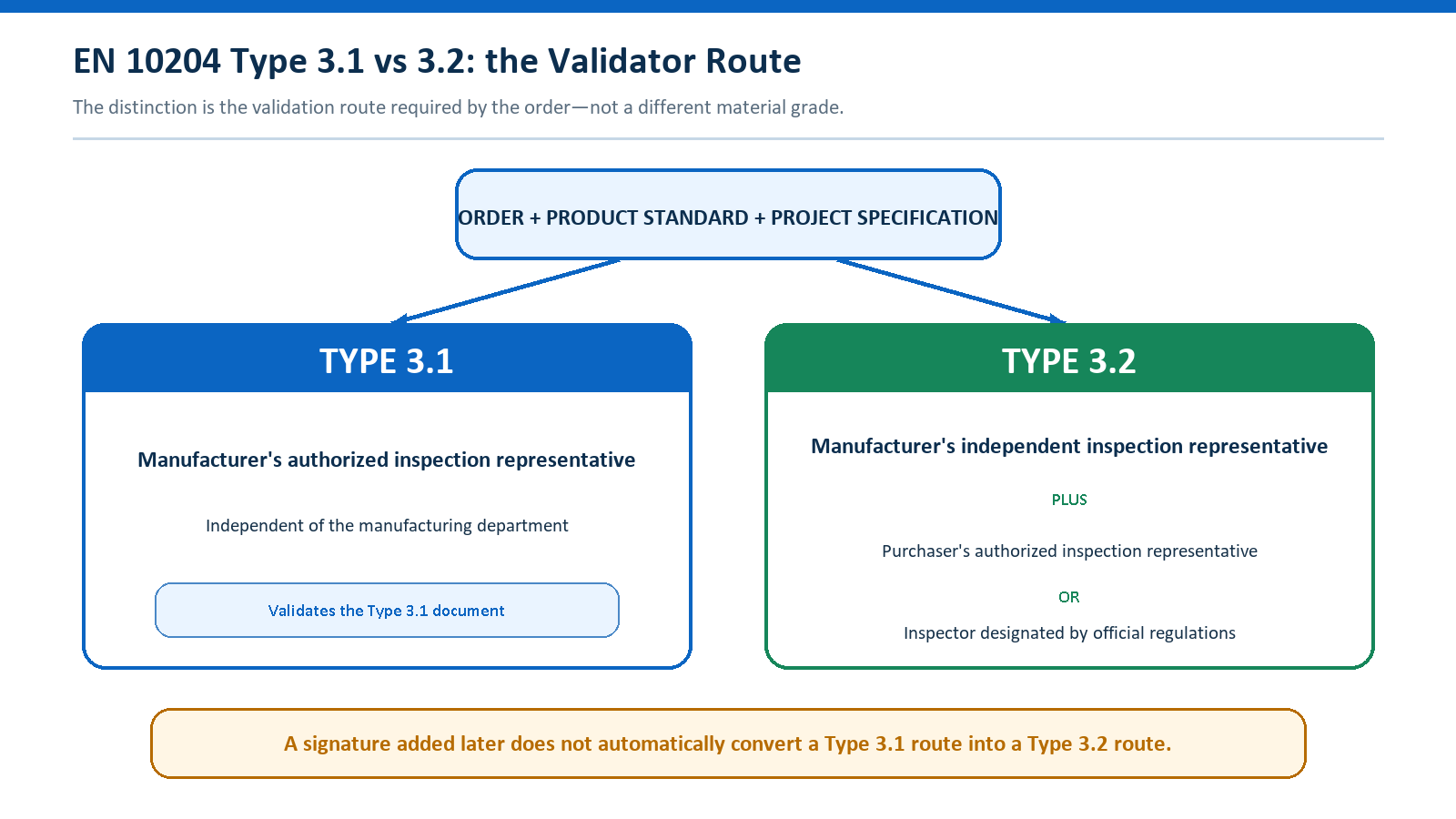
Read the Editorial PolicyThe practical difference between EN 10204 Type 3.1 and Type 3.2 is the validation route, not a different steel grade or an automatic increase in material quality. Type 3.1 is validated by the manufacturer's authorized inspection representative who is independent of the manufacturing department. Type 3.2 adds the purchaser's authorized inspection representative or an inspector designated by official regulations. The controlling order, product standard, project specification and regulatory basis decide which route is required.
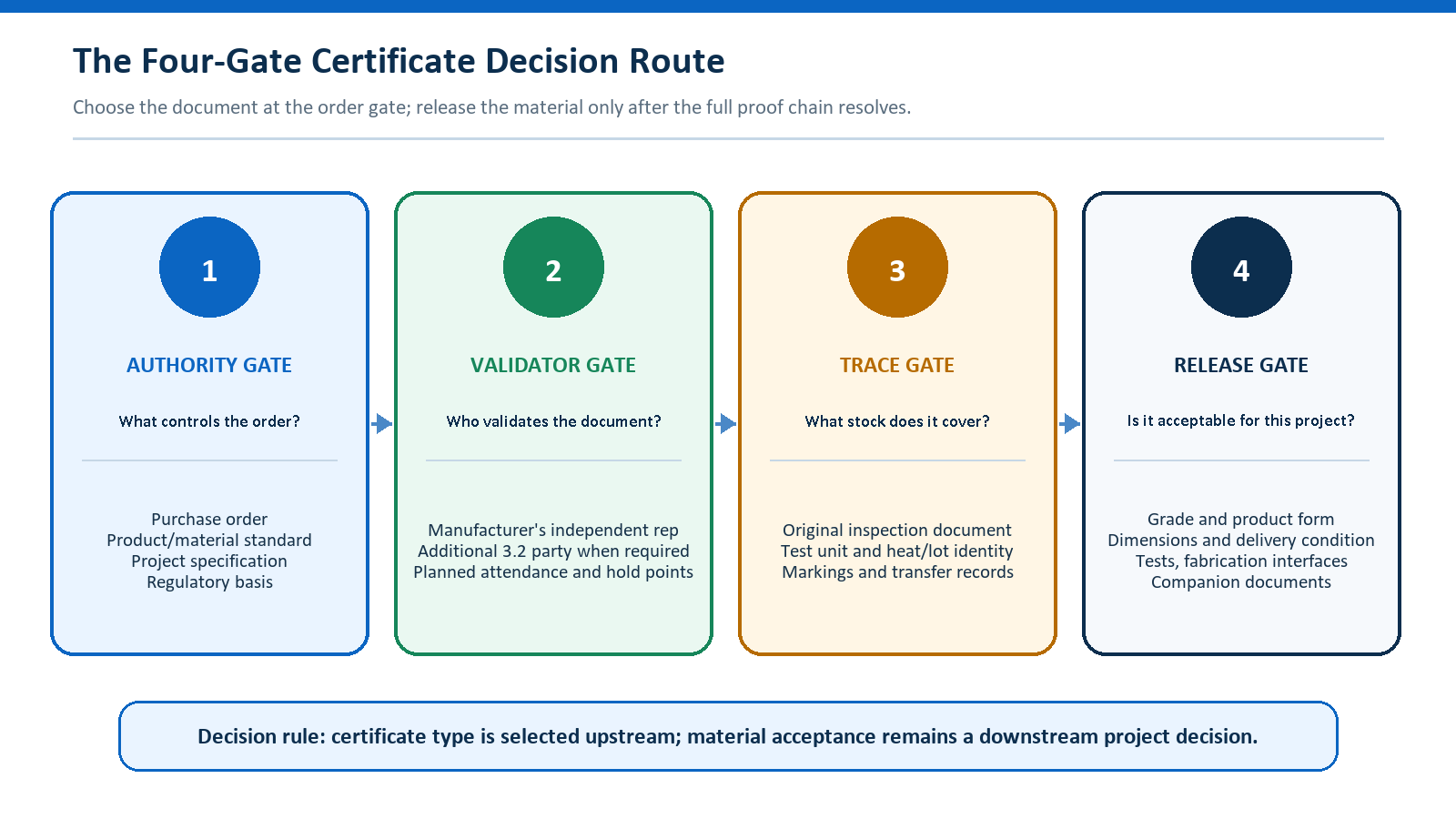
Select the certificate type before production and testing, then check more than the PDF title. A buyer still needs to reconcile the original inspection document, test unit, heat or lot, material markings, transfer records and delivered stock. Neither Type 3.1 nor Type 3.2 by itself approves the material for a project, replaces design or fabrication records, or proves that every test was witnessed. Use the Four-Gate Certificate Decision Route below to separate authority, validator, traceability and project release.
1. EN 10204 3.1 vs 3.2 at a glance
| Comparison axis | Type 3.1 | Type 3.2 | Buyer implication |
|---|---|---|---|
| Inspection basis | Specific inspection results for the supplied products/test unit | Specific inspection results for the supplied products/test unit | The order and applicable standard must define the required testing and test unit |
| Manufacturer-side validation | Manufacturer's authorized inspection representative independent of manufacturing | Manufacturer's authorized inspection representative independent of manufacturing | Check the role and authority, not only a signature image |
| Additional validation | Not part of the Type 3.1 route | Purchaser's authorized inspection representative or inspector designated by official regulations | Define the additional party and attendance route before the relevant inspection |
| Material quality | Does not create a material grade | Does not create a higher material grade | Grade, product form, delivery condition and tests remain separate requirements |
| Project acceptance | Supporting receipt evidence only | Supporting receipt evidence only | Project release still requires requirement and identity checks |
The current public scope page for BS EN 10204:2004 describes inspection documents for metallic products, including specific and non-specific inspection and document validation. Use the licensed standard, national implementation and contract to confirm the exact wording applicable to an order.
2. Begin with the order, not the PDF
A certificate cannot be evaluated in isolation from the purchase requirement. Start with the purchase order, material or product standard, drawing, project specification, approved vendor requirements and any regulatory rule that applies. Record the edition and amendment status. A familiar certificate title does not resolve a conflict between those documents, and a supplier should not choose Type 3.2 merely because it sounds more stringent.
| Order field | What to state | Failure prevented |
|---|---|---|
| Document type | EN 10204 Type 3.1 or Type 3.2, plus any project-defined naming | Certificate route decided after manufacture |
| Material identity | Grade, product form, dimensions, delivery condition and applicable standard/edition | Correct certificate attached to the wrong requirement |
| Inspection scope | Required tests, test unit, sampling and acceptance basis | Results accepted without knowing what population they represent |
| Type 3.2 party | Purchaser representative or officially designated inspector, authority and notification route | Late or unauthorized witnessing request |
| Records and timing | Hold/witness points, notice period, copies, language and final document package | Testing completed before required attendance |
| Substitution/change | Approval route for source, grade, form, test or certificate-route change | Commercial change treated as automatic technical acceptance |
For steel delivery context, ISO 404:2013 provides general technical delivery requirements and notes the role of the order and product standard. ISO 10474:2013 separately defines inspection documents for steel delivered against an order. These references are not a reason to assume automatic interchangeability with EN 10204; the contract must identify the required document system.
3. Authority gate: identify what actually controls
At the Authority Gate, list every document that can impose a certificate requirement and set a precedence rule. A product standard may call for one route while a project specification adds purchaser inspection. A regulation may designate an inspector. A purchase order may also ask for supplementary tests or information fields. Resolve these inputs before placing the material order; do not let a supplier's standard document package silently become the project requirement.
The output of this gate is a short, controlled certificate clause: document type, governing standard and edition, material/product identity, required test unit, inspection scope, validator route, notification, document language and distribution. If two requirements conflict, record the conflict and obtain an authorized disposition. Procurement convenience is not a technical resolution.
4. Validator gate: check roles and timing
For Type 3.1, verify that the document is validated through the manufacturer's authorized inspection function independent of the manufacturing department. For Type 3.2, verify the same manufacturer-side independence and the additional purchaser or officially designated inspector route required by EN 10204. The named person, organization, delegation and authority must fit the controlling requirement. A stamp, logo or digital signature alone does not establish that authority.
Plan Type 3.2 attendance before the relevant sampling, testing and final inspection. The independent party may need to review the order, identify or stamp samples, witness selected tests, review records or inspect material markings according to the agreed scope. This does not mean every Type 3.2 order requires the same activities or that every piece and every test is witnessed. The order, inspection plan and inspector's authorized scope control.
As one public service example, TÜV NORD's EN 10204 Type 3.2 overview describes activities such as sample identification, test witnessing and final material inspection. Treat that page as an example of a service route, not a universal inspection plan for every project.
5. Trace gate: connect results to the delivered stock
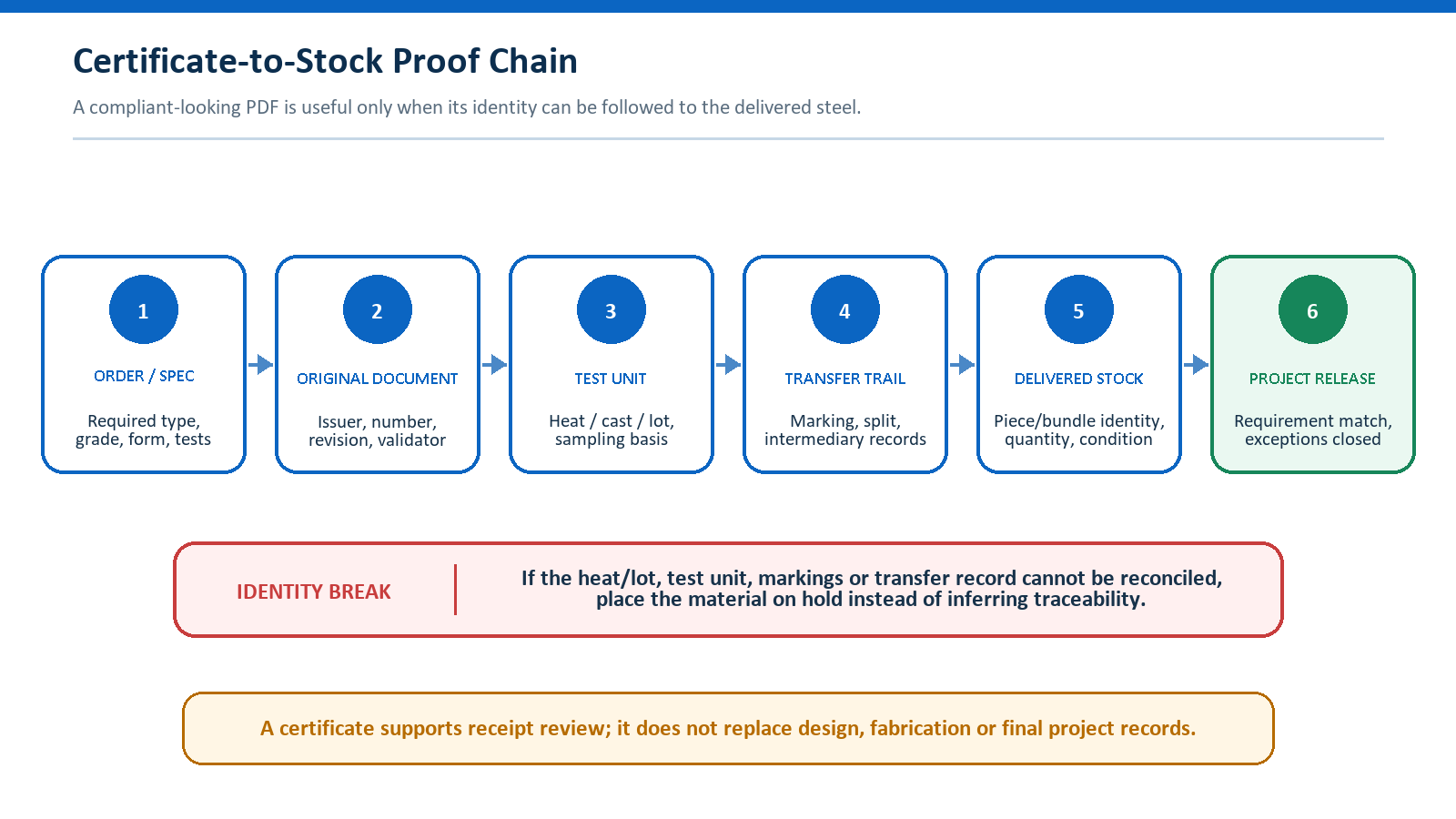
A certificate may contain plausible chemistry and mechanical values yet fail the receipt review if its identity cannot be connected to the delivered steel. Check the issuer, document number, revision, order or item reference, product description, grade, dimensions, delivery condition, quantity, heat/cast/lot, test unit and result fields. Then compare those identities with piece or bundle markings, tags, packing information and any controlled transfer record.
Stockholders and processors can split bundles, cut plates or transfer markings. The receiving route must preserve the link back to the original inspection document without implying that an intermediary created new test results. When identity is missing, duplicated, contradictory or altered without a controlled explanation, isolate the material and request evidence. Do not infer a heat number from grade, size, delivery date or visual similarity.
The public page for BS EN 10168:2004 covers information communicated in steel inspection documents and standardized designations. It helps organize the field review but does not replace the applicable product standard or project acceptance criteria.
6. Release gate: decide project acceptance separately
At the Release Gate, compare the traced material with the project requirement. Confirm grade, product form, dimensions, tolerances, delivery condition, required inspection results, supplementary tests, surface or through-thickness requirements where applicable, and any approved deviation. Confirm that the certificate type and validator route match the order. Record the disposition and the person authorized to release or reject the material.
Project release may also depend on documents outside EN 10204: declaration of performance and CE-marking information where the construction-product route applies, welding procedure and welder records, dimensional inspection, NDT, coating records, nonconformance closure and the manufacturing data record. A valid material certificate supports one part of that chain; it does not close the other gates.
The European Commission's Declaration of Performance and CE marking overview explains a distinct construction-product compliance route. Do not describe an EN 10204 certificate as a substitute for a required declaration or CE marking.
7. A controlled Type 3.1 route
A controlled Type 3.1 route begins with an order that names Type 3.1 and the applicable material requirements. The manufacturer assigns the test unit and performs the required inspection and testing under its procedures. Its authorized inspection representative, independent of the manufacturing department, validates the document. On receipt, the buyer checks both document content and the certificate-to-stock identity before project release.
| Stage | Controlled action | Retained evidence |
|---|---|---|
| Order | Name Type 3.1, standard/edition, material identity, tests, test unit and document fields | Purchase order and approved technical clause |
| Manufacture/testing | Apply required test and sampling route to the defined test unit | Original result records under the manufacturer's system |
| Validation | Authorized inspection representative independent of manufacturing validates the document | Original Type 3.1 inspection certificate |
| Receipt | Match document, heat/lot, markings, quantity and delivered condition | Receipt check and traceability disposition |
| Project release | Verify all project requirements and deviations, not only certificate type | Authorized release/hold record |
8. Plan Type 3.2 before testing
Type 3.2 is most reliable when the purchase order, inspection and test plan, and notification route agree before manufacturing begins. Identify the additional authorized party and the activities that require review, hold, witness or record access. State notice periods and what happens if the representative waives attendance. Keep the waiver or release decision under the project's approved procedure rather than treating silence as approval.
The supplier should confirm material source, test location, sample-selection stage, expected dates, laboratory route, document format and marking check. The inspector should know which order and test unit are being covered. After inspection, the final document package should show the intended validation route and remain traceable to the shipped material. Any change in source, heat/lot, test location or test timing should be evaluated before continuing.
9. Handle a late Type 3.2 request without relabelling
A late request often arrives after Type 3.1 material is already in stock or after the original tests have been completed. Do not solve that problem by adding an independent signature to the existing Type 3.1 PDF or by changing the title. The historical sampling, test-unit control and inspection attendance cannot be recreated by document editing.
Instead, place the material on hold and ask the responsible project authority to define an acceptable recovery route. An independent body may be able to verify identity, review the original documentation, select traceable samples and witness additional testing. The resulting deliverable may be a survey or verification report describing equivalence to the intent of Type 3.2; it is not automatically an original EN 10204 Type 3.2 inspection certificate. Acceptance remains project-, material- and evidence-specific.
For example, ABS's EN 10204 material verification overview describes independent verification of existing Type 3.1 material to the intent of Type 3.2 and issuance of a survey report. ABS also states that EN 10204 verification is not the same as compliance with ABS Rules. This is one service example, not blanket permission to upgrade documents.
10. Receipt review checklist
| Check | Buyer question | Disposition evidence |
|---|---|---|
| Requirement | Which order/specification clause requires 3.1 or 3.2, and which edition applies? | Controlled order and precedence review |
| Issuer/document | Is this the original controlled document with clear number, revision and issuer? | Source and authenticity check |
| Validator | Does the validator route and authority match the required certificate type? | Role/delegation verification |
| Product identity | Do grade, form, size, delivery condition and quantity match the order? | Line-item reconciliation |
| Test unit/results | What heat/lot/test unit do the results represent, and are required tests present? | Result and sampling-basis review |
| Physical trace | Do piece/bundle markings and transfer records lead back to that test unit? | Certificate-to-stock trace check |
| Exceptions | Are alterations, missing fields, deviations or retests controlled and accepted? | Authorized disposition |
| Release | Are companion project documents and downstream gates complete? | Release/hold record |
Record the review result as accepted for the named purpose, held for clarification, rejected, or accepted with an authorized concession. Avoid a generic 'certificate checked' stamp. It does not show which requirement, line item, heat/lot, delivered quantity or exception was reviewed.
11. Warning signs that require a hold
| Warning sign | Why it matters | Controlled response |
|---|---|---|
| Type 3.2 requested only after testing | Required attendance or sample control may not have occurred | Stop and define an authorized recovery route |
| Third-party logo with no stated role | Branding does not establish purchaser or regulatory authority | Verify delegation, scope and deliverable |
| Heat/lot missing from stock markings | Results cannot be tied reliably to delivered material | Isolate stock and request traceability evidence |
| Values copied onto an intermediary sheet | Original source, test unit or alteration history may be obscured | Obtain the original certificate and transfer trail |
| Grade matches but product form does not | A certificate for one product population may not cover another | Reconcile product standard, form and test unit |
| Certificate altered without revision control | The approved identity and content are uncertain | Request a controlled reissue or issuer confirmation |
| Certificate treated as project approval | Design, fabrication and conformity gates remain open | Complete the separate release checklist |
12. What neither certificate proves
Neither document type proves that one material is inherently better than another. The certificate records inspection results and a validation route for a defined product/test unit. It does not select the grade, determine design suitability, verify every delivered piece, guarantee service life, prove corrosion resistance in the project environment or eliminate the need for receipt inspection. Those conclusions require their own requirements and evidence.
Neither document automatically proves compliance with a building code, class rule, pressure equipment route or construction-product regulation. It does not approve a material substitution, welding procedure, welder qualification, NDT result, dimensional inspection, coating system, packing condition or finished steel assembly. It is one controlled input to the fabrication ITP and manufacturing data record, not a replacement for them.
13. Copy-ready order and ITP wording
Use the following structure as a drafting aid, then adapt it to the licensed standard, product standard, project specification and contract. It is not legal wording and does not define an inspection scope by itself.
| Clause element | Copy-ready prompt |
|---|---|
| Certificate requirement | Provide an inspection certificate to EN 10204 Type [3.1/3.2] for each defined test unit. |
| Material scope | Identify material grade, product form, dimensions, delivery condition, quantity and governing material/product standard with edition. |
| Inspection scope | Report the specified chemical, mechanical and supplementary inspection results using the defined test-unit and sampling basis. |
| Type 3.2 route | Coordinate the manufacturer's independent inspection representative and the named purchaser/official inspector; apply agreed notification and hold/witness points. |
| Traceability | Maintain original document, heat/lot/test-unit identity, markings and controlled transfer records through delivery. |
| Change control | Do not change source, material identity, test route, validator route or document revision without the authorized project disposition. |
| Submission/release | Submit the original controlled document package for receipt review; certificate receipt does not constitute project release. |
Connect the clause to East Baoyu's Steel Fabrication ITP guide so certificate receipt, identity checks and downstream fabrication records appear at defined inspection points. Use the Project Acceptance and Manufacturing Data Records guide to plan final record assembly without treating the material certificate as the entire MDR.
14. What to send East Baoyu
For a steel structure inquiry, send the drawings and specifications that define the material, product form, dimensions, delivery condition and intended certificate type. Include the purchase or project clause, applicable standard and edition, required tests, test-unit expectations, inspection authority, ITP/hold points, destination and document-submission requirements. If material is already in stock, include the original inspection document, clear marking photos, stock identity and any split or transfer record.
Mark whether the request is a new order, pre-award clarification, receipt review or late Type 3.2 recovery. Do not send confidential customer certificates through an unapproved channel. Ask which evidence is available for the exact material and fabrication scope; no certificate, test or third-party service is assumed in this article.
Use the Steel Structures, Evidence Center and Contact pages to frame the request and identify the relevant commercial and engineering contacts.
Share drawings and specifications
Send the controlled material clause, drawings and available certificate/traceability package. East Baoyu can then clarify the proposed supply scope, document route, evidence availability and unresolved project inputs without treating an unverified certificate as acceptance.

Open WhatsApp: +86 130 1228 3281
| Contact | Official detail |
|---|---|
| info@eastbaoyu.com | |
| Phone | +86 22 28352066 |
| +86 130 1228 3281 | |
| Website | https://eastbaoyu.com/contact/ |
Email the material package: info@eastbaoyu.com
Frequently asked questions
Is EN 10204 Type 3.2 always better than Type 3.1?
No. Type 3.2 adds a validation party; it does not create a higher material grade. The correct route is the one required by the order, product standard, project specification and applicable regulatory basis.
Can a Type 3.1 certificate be upgraded by adding a third-party signature?
Not automatically. A signature added after testing does not recreate the required authority, sample control, witnessing or validation route. An authorized recovery plan may produce an independent verification report, but that is not automatically an original Type 3.2 certificate.
Does Type 3.2 mean every test is witnessed?
No. The agreed order, inspection plan and inspector scope determine the attended activities. Do not infer universal 100% witnessing from the certificate type.
Who signs a Type 3.1 certificate?
The EN 10204 route uses the manufacturer's authorized inspection representative independent of the manufacturing department. The buyer should verify the controlled document and role rather than relying only on a visible signature.
What should I check when material arrives?
Check the order requirement, original document identity, validator route, grade and product form, dimensions, delivery condition, test unit, results, heat/lot, markings, transfer records, quantity, deviations and the separate project-release requirements.
Does a material certificate replace CE marking, an ITP or an MDR?
No. Those routes have different purposes. A material certificate is one input to receipt and fabrication control; it does not replace a required declaration/CE route, inspection plan, fabrication records or final manufacturing data record.
Related East Baoyu resources
Steel Structures | Engineering Articles
Evidence Center | Contact East Baoyu
Steel Fabrication ITP | Project Acceptance and Manufacturing Data Records
Material Grade Substitution | Project Document Register
Export Packing for Solar Mounting and Steel Components | Steel Structure Engineering
Research & Methods | Quality and Project Delivery Articles
References and scope notes
Official public sources were checked on 28 July 2026 and are paraphrased within their public scope. The licensed EN text and any referenced paid standards were not reproduced. Users must verify the required edition, amendments, national implementation, product standard, project specification, purchase order, inspection plan and named authorities. Service-provider examples illustrate possible inspection routes and are not universal requirements. This guide is not legal advice, a certificate review for a specific heat/lot, a conformity assessment, a class approval, a material release or a commercial commitment.
BS EN 10204:2004 public scope | BS EN 10168:2004 public scope
ISO 404:2013/Amd 1:2022 | TÜV NORD Type 3.2 overview
TÜV UK material inspection | ABS EN 10204 material verification
European Commission DoP and CE marking | East Baoyu Steel Structures
References, disclosure and change record
References and further verification
- https://knowledge.bsigroup.com/products/metallic-products-types-of-inspection-documents
- https://www.iso.org/standard/56861.html
- https://www.iso.org/standard/53736.html
- https://www.tuv-nord.com/it/it/certificazioni/tecnologia-dei-materiali/en10204-tipo-32/
- https://shop-checkout.bsigroup.com/products/steel-products-inspection-documents-list-of-information-and-description
- https://single-market-economy.ec.europa.eu/sectors/construction/construction-products-regulation-cpr/declaration-performance-and-ce-marking_en
- https://ww2.eagle.org/content/dam/eagle/publications/cutsheets/EN%2010204%20Material%20Verification%20Cutsheet.pdf
- https://eastbaoyu.com/steel-fabrication-itp-mtc-wps-ndt-coating/
- https://eastbaoyu.com/project-acceptance-and-manufacturing-data-records/
- https://eastbaoyu.com/steel-structures/
- https://eastbaoyu.com/evidence-center/
- https://eastbaoyu.com/contact/
- https://wa.me/8613012283281
- https://wa.me/8613012283281?text=Hello%20East%20Baoyu%2C%20I%20would%20like%20to%20discuss%20EN%2010204%20material%20certificate%20requirements.
- https://eastbaoyu.com/articles/
- https://eastbaoyu.com/material-grade-equivalence-in-international-steel-projects/
- https://eastbaoyu.com/project-document-register-manufactured-steel-solar-components/
- https://eastbaoyu.com/export-packing-for-solar-and-steel-components/
- https://eastbaoyu.com/research-methods/
- https://www.iso.org/standard/84013.html
- https://www.tuv-nord.com/uk/en/services/inspection/manufactured-products/material-inspection/
Disclosure: East Baoyu manufactures and supplies products discussed on this website. Structured drafting tools may assist research and editing, but technical claims, project inputs and release decisions require qualified review under the applicable project responsibilities.
Version 1.0: Initial scheduled publication in the East Baoyu engineering knowledge-base batch.
View the public Content Change Log · Corrections: info@baolaipipes.com