


Authorship, review and evidence boundary
- Technical review
- East Baoyu Engineering Editorial Team
- Reviewed
- 2026-07-29
- Scope
- General engineering and procurement guidance. This article is not a project-specific design, capacity statement, certificate, warranty, code interpretation or contract requirement.
Evidence basis: Official and public references identified in the article, together with original editorial diagrams. Project values and release decisions require qualified review under the applicable project responsibilities.
Read the Editorial PolicyThe fabricated steel has passed final inspection, the solar-component packs are labelled, and the shipment window is approaching. Then the buyer asks a simple question: which drawing, ITP, coating report and nonconformance closure revision is the final accepted record for this lot? If the answer requires opening folders, comparing email attachments and guessing from filenames, the goods may be physically ready while the contractual handover remains blocked.
A project document register is the control plane for that information. It should show what is required, who owns the next action, which revision is current, what decision was returned, which product or package the file covers, and whether the final handover set is complete. It is not the manufacturing data record itself, an inspection and test plan, a transmittal log or a shared folder. Those are governed objects or evidence sources; the register makes their lifecycle visible.
1. Define the register boundary before adding rows
Begin with the contract deliverable schedule, project specification, quality plan and agreed review procedure. List the information that must be submitted, reviewed, retained or handed over. Then decide whether one master register will cover the full order or whether controlled sub-registers will feed a master view. The answer depends on the product families, suppliers, packages, locations, confidentiality and buyer reporting needs—not on the convenience of one spreadsheet owner.
Set the control boundary explicitly. A document register controls identity and status. A transmittal records a formal movement of files. An ITP sequences inspection activities and creates records. An MDR or final dossier compiles the accepted evidence. A common data environment or document-management platform may store these objects, but software does not define their contractual meaning. The buyer and supplier still need one agreed interpretation of every code, date and responsibility.
| Object | Primary question | Register connection |
|---|---|---|
| Requirement schedule | What must be delivered, by whom and when? | Creates the planned document rows and milestone dates. |
| Transmittal | What files formally moved between parties? | Records actual submission, revision and transmission reference. |
| ITP | Which inspection or test creates each quality record? | Identifies expected record types and release dependencies. |
| MDR / final dossier | What accepted evidence is handed over? | Receives the final revision and completion status. |
| Repository / CDE | Where are controlled files and metadata stored? | Provides the governed link; it does not replace status rules. |
East Baoyu’s Quality & Manufacturing page describes the wider manufacturing context: traceability, inspection, NDT, coating and documentation packs. The register in this guide controls the information flow around those activities; it does not claim that one generic template satisfies every contract.
2. Build the minimum field set around decisions
A useful register row is a decision record in progress. It needs enough metadata to identify the document, connect it to the order, manage the next action and preserve the final outcome. Too few fields create ambiguity; too many uncontrolled fields become clerical noise. Group the columns by purpose so users can see why each one exists.
| Field group | Minimum fields | Control question |
|---|---|---|
| Identity | Document number, title, type, originator and discipline. | Can two people select the same controlled object? |
| Applicability | Order, product, assembly, lot, pack, phase or milestone as needed. | Which delivered goods and decision point does it cover? |
| Submission | Planned date, actual date, revision and transmittal. | Did the intended revision arrive through the agreed route? |
| Review | Reviewer, code, response date, comments and next owner. | What technical or contractual decision is current? |
| Final handover | Final required, final revision, package/index and handover date. | Is the accepted record present in the delivery set? |
| Governance | Controlled link, access class, retention note and remarks. | Can the record be found, protected and retained appropriately? |
Do not force every business rule into a free-text note. Use controlled values for document type, review code, status, responsible party and final-required flag; preserve commentary for exceptions. Validation lists and automated aging can improve consistency, but the register owner should be able to explain each calculation and correct the source data. A dashboard is useful only when it traces back to governed rows.
This approach aligns with the flexible documented-information principle described in ISO 9001:2015 and ISO 10013:2021: organizations tailor documented information to the effective control of their processes. The article applies that principle to project delivery; it is not quoting or replacing either standard.
3. Separate the three status lanes
The most damaging register shortcut is one column called “Status.” Received, reviewed, approved for a limited purpose, comments closed and included in the final dossier are different conditions. A document can be received but technically rejected. It can be accepted for fabrication yet still need an as-built revision. It can have closed comments but remain missing from the handover package.
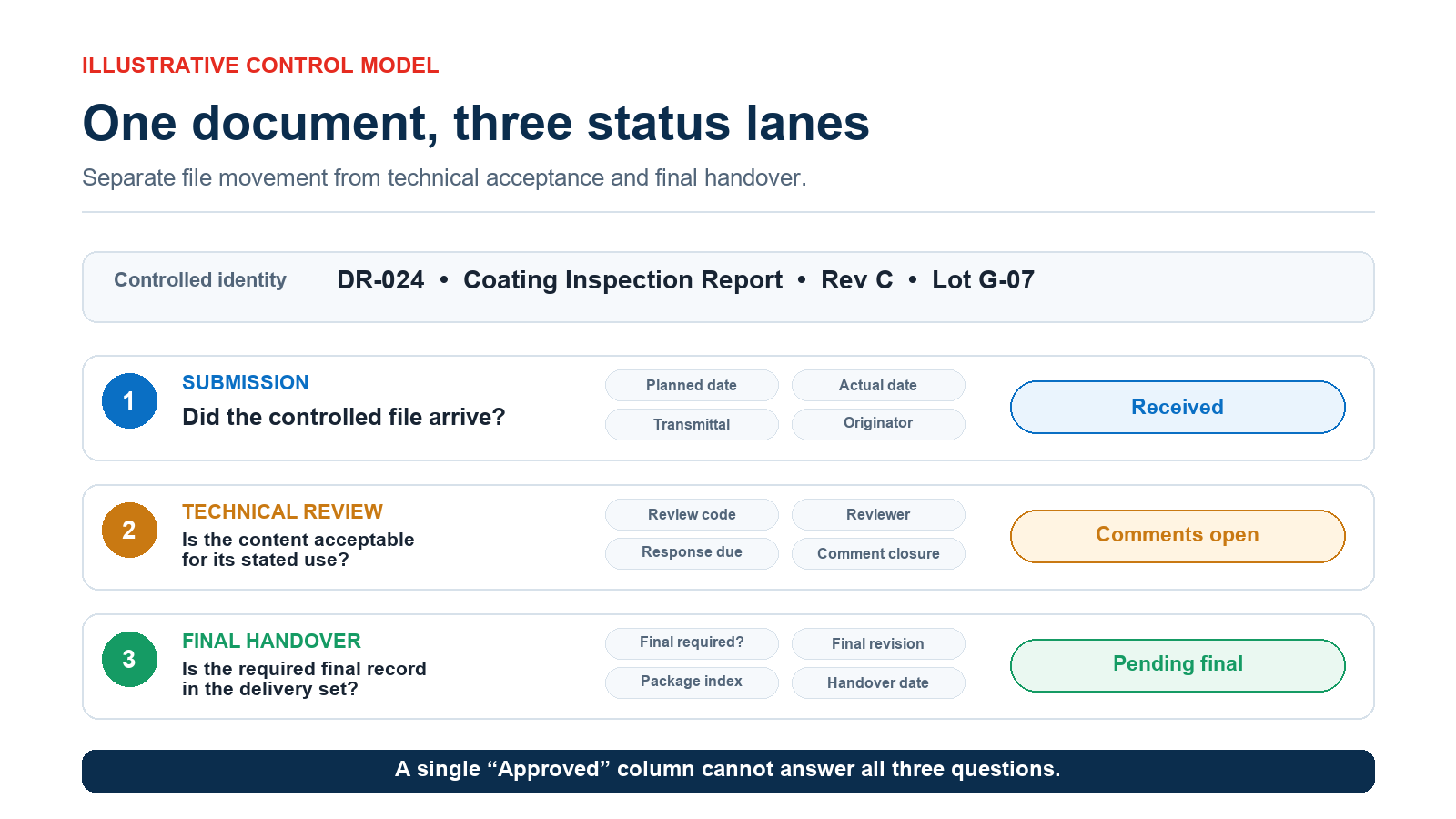
Submission status — required, planned, submitted, resubmitted or not applicable. It answers whether the controlled file arrived and through which transmittal.
Technical review status — not reviewed, accepted for a stated use, accepted with comments, revise and resubmit, rejected or another contract-defined code. It records the decision, reviewer and response date.
Final-handover status — not required, pending final, final received, included in package, handed over or accepted with a listed exception. It answers whether the required final record is in the delivered set.
Write the review-code legend into the procedure or register cover sheet. “Approved” should never float without a defined purpose and responsibility boundary. Document review does not automatically transfer design responsibility, validate unstated assumptions or waive contract requirements. If one code has different meanings across teams, replace it with clearer language before production accelerates.
4. Control identity, revisions, transmittals and comments
A controlled document number should remain stable while the revision changes. The title should describe the content rather than the recipient. Record the originator because similar numbering can exist across a buyer, fabricator, coating subcontractor and third-party inspector. If the project uses separate internal and external numbers, map them instead of silently replacing one identity.
Every formal submission should identify the transmitted revision. Receipt proves movement, not acceptance. When a reviewer returns comments, retain the response reference, responsible owner and due date. On resubmission, connect the new revision to the prior decision and comment set. Do not overwrite the rejected or superseded history with a green cell; preserve enough status accounting to reconstruct why the current revision became current.
| Event | Register update | Evidence retained | Do not do |
|---|---|---|---|
| Initial submission | Actual date, revision and transmittal. | Submitted file and transmittal receipt. | Mark technically accepted on receipt. |
| Review return | Code, reviewer, response date and next owner. | Marked-up file or comment sheet. | Hide conditions inside email only. |
| Resubmission | New revision, new transmittal and comment response. | Revised file and response matrix. | Delete the rejected revision history. |
| Supersession | Current revision and superseded flag. | Change trail and affected-item review. | Allow both revisions to look current. |
| Final issue | Final/as-built revision and package location. | Final index and handover transmittal. | Assume the last email attachment is final. |
ISO 10007:2017 provides configuration-management guidance across product and service lifecycles, while ISO 15489-1:2016 addresses records, metadata, responsibilities and controls over time. The revision and history fields above are a practical project application of those concepts.
5. Map documents to the manufactured population
Document control becomes quality control when a record can be tied to the goods it governs. Not every document covers the entire order. A drawing revision may apply after a production change. One material certificate may cover a heat or batch. An NDT report may cover selected welds. A coating report may cover a production lot, while a packing list maps items into shipment units.
Use the level of applicability required by the contract and technical risk: product family, assembly, drawing, serial item, production lot, heat/batch, inspection lot, pack or shipment. Avoid duplicating hundreds of document rows when a controlled relationship table is more suitable, but do not compress several populations into “all goods” if the effective revision or evidence differs. The register must make transition points visible.

The related steel fabrication ITP guide explains how inspection activities generate traceable records. The MDR buyer checklist describes the evidence package. This register guide controls whether those records are planned, submitted, reviewed and handed over for the correct population.
6. Manage one document with three clocks
A register should distinguish the planned submission date, the review-response date and the final-handover date. Combining them into one “due date” makes aging reports unreliable. The supplier may be on time while the buyer review is overdue; the technical review may be complete while the final as-built issue is not yet due. Each clock needs an owner and a rule for pausing, resetting or escalating it.
| Clock | Starts from | Owner | Useful measure |
|---|---|---|---|
| Planned submission | Agreed schedule, hold point or upstream release. | Document originator / supplier. | Due, submitted early/on time/late, forecast variance. |
| Review response | Accepted receipt of a reviewable submission. | Named buyer, engineer or reviewer. | Days open, overdue response, comments pending. |
| Final handover | Contract milestone, shipment or completion rule. | Supplier plus handover authority. | Final required, final received, package completeness. |
Define working days, time zone, cut-off time, rejected-submission treatment and notice periods in the project procedure. Use formulas to flag overdue rows, but report the denominator: “12 overdue of 84 required documents” is more useful than a red chart without scope. Do not restart aging simply because the file was renamed or moved. The event that resets a clock should be a controlled submission, decision or agreed schedule change.
7. Run the lifecycle without rebuilding the register
Create the planned rows before design and manufacturing generate files. Review the register at the same cadence as physical progress: design release, material approval, pre-production, first-off inspection, routine production, pre-shipment and final handover. Missing information discovered before an activity is recoverable; missing heat mapping or an unrecorded concession discovered after coating and packing may not be.
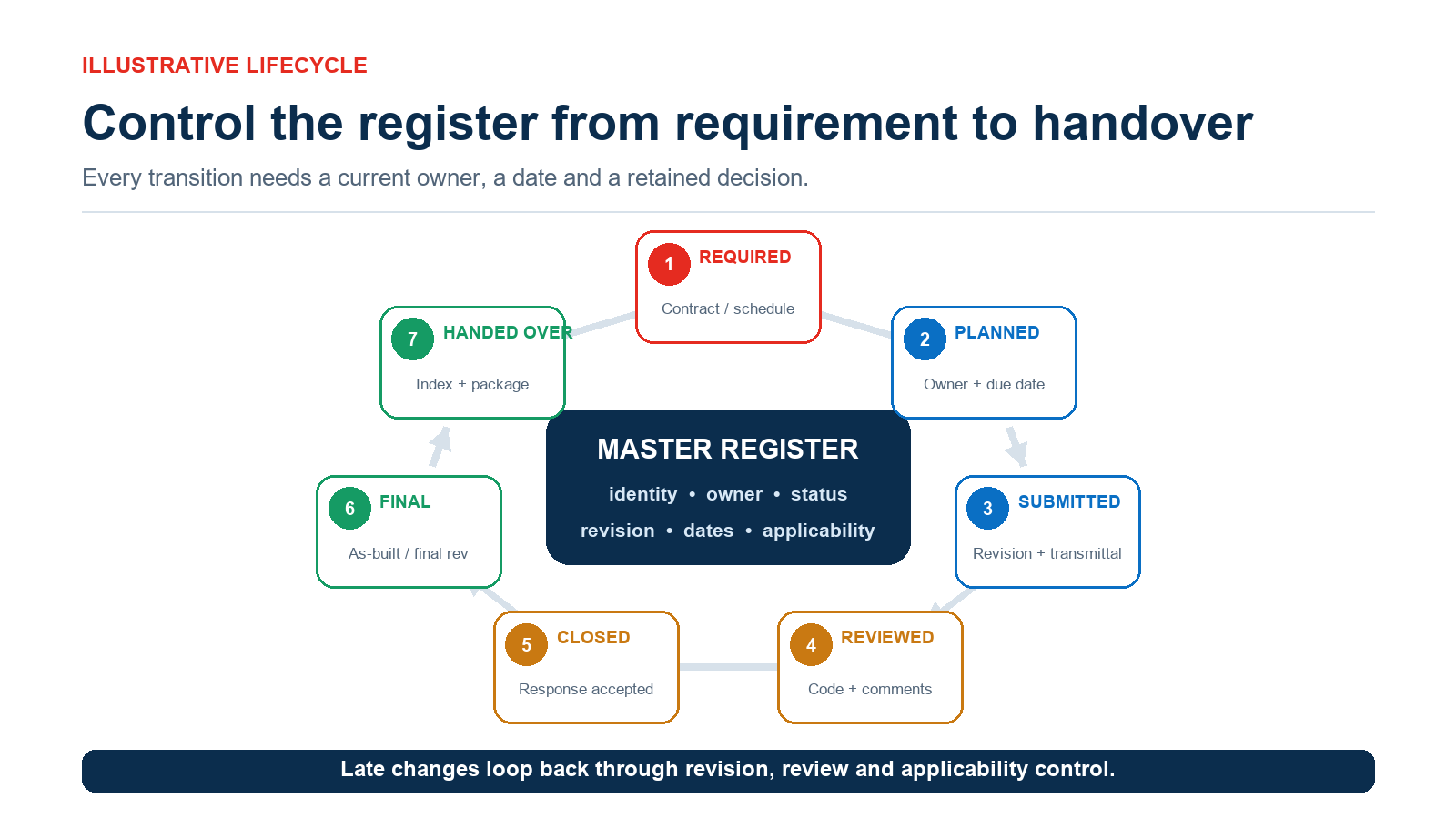
The register should be a maintained status record, not a month-end report assembled from memory. Assign a register owner, but keep action ownership with the person who can resolve the issue. At each meeting, review exceptions: documents blocking a hold point, overdue reviewers, rejected submissions without a forecast, open comments, unapproved changes and final records missing from the dossier. Archive or snapshot agreed baselines so schedule and status changes remain explainable.
For built-asset information management, ISO 19650-1:2018 discusses exchanging, recording, versioning and organizing information, and the UK BIM Framework guidance shows an information-container example using identity, status and revision metadata. These are useful information-management examples, not a statement that BIM codes govern every manufactured-component order.
8. Protect access, integrity and retention
The register should point to a controlled location rather than a private desktop, temporary transfer link or uncontrolled email copy. Apply access by role and project need: some users may submit, others review, and a smaller group may change status rules or final dispositions. External parties should receive only the information and permissions agreed for their scope. When a link changes, update it through a governed migration rather than leaving parallel folders that both appear current.
Protect the register itself. Lock formula and reference fields where practical, validate controlled values, back up the current data, and retain a change trail appropriate to the project risk. If the working surface is a spreadsheet, identify the master copy and avoid simultaneous emailed versions. If it is a platform, test exports so the project can preserve an intelligible register and final index outside a vendor-specific interface. Automation may move a workflow forward, but it should not erase the person, time and decision behind a status change.
Define retention, confidentiality and disposition with the contract, legal requirements, company policy and the value of the record. Do not put sensitive commercial, personal or security information into a widely shared remarks column. Keep controlled links, access classifications and retention notes as metadata while the protected content remains in the approved repository. The ISO release note for ISO 10013:2021 specifically highlights digitization, security measures and automation of documented-information flows as modern considerations. Project controls should apply those ideas in proportion to the actual information risk.
9. Prepare final handover from day one
Mark whether a final issue is required when the row is created. A calculation may be handed over in its accepted design revision, while a drawing may require an as-built issue and a batch report may become final only after production closes. Record the expected final form, naming, native/PDF requirement, signature rule, confidentiality class and package location before the last week of the project.
Before shipment or contractual completion, reconcile the register in both directions. From the requirement list, prove that every required row has an acceptable final disposition. From the final package, prove that every included file has a controlled identity and is applicable. Then sample from delivered items or packs back to the governing drawing, material and inspection records. A large dossier is not complete when the index cannot show what is missing or why an exception is accepted.
Freeze the final index — identify package, section, document number, title, revision and status.
Close comments explicitly — do not infer closure from the arrival of a new file.
Resolve open deviations — link accepted exceptions to the affected document and population.
Test access — verify links, permissions, searchability and non-expiring delivery arrangements.
Retain a handover record — preserve the transmittal, recipient, date and any listed exceptions.
Where shipment documentation is part of the handover, use the export-packing guide to connect pack identity, released goods and shipment records. Keep factory release, transport acceptance and site acceptance distinct.
10. Red flags in a supplier document register
| Red flag | Why it matters | Corrective action |
|---|---|---|
| One “Approved” status column | Arrival, technical decision and handover are confused. | Split the three status lanes and define codes. |
| No planned rows | Completeness cannot be measured until files arrive. | Load contract requirements before production. |
| Revision stored only in filename | Current and superseded states are hard to audit. | Use dedicated revision and superseded fields. |
| No next owner or due date | Open comments age without accountability. | Assign action owner and clock at each return. |
| Every record applies to “all” | Changes and lot-specific evidence lose traceability. | Map the appropriate product/lot/package scope. |
| Final package built outside the register | Handover status diverges from review history. | Use final-required and package-index fields from start. |
11. What to send East Baoyu for a documentation review
For an efficient first review, send the project document requirements and the current register export together. East Baoyu can help identify missing fields, ambiguous status rules and manufacturing-document interfaces within the agreed scope. Final contractual acceptance, design responsibility, statutory compliance and third-party approval remain with the designated project parties.
| Send | Minimum content |
|---|---|
| Requirements | Specification, deliverable schedule, quality plan and final-handover rules. |
| Status rules | Document codes, review meanings, notice periods and responsibility matrix. |
| Order structure | Products, assemblies, lots, packages, suppliers and key milestones. |
| Current register | Native export with identity, revision, dates, status, owner and links. |
| Open issues | Overdue items, rejected files, comments, NCRs, changes and shipment blockers. |
| Decision needed | Review scope, required output, authority and target date. |
Request a documentation review
Send the controlled document schedule or register, product and package breakdown, review-code legend, milestone plan and open issues. The review can then focus on the exact gaps that affect manufacturing evidence and final handover.

Questions? Chat with East Baoyu on WhatsApp. Fast reply on capacity, pricing, configuration and available product videos.
Open WhatsApp: +86 130 1228 3281
| Contact | Official detail |
|---|---|
| info@eastbaoyu.com | |
| Phone | +86-22-28352066 |
| +86-130-1228-3281 | |
| Website | https://eastbaoyu.com/quality/ |
Frequently asked questions
What is a project document register?
It is a controlled index of required project information and its lifecycle status. A useful register identifies each document, owner, revision, submission, review decision, due dates, applicability and final-handover position.
Is a document register the same as an MDR index?
Not necessarily. An MDR index focuses on the final manufacturing evidence package. The project document register can begin earlier and control design, quality, commercial or interface documents through planning, review, change and handover.
Should each document have only one status?
No. Separate at least submission status, technical review status and final-handover status. A file can be received, rejected for technical reasons and still pending a final issue at the same time.
How should superseded revisions be handled?
Keep the controlled identity stable, mark the current revision clearly and make superseded versions distinguishable. Preserve enough history to show the prior decision and change path, subject to the project’s retention and security rules.
Can a spreadsheet be used as the master register?
Yes, when access, validation, change control, backup, ownership and links are governed for the project scale and risk. A dedicated platform may improve workflow, but software does not remove the need for defined status and responsibility rules.
What should block final document handover?
Missing required records, unresolved rejected submissions, open comments affecting acceptance, ambiguous revisions, broken traceability, inaccessible files and unapproved exceptions should remain visible until the designated authority resolves them.
Related East Baoyu resources
Quality & Manufacturing — parent resource
Project Acceptance and Manufacturing Data Records: A Buyer Checklist
Steel Fabrication ITP: Linking MTC, WPS, NDT, Dimensions and Coating Records
Export Packing for Solar Mounting and Steel Components
Evidence Center — controlled evidence classifications
Downloads — controlled public resources
Engineering Articles — East Baoyu knowledge base
References and scope notes
Sources were checked on 28 July 2026. ISO 9001:2015 remains the published edition on that date; ISO shows the sixth edition under publication with an expected September 2026 publication. Standard scopes and public guidance are paraphrased. Contract requirements, adopted codes and designated project authorities remain controlling.
ISO 9001:2015 — Quality management systems — Requirements
ISO — Guidance on the documented-information requirements of ISO 9001:2015
ISO 10013:2021 — Guidance for documented information
ISO announcement — Release of ISO 10013:2021
ISO 10007:2017 — Guidelines for configuration management
ISO 15489-1:2016 — Records management concepts and principles
ISO 19650-1:2018 — Information management concepts and principles
UK BIM Framework — Guidance Part 1: Concepts
AISC — Code officials and current standards resource
References, disclosure and change record
References and further verification
- https://eastbaoyu.com/quality/
- https://www.iso.org/standard/62085.html
- https://www.iso.org/standard/75736.html
- https://www.iso.org/standard/70400.html
- https://www.iso.org/standard/62542.html
- https://eastbaoyu.com/steel-fabrication-itp-mtc-wps-ndt-coating/
- https://eastbaoyu.com/project-acceptance-and-manufacturing-data-records/
- https://www.iso.org/standard/68078.html
- https://ukbimframework.org/wp-content/uploads/2019/10/Information-Management-according-to-BS-EN-ISO-19650_-Guidance-Part-1_Concepts_2ndEdition.pdf
- https://committee.iso.org/sites/tc176/home/news/content-left-area/news-and-updates/release-of-iso-100132021-quality.html
- https://eastbaoyu.com/export-packing-for-solar-and-steel-components/
- https://wa.me/8613012283281
- https://wa.me/8613012283281?text=Hello%20East%20Baoyu%2C%20I%20would%20like%20to%20discuss%20a%20project.
- https://eastbaoyu.com/evidence-center/
- https://eastbaoyu.com/downloads/
- https://eastbaoyu.com/articles/
- https://eastbaoyu.com/contact/
- https://www.iso.org/iso/documented_information.pdf
- https://www.aisc.org/certification/code-officials/
Disclosure: East Baoyu manufactures and supplies products discussed on this website. Structured drafting tools may assist research and editing, but technical claims, project inputs and release decisions require qualified review under the applicable project responsibilities.
Version 1.0: Initial scheduled publication in the East Baoyu engineering knowledge-base batch.
View the public Content Change Log · Corrections: info@baolaipipes.com