

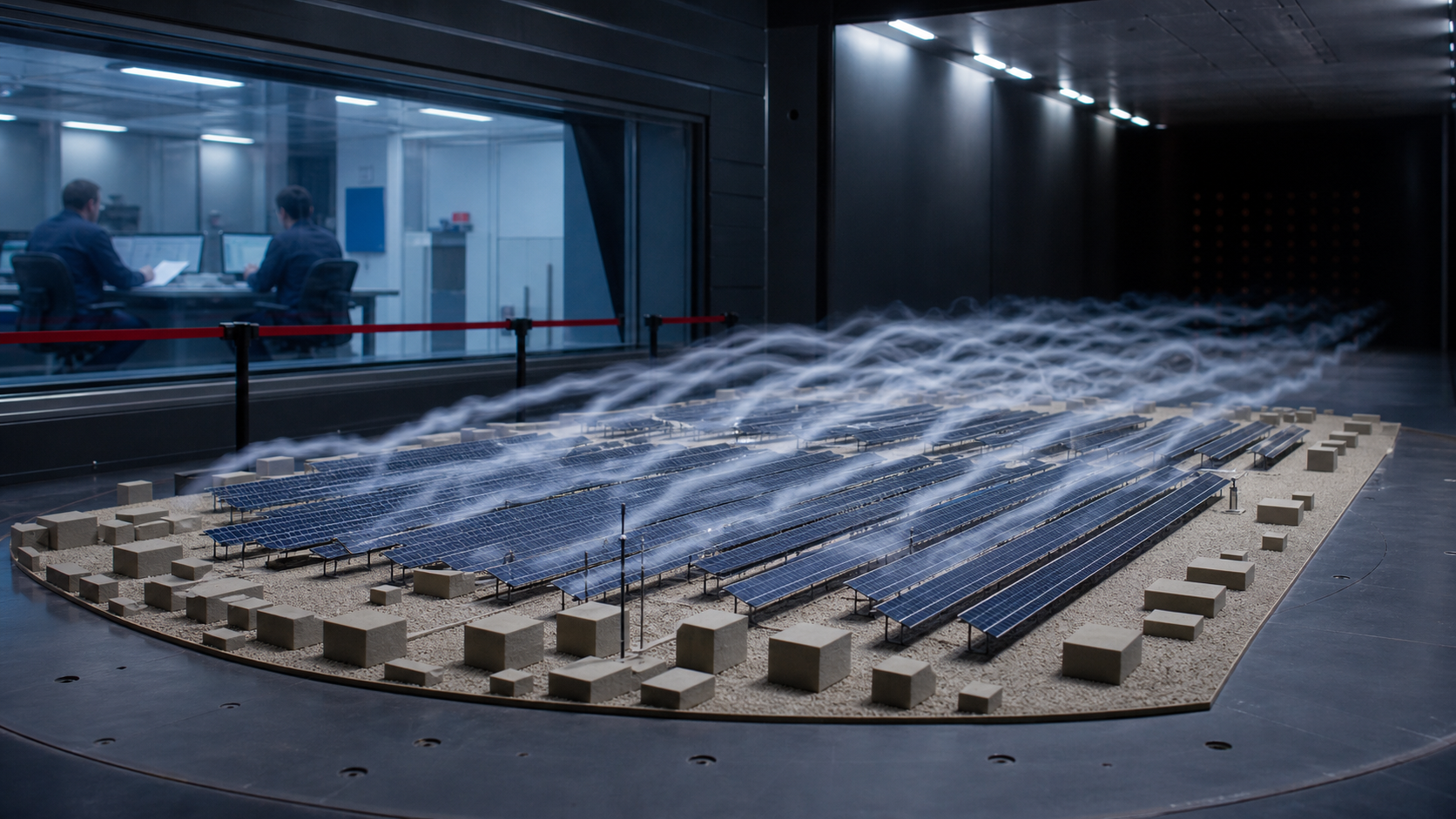
Authorship, review and evidence boundary
- Technical review
- East Baoyu Engineering Editorial Team
- Reviewed
- 2026-07-29
- Scope
- General engineering and procurement guidance. This article is not a project-specific design, capacity statement, certificate, warranty, code interpretation or contract requirement.
Evidence basis: Official and public references identified in the article, together with original editorial diagrams. Project values and release decisions require qualified review under the applicable project responsibilities.
Read the Editorial PolicyA PV project should escalate to a wind tunnel study when the design decision lies outside the reliable, accepted evidence envelope—not merely because the project is large. The strongest triggers are an analytical code route that does not represent the geometry or operating state, unresolved aeroelastic behavior, site or array effects not captured by standard coefficients, or a test route required by the authority, engineer, owner, lender, insurer or contract.
There is no universal megawatt, acreage or contract-value threshold. Scale can increase consequence, configuration diversity and the value of optimization, but it does not prove that testing is technically necessary. Start with the governing design basis, pass the project through three evidence gates, then commission only the study type and outputs that close the documented gap.
1. Use the evidence-envelope test
An evidence envelope is the combination of conditions for which a design method is demonstrably applicable and accepted. It includes geometry, tilt or tracking states, height, row spacing, array position, terrain, topography, nearby features, wind climate, structural behavior and the authority's approved procedure. A standard coefficient can be entirely appropriate inside that envelope and unreliable outside it.
Ask one concrete question: “Can the current route produce every load effect needed for this configuration, with assumptions the responsible parties will accept?” If yes, record the basis and stay on the analytical route. If not, name the missing evidence. A solar wind tunnel study is one possible way to close that gap; it is not the default answer to an undefined concern.
2. Confirm the governing route before ordering a study
Freeze the adopted code or standard, edition, national annex, amendments, risk basis, design life, wind-speed definition and approval path first. In the United States, current public ASCE information shows that ASCE 7-22 modernized wind requirements for ground-mounted solar facilities and includes a wind tunnel procedure; public 2024 IBC provisions reference ASCE 49 and relevant ASCE 7 tunnel procedures in the displayed wind routes. Elsewhere, ISO 4354, EN 1991-1-4 or AS/NZS 1170.2 may form part of the project basis.
Those names do not create one global rule. Adoption, amendments and contractual requirements differ. Ask the engineer of record and approving authority to identify whether an analytical route is permitted, whether existing product data may be transferred, and whether a project-specific tunnel program must follow a named standard. Do this before laboratory procurement, because a technically sophisticated test can still be unusable if it answers a route the approver will not accept.
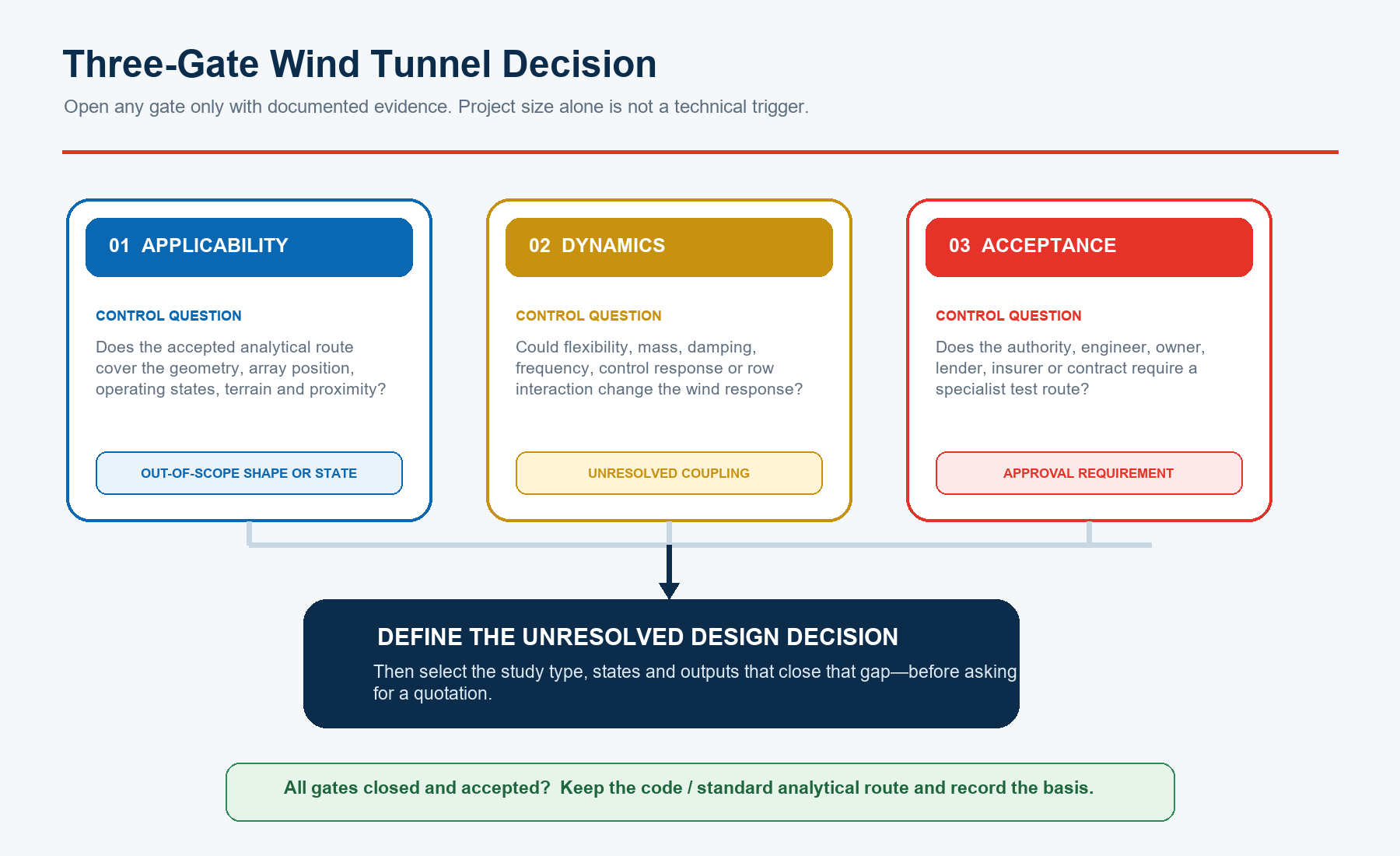
3. Apply three gates: applicability, dynamics and acceptance
The applicability gate asks whether the accepted analytical coefficients cover the actual product and site states. The dynamics gate asks whether motion changes the aerodynamic response. The acceptance gate asks whether an authority or commercial stakeholder requires specialist evidence. Opening any gate should produce a written problem statement, owner and decision; it should not produce a vague request to “test the system.”
| Trigger | Evidence gap to document | Study question | Gate owner |
|---|---|---|---|
| Unusual geometry | Shape, height, gaps, tilt, chord or edge detail outside the accepted method | What local and overall actions occur on the represented geometry? | Engineer of record |
| Array interaction | Boundaries, row spacing, blocks, neighbors or nonuniform states not represented | Which positions, directions and correlations govern? | Wind specialist + EOR |
| Flexible / tracker response | Motion-dependent behavior cannot be bounded with rigid coefficients | Is response stable over approved operating and degraded states? | Structural + wind specialists |
| Terrain / proximity | Directional roughness, topography or nearby features exceed the analytical model | How does the site change approach flow and array loading? | Wind specialist |
| Approval requirement | Authority, contract, owner, lender or insurer calls for specialist evidence | What report and acceptance route will satisfy the reviewer? | Named approving party |
4. Trigger 1 — geometry outside the analytical scope
Escalate when the geometry cannot be shown to fit the chosen analytical provision or a validated database. Examples may include atypical chord-to-height relationships, large gaps or fairings, multi-surface assemblies, unusual module orientation, high-clearance systems, nonstandard edge details or a tracking range not covered by the available coefficients. The issue is not whether the system looks unconventional; it is whether the method's applicability statement and assumptions represent it.
Before testing, compare the project dimensions against the exact represented ranges. If a product-level dataset exists, create a deviation register rather than declaring it “similar.” Small dimensional changes may affect local pressure, tributary area, torque or connection demand even when the overall structure appears comparable. The engineer should decide which deviations can be bounded analytically and which open the gate.
5. Trigger 2 — array interaction, edges and unusual states
A PV array is not an infinite field of identical interior rows. Perimeter rows, corners, gaps between blocks, roads, equipment pads, changing row spacing and neighboring structures can alter exposure and wake shelter. Trackers can also occupy different angles during normal operation, transition, stow and recovery. A study becomes useful when the accepted route cannot identify the governing positions, directions and simultaneous actions with enough confidence for the design decision.
Model the states that can credibly exist during the design event, not only the nominal marketing state. A clean uniform stow picture may omit rows that are moving, delayed, unavailable or held at a mechanically limited angle. The control engineer, tracker supplier and engineer of record should agree which failures or delays are credible and how they enter load cases; the wind tunnel specialist then represents only the approved state matrix.
6. Trigger 3 — flexible or aeroelastic behavior
Rigid-model pressure or force tests assume that structural motion does not materially change the wind action. That assumption needs examination for long tracker rows, flexible cables, low-torsional-stiffness members, large thin modules or systems whose damping and natural frequencies allow motion-dependent effects. NREL research has investigated torsional galloping, flutter-type behavior, array layout and fluid-structure interaction in single-axis trackers; it shows why orientation and structural properties belong in the decision, not why every tracker automatically needs a tunnel.
If instability is the open question, use a method capable of representing the relevant coupling—such as an aeroelastic section, partial or full model, or a validated fluid-structure-interaction route accepted by the project specialists. Supply defensible mass, stiffness, damping, frequency, bearing behavior and tolerances. A static coefficient table cannot be stretched into proof of dynamic stability, and a rigid pressure test should not be purchased for that purpose.
7. Trigger 4 — complex terrain, proximity or directionality
Directional roughness changes, escarpments, ridges, valleys, forest edges, industrial buildings and other nearby features can alter the approach flow. First determine whether the adopted analytical provisions already cover those conditions. If they do not—or if several effects interact in a way material to the design—a topographic or proximity study may be justified. The model extent and wind sectors should be tied to survey data and the design wind climate, not chosen after the result is seen.
Do not confuse a site model with a structural response model. A terrain study can characterize speed-up, shelter or directionality, while a separate pressure, force or aeroelastic model may be needed to convert that flow into component and system actions. The brief should state how the two datasets will be combined and which reference velocity or pressure connects them.
8. Trigger 5 — authority or commercial acceptance
A study may be required even where an analytical solution appears technically possible. Authorities having jurisdiction, owners, lenders, insurers, independent engineers or contracts may call for a named laboratory, standard, peer review, report format or project-specific evidence. Treat that as an acceptance gate: identify the reviewer, obtain written expectations and include review hold points in the program.
Conversely, a laboratory report does not automatically satisfy the gate. The approving party may reject a study whose geometry is obsolete, dynamic similarity is unproven, wind climate is inconsistent, uncertainty is missing or load mapping is opaque. Acceptance requirements belong in the request for proposal and the technical bid comparison—not in a final clarification after testing.
9. When a project-specific wind tunnel study may not be needed
Remain on the analytical route when the adopted method clearly covers the system and site, all assumptions are documented, dynamic response can be defensibly bounded, the required load effects are available and the approving parties accept the route. Existing product or project data may also be usable when an engineer confirms that the complete similarity envelope covers the current configuration and wind basis.
A study can also be premature. If the array layout, module, tracker, stow logic, member stiffness or site basis is still changing, testing an unstable design freeze creates expensive rework. Close ordinary input gaps first. The decision should be “we need this evidence to choose or verify X,” not “testing might make the design look better.” Standard coefficients are not guaranteed to be conservative, and tunnel results are not guaranteed to reduce steel or foundation demand.
10. Choose the study type that matches the unresolved question
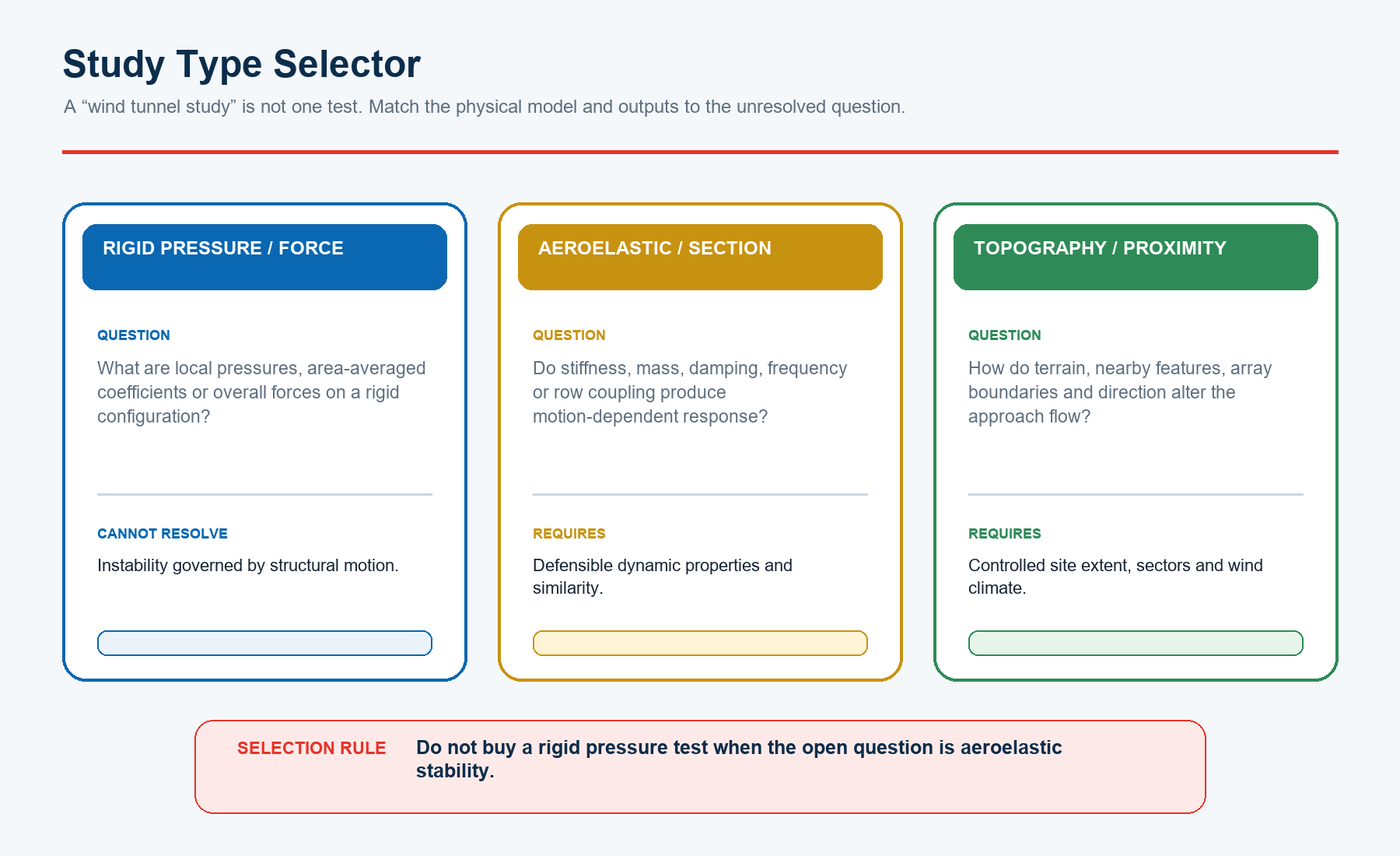
| Study family | Best-suited question | Minimum critical input | Important limitation |
|---|---|---|---|
| Rigid pressure / force | Local pressures, area effects, overall forces or moments for a nonmoving model | Geometry, array positions, terrain simulation and reference flow | Does not resolve motion-dependent instability |
| Aeroelastic / section / partial | Response affected by stiffness, mass, damping, frequency or row coupling | Dynamic properties, scaling laws, tolerances and state matrix | Results depend on defensible similarity and represented modes |
| Topography / proximity | Site speed-up, shelter, directional flow or nearby-feature effects | Survey extent, roughness sectors, features and wind climate | May still need a separate structural load model |
| Wind-climate integration | How directional tunnel data connect to the project wind basis | Accepted meteorological and code basis | Does not replace structural or foundation design |
11. Freeze the Wind Tunnel Brief before procurement
The brief should be a decision document, not a picture of a model. State the unresolved decisions, governing route, required standards, model families, geometry revision, array positions, approach-flow sectors, design states, dynamic properties, scaling requirements, reference quantities, output definitions, uncertainty, quality controls, deliverables, independent review and acceptance owner. ASCE/SEI 49-21 publicly identifies boundary-layer simulation, load measurement, flexible and aeroelastic structures, wind climate and quality assurance as distinct parts of a wind tunnel method.
Ask bidders to list exclusions and proposed substitutions. Require a model review before fabrication, a test matrix review before the run, an anomaly process during testing and a draft-data review before final reporting. NIST work on wind tunnel methods supports the importance of documentation and quality: different or inadequate methods can produce materially different results. Price comparisons are meaningful only after the bidders are answering the same technical question.
12. Define operating, stow and degraded-control states
For fixed-tilt systems, states may still vary through construction tolerances, missing modules, open gaps or temporary phases. For trackers, establish operating angles, commanded stow, movement path, trigger basis, sensor availability, power and communications dependencies, actuation time, row-to-row tolerance and credible failure configurations. IEA PVPS reporting shows that tracker stow strategies and thresholds vary; do not borrow a universal value from another system.
The wind study does not prove that the controls will deliver the modeled state. The controls and reliability teams must support the probability and duration of each state; the structural engineer must apply the state to accepted load combinations; and the wind specialist must explain which states and transitions the model represents. A favorable stow coefficient is useful only when the project can credibly reach and hold that stow.
13. Demand a transferable result package
A final report should allow another competent engineer to understand, reproduce and apply the results. Request the model geometry and revision, scale, simulated boundary layer, terrain and proximity representation, test matrix, reference velocity or pressure, Reynolds or other similarity considerations, instrumentation, sampling, filtering, uncertainty, QA observations, anomalies and limitations. Photographs are supporting records; they are not a substitute for definitions.
The data package should define coefficient signs, axes, reference areas, tributary areas, local versus area-averaged values, array position, wind direction, state, correlation or simultaneity rules, load duration treatment and conversion to the project wind basis. If only a plotted curve or maximum coefficient is supplied, the structural team may be unable to form connection, member, driveline and foundation load cases without inventing assumptions.
14. Control the similarity envelope for reusable data
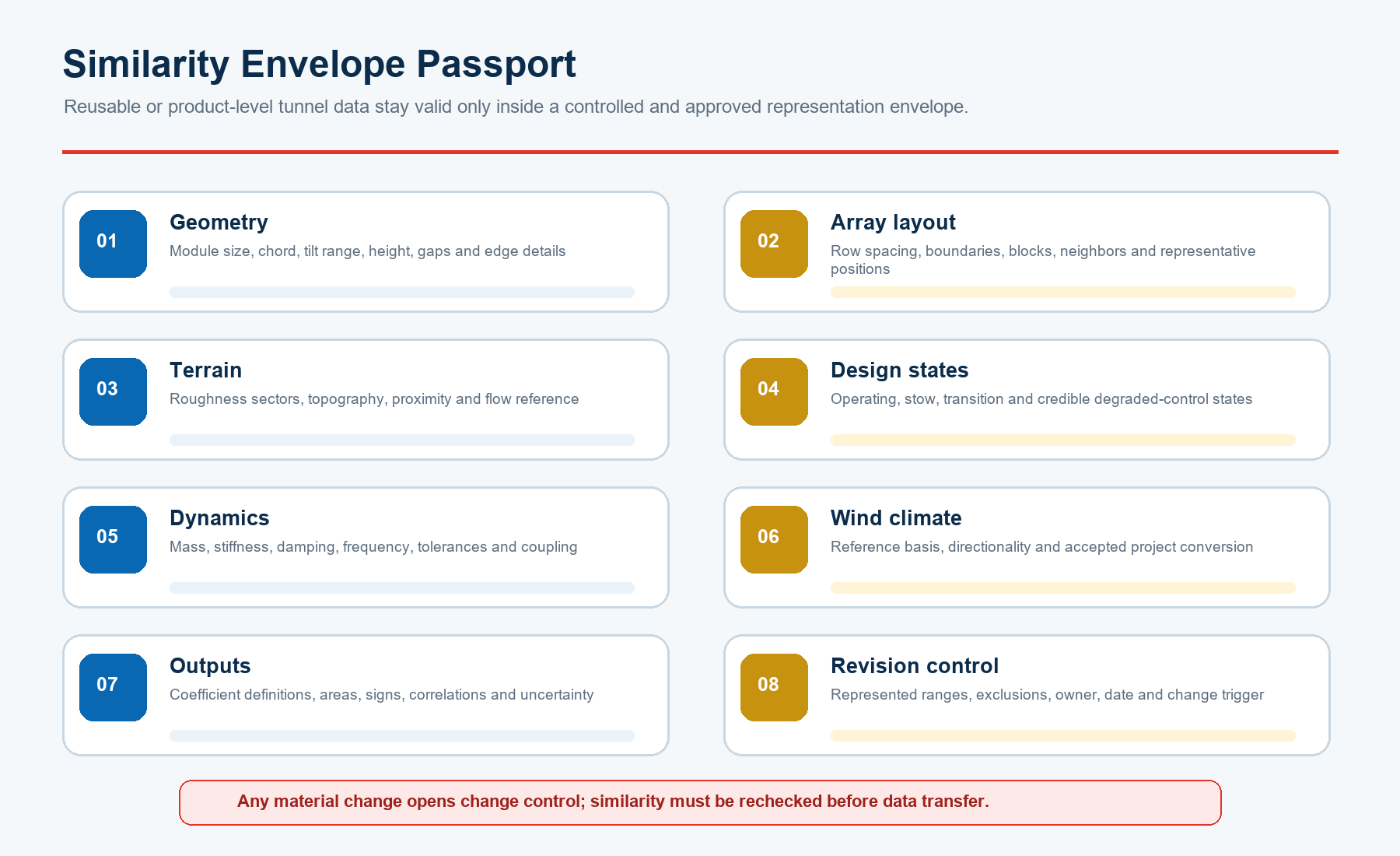
| Passport field | Represented range / evidence | Change-control question |
|---|---|---|
| Geometry | Module, chord, tilt, height, gaps, edge details | Does the project remain inside every range? |
| Layout | Spacing, boundaries, blocks, neighbors, positions | Are shelter and edge cases still represented? |
| Terrain | Roughness, topography, proximity, sectors | Has the site exposure changed? |
| States | Operating, stow, transition, degraded controls | Can a new state govern? |
| Dynamics | Mass, stiffness, damping, frequency, tolerances | Is structural-aerodynamic similarity retained? |
| Wind basis | Reference and accepted directional conversion | Can the data map to this project basis? |
| Outputs | Signs, axes, areas, correlations, uncertainty | Can the required load cases be rebuilt? |
| Revision | Owner, issue date, exclusions, trigger | Who approves transfer after a change? |
15. Use CFD and field monitoring in the right roles
Computational fluid dynamics can screen geometry, compare sensitivities, explore flow fields and help plan a physical program. NIST's public discussion of practical CFD notes its potential while emphasizing the difficulty of representing atmospheric-boundary-layer turbulence and the need for validation and resources. Therefore, CFD is not automatically equivalent to a governing code-accepted tunnel route. Agree the validation evidence, numerical uncertainty and approval status before relying on it for design values.
Field monitoring can check actual positions, accelerations, strains or control performance and can support model calibration or anomaly investigation. It is valuable evidence but usually samples a limited wind climate and configuration history. Use it to test assumptions and improve future models, not to claim that an unobserved design event is safe. Tunnel, computation and field data are complementary only when their reference conditions and uncertainty are connected.
16. Map tunnel outputs into structural and foundation design
Tunnel coefficients do not design the structure. The engineer of record must convert them using the approved wind-speed and load-combination basis, define simultaneous component and global effects, and distribute actions into modules, rails or purlins, torque tubes, posts, bracing, bearings, drives, connections and foundations. Positive and negative signs, axes and reference areas need explicit checks at every transfer.
Foundation demand should include the combinations produced by the structural model—compression, uplift, lateral load, moment and torsion as applicable—not a single isolated coefficient. Confirm whether edge zones, row positions, wind directions and operating states create different foundation schedules. The wind study does not replace geotechnical design, load testing, corrosion design or construction tolerances.
17. Run a stage-gate procurement workflow
Use five hold points. Gate A approves the evidence-gap statement and governing route. Gate B freezes the geometry, site inputs, dynamics and state matrix. Gate C approves the laboratory method, model design and output schedule. Gate D witnesses or reviews readiness, anomalies and preliminary data. Gate E accepts the final report, digital dataset, uncertainty and structural load mapping. No gate should pass because the calendar says testing must start.
- Gate A — signed decision statement: what question will the study close?
- Gate B — controlled input pack: geometry, site, states, dynamics and revisions.
- Gate C — approved method: model family, scaling, test matrix, outputs and QA.
- Gate D — execution record: readiness, deviations, anomalies and preliminary checks.
- Gate E — usable evidence: report, data, limitations, mapping and acceptance record.
Procurement should compare technical completeness, relevant specialist experience, facility capability, uncertainty treatment, peer-review route, data ownership, change policy and schedule—not price alone. Include who pays for remaking a model after a design revision and whether raw or processed data may be reused on later sites. These commercial terms protect the evidence envelope.
18. What to send East Baoyu
For a mounting-system input review, send the adopted project basis, site coordinates and terrain summary, array layout, module schedule, tracker or fixed-tilt geometry, height and angle envelope, connection interfaces, operating and stow states, preliminary design reactions, material and coating requirements, and the current wind tunnel brief or evidence-gap statement. Mark every file with revision and approval status.
East Baoyu can support product geometry, material, connection, manufacturing and supply-interface information for the project team. A qualified wind engineering specialist remains responsible for study design and interpretation, and the engineer of record remains responsible for the governing route, project load mapping and structural adequacy. East Baoyu does not perform, certify or approve wind tunnel studies and this guide does not replace project-specific engineering.
Request a Wind-Study Input Review
Send the current geometry, site basis, design states, open wind questions and proposed output schedule. East Baoyu can help identify missing product and manufacturing interfaces before the responsible specialists release the wind engineering program.

Open WhatsApp: +86 130 1228 3281
| Contact | Official detail |
|---|---|
| info@eastbaoyu.com | |
| Phone | +86 22 28352066 |
| +86 130 1228 3281 | |
| Website | https://eastbaoyu.com/contact/ |
Email the project inputs: info@eastbaoyu.com
Frequently asked questions
Is there a project-size threshold for a solar wind tunnel study?
No universal MW, acreage or project-value threshold applies. Size can raise consequence and the value of optimization, but the technical trigger is an evidence or acceptance gap.
Does every solar tracker project need wind tunnel testing?
No. The adopted analytical route, geometry, control states, dynamic behavior and approval requirements determine the need. Unresolved aeroelastic response is a stronger trigger than the tracker label alone.
Can CFD replace a physical wind tunnel?
Sometimes an approved and validated computational route may answer part or all of the question, but it is not automatically equivalent. Validation, uncertainty and governing acceptance must be agreed in advance.
Will a wind tunnel study always reduce design loads?
No. It may reduce, increase or redistribute demands and can reveal governing edge, direction, state or dynamic effects. The purpose is better evidence, not a guaranteed lower coefficient.
Can a product-level wind tunnel report be reused on another site?
Only if a responsible engineer confirms that geometry, layout, terrain, states, dynamics, wind basis and outputs remain inside the documented similarity envelope and the approving parties accept the transfer.
Who approves the wind tunnel study for design?
A qualified wind specialist should develop and interpret the program, while the engineer of record and named approving parties accept its use and map the outputs into project design.
Conclusion: commission evidence, not a generic test
A useful solar wind tunnel study begins with a controlled decision: the current evidence envelope cannot reliably and acceptably answer a defined project question. Apply the applicability, dynamics and acceptance gates; select the study family that matches the unresolved physics; freeze the brief and state matrix; demand transferable data; and place the results under structural change control. That workflow makes wind engineering evidence usable without turning testing into a substitute for governing design, controls, foundations or professional approval.
Related East Baoyu resources
Solar Mounting Systems | Engineering Articles
Evidence Center | Contact East Baoyu
Solar Tracker Wind Load and Stow Strategy | Flexible PV Mounting: Span, Pretension and Dynamic Verification
Terrain Category and Roughness for Solar Mounting Wind Design | Basic Wind Speed Conversions for Solar Projects
Topographic Survey Requirements for Solar Mounting Design | Solar Mounting Project Input Sheet
References and scope notes
Official public sources were checked on 29 July 2026 and are paraphrased within their public scope. Licensed standards were not reproduced. Confirm the contract, jurisdiction, adopted edition, national annex, amendments, wind climate, authority interpretation, laboratory accreditation or qualification, approved study brief, engineer-of-record mapping and peer review. This guide is a decision and evidence-control method, not a wind tunnel procedure, coefficient database, code opinion or structural-adequacy certificate.
ASCE/SEI 49-21 Wind Tunnel Testing for Buildings and Other Structures | ASCE 49-21 Chapter 2: Wind Tunnel Testing Requirements
ASCE 49-21 Chapter 4: Flexible Structures | ASCE 49-21 Chapter 8: Instrumentation, Uncertainty and QA
ASCE 7 official overview | ASCE 7-22 release notice
2024 IBC Chapter 16 | SEAOC PV2-2017
ISO 4354:2009 public abstract | European Commission JRC: Eurocode 1
Standards Australia: AS/NZS 1170.2 update | NREL: Fluid-Structure Interaction Solver for Tracker Galloping
NREL: Predicting Instability and Wind Loading on Single-Axis Trackers | NREL: Predicting Wind Loading and Instability in Tracking PV Arrays
NIST: Practical CFD Simulations of Wind Tunnel Tests | NIST: Toward a Standard on the Wind Tunnel Method
NIST Aerodynamic Database | IEA PVPS: Bifacial Tracking Best Practices
ASCE SEI Solar PV Structures Committee | ASCE MOP 162: Design and Construction of Solar PV Structures
References, disclosure and change record
References and further verification
- https://wa.me/8613012283281
- https://wa.me/8613012283281?text=Hello%20East%20Baoyu%2C%20I%20would%20like%20to%20discuss%20solar%20mounting%20inputs%20for%20a%20wind%20tunnel%20study.
- https://eastbaoyu.com/solar-mounting/
- https://eastbaoyu.com/articles/
- https://eastbaoyu.com/evidence-center/
- https://eastbaoyu.com/contact/
- https://eastbaoyu.com/solar-tracker-wind-load-and-stow-strategy/
- https://eastbaoyu.com/flexible-pv-mounting-span-pretension-dynamics/
- https://eastbaoyu.com/terrain-category-roughness-solar-mounting-wind-design/
- https://eastbaoyu.com/basic-wind-speed-conversions-solar-projects-avoiding-input-errors/
- https://eastbaoyu.com/topographic-survey-requirements-ground-mount-solar-structures/
- https://eastbaoyu.com/solar-mounting-project-input-sheet/
- https://sp360.asce.org/personifyebusiness/Merchandise/Product-Details/productId/275359752
- https://amplify.asce.org/content/standard/9780784440100/part/provisions/standard-chapter/s3
- https://amplify.asce.org/content/standard/9780784440100/part/provisions/standard-chapter/s5
- https://amplify.asce.org/content/standard/9780784440100/part/provisions/standard-chapter/s8
- https://www.asce.org/publications-and-news/asce-7
- https://www.asce.org/publications-and-news/civil-engineering-source/society-news/article/2021/12/01/newly-updated-minimum-design-loads-and-associated-criteria-for-building-and-other-structures-asce-sei-7-22-standard-now-available/
- https://codes.iccsafe.org/content/IBC2024P1/chapter-16-structural-design
- https://seaoc.org/content.aspx?club_id=32108&item_id=18912&page_id=586
- https://www.iso.org/standard/38882.html
- https://eurocodes.jrc.ec.europa.eu/EN-Eurocodes/eurocode-1-actions-structures
- https://www.standards.org.au/news/update-to-the-go-to-combined-wind-actions-standard
- https://research-hub.nlr.gov/en/publications/a-fluid-structure-interaction-solver-for-investigating-torsional--2/
Disclosure: East Baoyu manufactures and supplies products discussed on this website. Structured drafting tools may assist research and editing, but technical claims, project inputs and release decisions require qualified review under the applicable project responsibilities.
Version 1.0: Initial scheduled publication in the East Baoyu engineering knowledge-base batch.
View the public Content Change Log · Corrections: info@baolaipipes.com