

Authorship, review and evidence boundary
- Technical review
- East Baoyu Engineering Editorial Team
- Reviewed
- 2026-07-29
- Scope
- General engineering and procurement guidance. This article is not a project-specific design, capacity statement, certificate, warranty, code interpretation or contract requirement.
Evidence basis: Official and public references identified in the article, together with original editorial diagrams. Project values and release decisions require qualified review under the applicable project responsibilities.
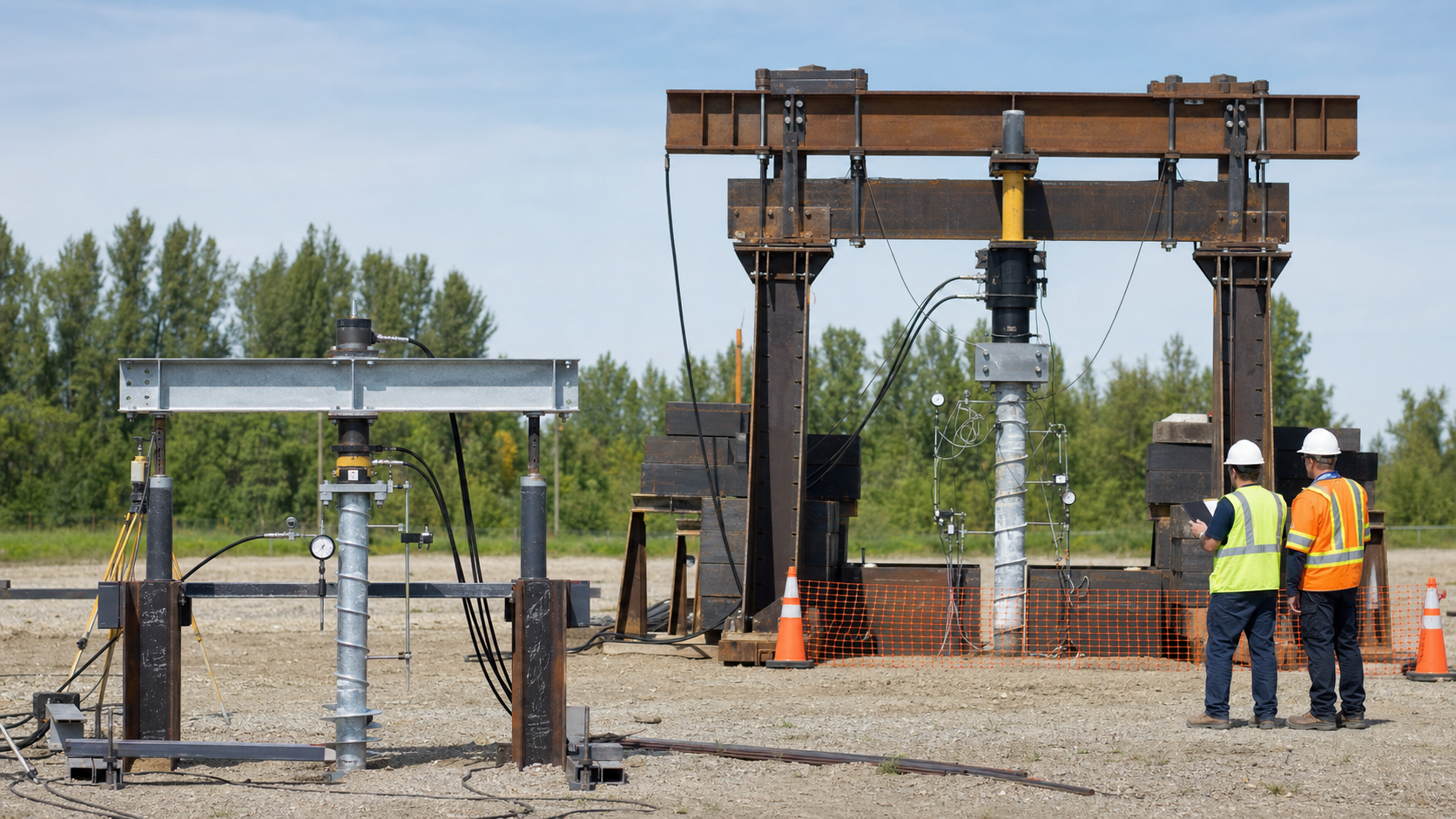
Read the Editorial PolicyThe shortest useful answer is that a proof test checks a declared requirement, while an ultimate test investigates the resistance boundary. The difference is the decision the test is designed to support—not a universal load multiplier, apparatus type or movement value. A proof test can validly stop at its specified maximum without reaching failure. An ultimate or investigation test needs enough response for the responsible engineer to interpret resistance, but it must still respect structural, apparatus and safety limits.
For screw-pile projects, the specification should identify the test role, load direction, specimen status, loading procedure, maximum and stop conditions, evaluation rule, represented population and post-test disposition before mobilization. Without those controls, a clean load-movement curve may still be unable to answer whether production piles can be released or whether the design basis needs revision.
1. Start with the decision, not the test label
Teams sometimes request a “two-times test,” an “acceptance test” or a “full-scale test” before agreeing on the question. Those phrases are incomplete. A project may need to verify that selected production piles meet a stated load and movement requirement, establish the resistance available in a representative ground zone, compare an installation change, or investigate an anomalous result. Each decision needs a different evidence boundary even when the same jack, reaction system and measuring instruments are used.
Write the decision as a sentence: “This test will release production population P if criteria C are met,” or “This test will inform design assumption D by interpreting resistance under method M.” That sentence prevents a common failure: observing more movement than expected during a proof test and retrospectively calling it an ultimate result. Unexpected movement may trigger investigation, but it does not supply the preplanned range, controls or interpretation route of an ultimate test.
2. Separate the test role from the loading procedure
Proof and ultimate describe roles. Compression, uplift and lateral describe directions. Maintained load, quick load, cyclic stages and other sequences describe procedures. Production, preproduction and sacrificial describe specimen status. Keeping these fields separate matters because ASTM notes that different loading procedures can produce different load-movement curves. A method reference therefore does not by itself define the test objective or the project acceptance rule.
The current official pages for ASTM D1143/D1143M, D3689/D3689M and D3966/D3966M address static axial compression, axial tension and lateral testing respectively. They emphasize field load-movement response, project-specific plans and qualified engineering judgment. Their scope should not be shortened to “use ASTM and test to X.” The project documents must also state the adopted edition, load sequence, instrumentation, hold times, termination criteria, interpretation method, reporting and authority for deviations.
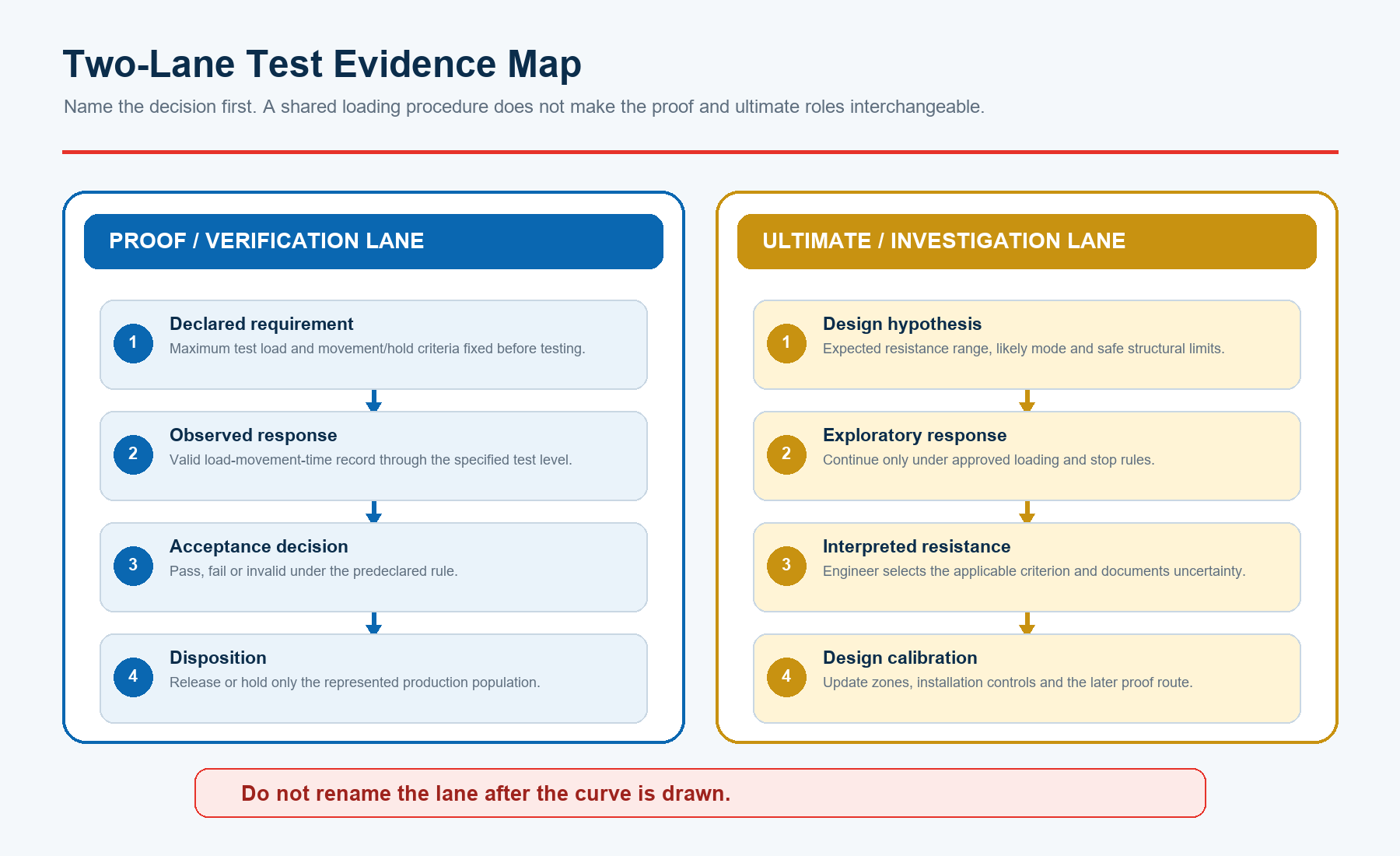
3. Compare proof and ultimate tests across eight controls
| Control | Proof / verification role | Ultimate / investigation role | Release question |
|---|---|---|---|
| Primary decision | Does the tested element meet the declared requirement? | What resistance boundary or governing response can be interpreted? | Acceptance or design calibration? |
| Specimen | Often a production element; project documents decide. | Often preproduction or sacrificial; not automatically. | May it remain in service? |
| Maximum load | Specified level; failure need not be reached. | Sufficient response for interpretation, within approved limits. | What are the stop rules? |
| Evaluation | Predeclared pass/fail/invalid criteria. | Named resistance criterion and engineering interpretation. | Who signs the decision? |
| Population | Only the stated matching production population. | Only the stated design zone and installation family. | What evidence can transfer? |
| Outcome | Release, hold, correct or retest. | Confirm, recalibrate, redesign or add investigation. | What changes next? |
No cell in this comparison contains a universal load factor, proof percentage or movement limit. Those values come from the adopted design basis, jurisdiction, project specification, evaluation report or approved test plan. A locally applicable supplement may contain a percentage or proof requirement, but it remains tied to that scope. It should not be copied into another project simply because both projects use helical piles.
4. Decide whether the test element may remain in service
A production pile may be a practical proof specimen when the specified loading, connection, head condition and post-test inspection are compatible with continued service. The program must say whether it can be released after a valid pass and who approves that disposition. The load history should remain linked to the pile identifier, location, installation record and represented population. Passing does not erase the test history; it makes that history part of the production evidence.
An intended ultimate test may use a sacrificial or preproduction element because the investigation could approach a soil, shaft, helix, coupling, bracket, connection or apparatus limit. However, “ultimate” does not automatically mean destroyed, and “production” does not automatically mean safe for exploratory loading. The responsible engineer should precheck every structural and reaction-system limit and define the element's post-test status before the first load increment.
5. Set the maximum load and stop rules before mobilization
For proof testing, the specified maximum is linked to a declared acceptance question. Reaching that load without breaching the approved movement, creep, rebound, stability or other criteria can support a pass within the stated scope. If failure is not reached, the result demonstrates performance only through the applied level under the tested conditions. It does not reveal an unobserved ultimate resistance.
For ultimate testing, the plan should name the intended interpretation range and the stop hierarchy. Stops may protect personnel, reaction anchors, frame, jack, load cell, reference beam, pile shaft, couplings, helices or head connection; they may also address excessive movement, instability or data-quality loss. ASTM public summaries recognize loading toward failure only when feasible and within safe structural limits. A safe stop before a clear resistance boundary may produce a valid test record but an inconclusive ultimate interpretation.
6. Define what a proof test can and cannot demonstrate
A valid proof test can show that a specified pile, installed in a recorded location and condition, sustained the approved test sequence and met the declared criteria. If the sampling plan is defensible, that evidence may release a stated production population. The population should be bounded by pile type and size, helix configuration, embedment, installation equipment and method, ground zone, load direction, head condition, grading stage and any other variable used by the design.
It cannot establish resistance beyond the demonstrated range, compensate for an undeclared acceptance rule, prove another load direction or release piles outside the represented population. A compression proof test does not automatically prove uplift or lateral performance. Installation torque can be an installation-control or correlation input where the approved design route allows it, but it does not change the test's declared role and does not replace the project engineer's evidence decision.
7. Define what an ultimate test must reveal
The investigation plan should state how the engineer will recognize and interpret the relevant resistance boundary. That may involve a named load-movement criterion, a defined deformation response, a plunging or progressive behavior pattern, structural limitation, or another approved method. The term “ultimate load” is not self-interpreting: the raw maximum applied load, a peak reaction and an interpreted geotechnical resistance are not automatically the same value.
The report should preserve the complete curve, time observations, unloading and rebound where required, instrument ranges, corrections, deviations and reason for termination. If the test stops because the apparatus or steel system reached its approved limit before the soil response was resolved, say so. An allowable design load then requires the adopted design method, resistance or safety factors and project review; it should not be presented as an automatic fraction of the largest recorded test load.
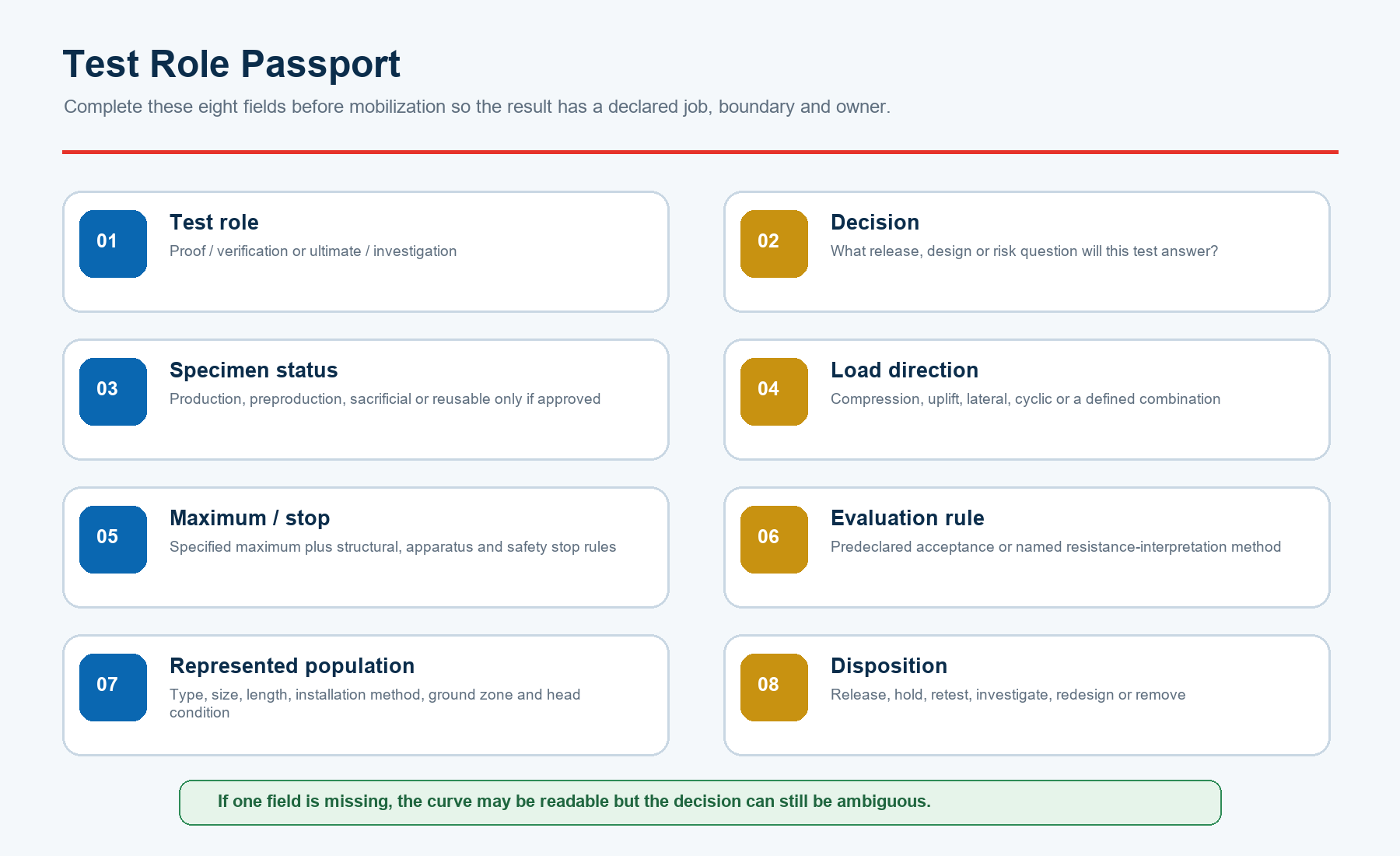
8. Build the Test Role Passport
The Test Role Passport is a one-page control record placed ahead of the detailed method statement. It makes eight fields visible to engineering, procurement, site operations and the testing specialist: role, decision, specimen status, direction, maximum/stop condition, evaluation rule, represented population and disposition. If any field is missing, mobilization should pause until its owner closes the gap.
9. Use a paired program: investigation first, verification second
Where ground uncertainty or design novelty warrants it, a paired program can be more informative than one ambiguous test. Preproduction investigation first explores resistance and validates assumptions in the relevant zones. The engineer then fixes the design basis, installation controls and production acceptance route. Proof testing follows to verify selected installed piles against that released requirement. This is an evidence sequence, not a mandatory formula for every project.
FHWA guidance for deep foundations distinguishes preproduction work that establishes or verifies design and installation means from production testing used to verify consistent, acceptable construction. The cited guidance is not helical-pile project specification language, but the evidence-role distinction is useful. Investigation reduces design uncertainty; proof testing checks whether production remains within the released basis. One successful investigation test does not automatically release all later production piles.
10. Select sample quantity and zones through risk
Sample quantity should respond to variability and consequence: changes in geology, fill, groundwater, grading, pile geometry, installation equipment, crew, access, load demand and design criticality. A percentage without a zoning logic can oversample a uniform area while missing a smaller high-risk zone. The sampling plan should therefore map each test to a represented population and state what change causes that population to split.
Local codes, evaluation reports or owner specifications may impose minimum tests or locations. Read them with their scope, edition and conditions of use. The 2024 IBC, for example, links extrapolation from tested elements to matching type, size, relative length, installation and subsoil conditions. An ICC-ES report or supplement may add product- or jurisdiction-specific conditions. Neither source creates one global test percentage for all screw-pile projects.
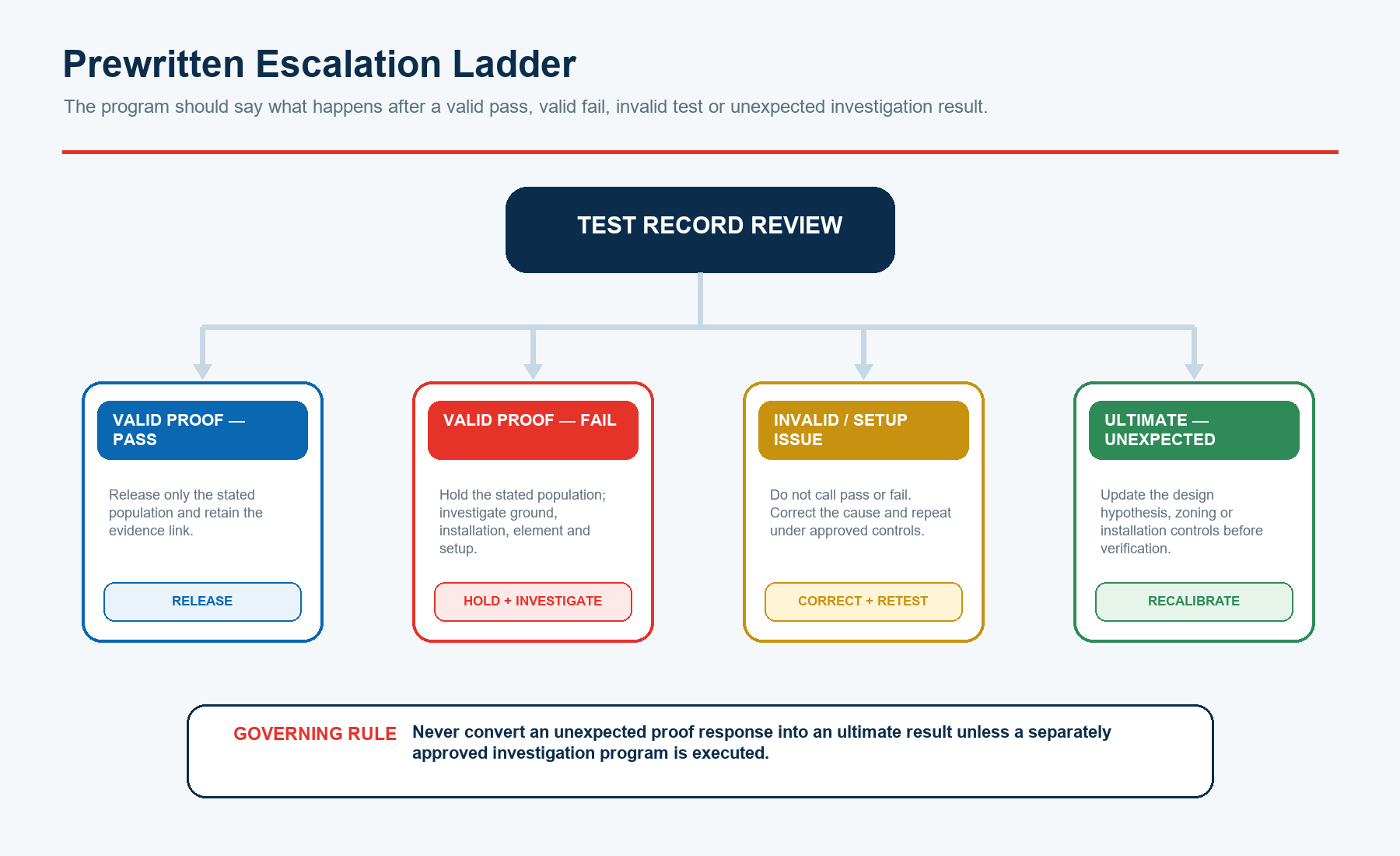
11. Prewrite the escalation ladder
The test plan should contain the decision tree before results are known. A valid proof pass can release only the stated population. A valid proof fail should hold that population and trigger the named investigation of ground, installation, component and setup variables. An invalid test caused by unstable reaction, reference movement, instrumentation range, connection slip or procedural deviation should be corrected and repeated; it should not be called pass or fail.
An unexpected ultimate result can require revised design zones, pile geometry, installation criteria or a new investigation. After the design basis is updated, a corresponding verification route should be released. This prewritten ladder protects commercial decisions from being improvised at the test location and preserves the difference between data validity, acceptance and resistance interpretation.
12. Interpret the curve without changing the test identity
Begin interpretation by confirming validity: calibrated instruments, independent reference, reaction stability, correct load direction and application point, synchronized readings, approved sequence and documented deviations. Then apply the evaluation rule named before the test. Proof acceptance asks whether the declared requirement was met. Ultimate interpretation asks what boundary the response supports and with what limitation.
Do not search the curve after testing for whichever criterion produces the desired commercial answer. If the planned criterion proves unsuitable, the responsible engineer should document the reason, status the original decision as unresolved and approve a revised analysis or new test. Traceability is stronger when the report shows raw readings, corrected values, plots, observations, photographs and every calculation that connects the record to the conclusion.
13. Transfer evidence only to the represented population
| Evidence-control field | Transfer check | If it changes |
|---|---|---|
| Pile system | Same shaft, helix, coupling, bracket and connection family? | Split the population or justify. |
| Installation | Same equipment, method, torque/advance controls and termination? | Review correlation and add tests. |
| Ground zone | Same strata, fill, groundwater, grading and disturbance? | Create a new evidence zone. |
| Geometry | Same embedment, head condition, loading height and direction? | Reassess the test applicability. |
| Construction state | Same cut/fill, drainage, frost, scour and working platform? | Hold release until reviewed. |
The result should carry an evidence identifier linked to the pile schedule, installation record, ground zone and approved interpretation. If later work changes grading, pile length, installer, equipment or connection, the team can see whether the original evidence still applies. This is more defensible than filing a PDF under “load tests” and assuming it covers every pile shown on the latest layout.
14. Control code, evaluation-report and specification interfaces
A standards list is not a completed test program. Use the code to identify the regulatory route, the evaluation report to confirm product scope and conditions of use, the project specification to state the contractual test roles and criteria, the approved method statement to control execution, and the engineer's report to interpret and release evidence. Conflicts should be resolved before testing, with the governing document and approved deviation recorded.
ISO 22477-1's public abstract recognizes static compression maintained-load testing both to check that a pile behaves as designed and to measure resistance. ISO 22477-10 uses investigation and control terminology in its rapid-load context. These sources reinforce the importance of objective, but their licensed procedures and scope must be applied directly. Do not treat a public abstract, an AC358 listing or a local ESR supplement as a substitute for the project's approved field-testing documents.
15. What to send East Baoyu
For a screw-pile test input review, send the project location and jurisdiction; adopted code, standard and edition; geotechnical report and ground zoning; design reactions by direction; pile schedule and component limits; layout and test locations; installation equipment and records; proposed Test Role Passport; loading procedure; reaction and instrumentation concept; maximum and stop rules; acceptance or interpretation method; sampling/population logic; and the intended post-test disposition.
East Baoyu can support product geometry, material, connection, manufacturing and supply-interface information for the project team. The project geotechnical and structural professionals remain responsible for the design basis, test program, field execution oversight, deviations, interpretation, allowable resistance and release. This guide does not certify a test, approve an apparatus, promise capacity or replace site-specific engineering.
Request a Screw-Pile Test Input Review
Send the current ground zones, pile schedule, load directions, proposed test roles, maximum/stop rules and represented populations. East Baoyu can help identify missing product and manufacturing interfaces before the responsible project engineer releases the field program.

Open WhatsApp: +86 130 1228 3281
| Contact | Official detail |
|---|---|
| info@eastbaoyu.com | |
| Phone | +86 22 28352066 |
| +86 130 1228 3281 | |
| Website | https://eastbaoyu.com/contact/ |
Email the project inputs: info@eastbaoyu.com
Frequently asked questions
Does a proof test establish the ultimate capacity of a screw pile?
No. If failure or a resistance boundary is not reached and interpreted under an approved investigation plan, the result supports performance only through the demonstrated range and declared proof criteria.
Must an ultimate test destroy the test pile?
Not necessarily. The intended role is to investigate resistance, but approved structural, apparatus and safety limits still apply. The plan must predeclare the specimen's post-test disposition.
Can a production screw pile be used for an ultimate test?
Only when the project engineer has approved the loading range, structural limits, continued-service or removal decision and all safety controls. Production status does not make exploratory loading appropriate.
Is there one standard proof-load factor for every helical pile project?
No. Load level, sampling, movement criteria and hold requirements depend on the adopted project route, jurisdiction, design basis and approved specification.
Can a failed proof test be treated as an ultimate test?
Not retrospectively. A valid proof failure should trigger the prewritten hold and investigation route. A separate approved investigation may use later testing to explore resistance.
Does a successful ultimate test release all production piles?
No. The investigation informs only its stated design zone and assumptions. Production release still depends on the approved installation controls, represented population and verification plan.
Related East Baoyu resources
Screw Piles | Engineering Articles
Evidence Center | Contact East Baoyu
Ground Screw Selection from Site Investigation | Installation Torque and Ground Screw Capacity
How to Plan a Ground Screw Load Test Program | Compression Load Testing for Ground Screws
Uplift Load Testing for Ground Screws | Lateral Load Testing for Ground Screws
References and scope notes
Official public sources were checked on 28 July 2026 and are paraphrased within their public scope. Licensed standards and acceptance-criteria text were not reproduced. Confirm the project contract, jurisdiction, adopted edition, amendments, evaluation report and supplements, geotechnical design basis, structural limits, test specification, approved method statement and engineer's interpretation. This guide is a test-role and evidence-control method, not a field procedure, allowable-capacity calculation or compliance certificate.
ASTM D1143/D1143M-26 | ASTM D3689/D3689M-25
ASTM D3966/D3966M-25 | ASTM geotechnical standards index
ISO 22477-1:2018 public abstract | ISO 22477-10:2016 public abstract
2024 IBC Chapter 18 | ICC-ES AC358 listing
How to read an ICC-ES evaluation report | ICC-ES ESR-5629 Los Angeles supplement
FHWA GEC 8 | FHWA GEC 12 Volume II
FHWA Central Artery case study, test program | FHWA Central Artery case study, results
DFI professional resources | East Baoyu Screw Piles
References, disclosure and change record
References and further verification
- https://wa.me/8613012283281
- https://wa.me/8613012283281?text=Hello%20East%20Baoyu%2C%20I%20would%20like%20to%20discuss%20proof%20and%20ultimate%20testing%20inputs%20for%20a%20screw%20pile%20project.
- https://eastbaoyu.com/screw-piles/
- https://eastbaoyu.com/articles/
- https://eastbaoyu.com/evidence-center/
- https://eastbaoyu.com/contact/
- https://eastbaoyu.com/ground-screw-selection-from-site-investigation/
- https://eastbaoyu.com/installation-torque-and-ground-screw-capacity/
- https://eastbaoyu.com/plan-ground-screw-load-test-program/
- https://eastbaoyu.com/compression-load-testing-ground-screws/
- https://eastbaoyu.com/uplift-load-testing-ground-screws-project-specification-should-define/
- https://eastbaoyu.com/lateral-load-testing-ground-screws/
- https://store.astm.org/d1143_d1143m-26.html
- https://store.astm.org/d3689_d3689m-25.html
- https://store.astm.org/d3966_d3966m-25.html
- https://store.astm.org/products-services/standards-and-publications/standards/geotechnical-engineering-standards.html
- https://www.iso.org/standard/70807.html
- https://www.iso.org/standard/64645.html
- https://codes.iccsafe.org/content/IBC2024P1/chapter-18-soils-and-foundations
- https://icc-es.org/evaluation-report-listing/ac358/
- https://icc-es.org/evaluation-report-program/evaluation-report-read/
- https://icc-es.org/wp-content/uploads/report-directory/ESR-5629.pdf
- https://www.fhwa.dot.gov/engineering/geotech/pubs/gec8/gec8.pdf
- https://www.fhwa.dot.gov/engineering/geotech/pubs/gec12/nhi16009_v2.pdf
Disclosure: East Baoyu manufactures and supplies products discussed on this website. Structured drafting tools may assist research and editing, but technical claims, project inputs and release decisions require qualified review under the applicable project responsibilities.
Version 1.0: Initial scheduled publication in the East Baoyu engineering knowledge-base batch.
View the public Content Change Log · Corrections: info@baolaipipes.com