

Authorship, review and evidence boundary
- Technical review
- East Baoyu Engineering Editorial Team
- Reviewed
- 2026-07-29
- Scope
- General engineering and procurement guidance. This article is not a project-specific design, capacity statement, certificate, warranty, code interpretation or contract requirement.
Evidence basis: Official and public references identified in the article, together with original editorial diagrams. Project values and release decisions require qualified review under the applicable project responsibilities.
Read the Editorial PolicyA ground screw load test can produce an accurate curve and still fail to answer the project question. The wrong location may have been tested, the selected element may not represent production geometry, the load direction may not match the governing action, or the acceptance rule may be chosen only after the result is visible. In each case, the field work creates data without creating a defensible decision.
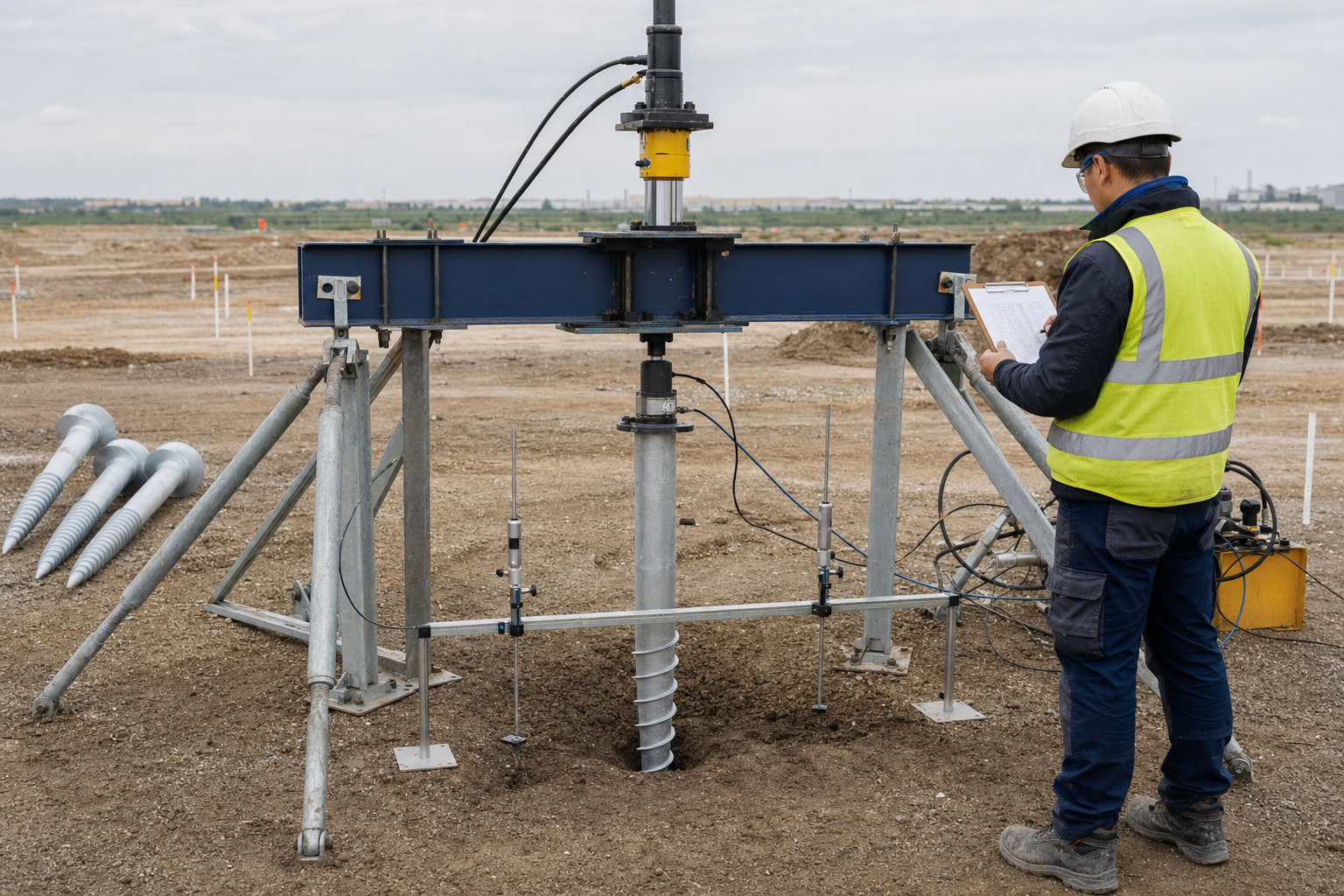
A ground screw load test plan should therefore be written as a decision program before it becomes a field procedure. It connects the ground model, structural demand, element configuration, installation method, adopted test basis, measurements, responsibilities and disposition route. The detailed setup and step-by-step compression procedure belong in the approved method statement; the program determines why, where and how the evidence will be used.
1. Define the decision before selecting the test method
Start with one sentence that states what the test must decide. The question may be whether a proposed ground screw type is suitable for a defined ground zone, whether a design resistance can be supported, whether an installation change requires verification, or whether production can proceed in a bounded area. Different decisions can require different elements, locations, load levels, measurements and interpretation.
The objective must also name the decision owner and the consequence of the outcome. A valid pass might release a design zone or a limited production lot. A valid nonconformance might trigger redesign, a different screw, deeper installation, ground-treatment review or additional testing. An invalid test, caused for example by an unstable datum or damaged apparatus, should trigger investigation and an approved repeat route rather than being counted as a structural failure or quietly discarded.
ISO 22477-1:2018 describes maintained static axial compression testing of a single pile to check behaviour or measure resistance. The ISO page also states that constant-rate and cyclic tests are outside that document's scope. This makes the program objective and adopted test basis explicit project inputs, not assumptions hidden in a generic form.
2. Build the six-question load-test matrix
The matrix below is an East Baoyu editorial control device. It is not a test standard and does not replace a qualified engineer's specification. Its purpose is to prevent a complete-looking method statement from omitting the decision coordinates that make results transferable and auditable.
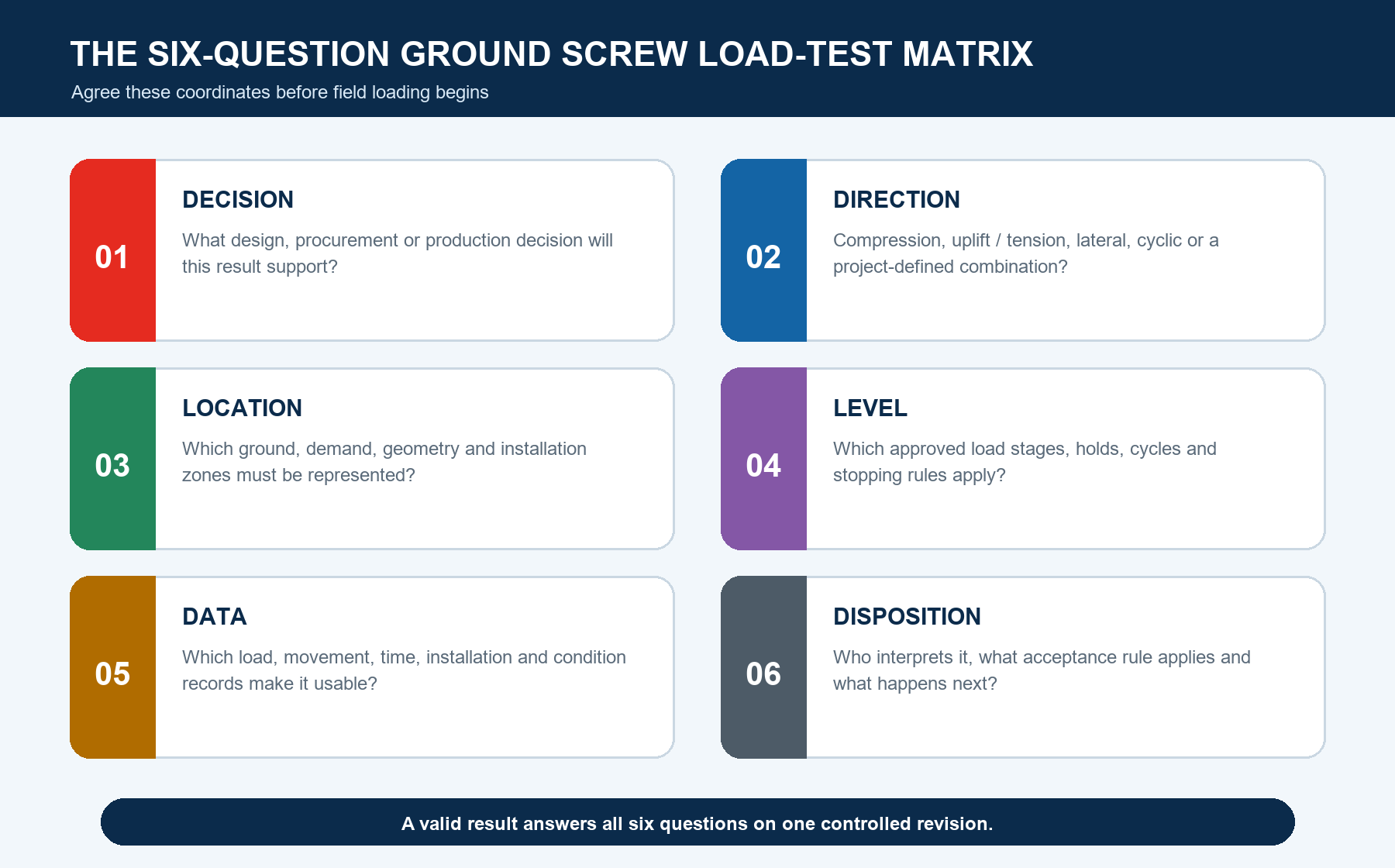
| Coordinate | Program answer | Required control |
|---|---|---|
| Decision | Named engineering, procurement or production decision. | Owner, approval action and consequence of each outcome. |
| Direction | Compression, uplift/tension, lateral, cyclic or defined combination. | Connection to project actions and adopted test method. |
| Location | Ground, demand, geometry and installation zones represented. | Selection map and reasons for inclusion or exclusion. |
| Level | Approved stages, holds, cycles, stopping rules and sequence. | Controlled schedule; apparatus and element limits respected. |
| Data | Installation, condition, load, movement, time and deviation records. | Calibrations, independent datum, synchronized log and identifiers. |
| Disposition | Acceptance, invalid-test and nonconformance routes. | Interpreter, release authority, expansion/retest approval and traceability. |
3. Divide the site into representative test zones
A site should not be treated as one statistical population merely because it has one address. Build zones from the ground model and the structural/installation plan. Consider stratigraphy, density or consistency, fill, groundwater, surface preparation, grade, erosion or scour exposure, topographic position, investigation confidence and observed installation response. Then overlay screw type, length, shaft and helix geometry, inclination, head condition, design demand and installation equipment or procedure.
Select locations that answer the decision rather than locations that are easiest to access. Include expected critical or uncertain conditions when they are relevant, but do not label a single worst-looking location as universally governing without engineering justification. Record why each location is representative, what area it can support and which conditions remain outside the evidence boundary.
Use the existing Ground Screw Selection from Site Investigation and Ground Screw Design Input Checklist to establish the ground and product inputs before drawing the test-location plan. Testing cannot repair an unbounded ground model; it can only add evidence for conditions that were identified and recorded.
Ground zone – stratigraphy, variability, groundwater, fill and surface condition.
Demand zone – compression, uplift, lateral or combined actions and serviceability sensitivity.
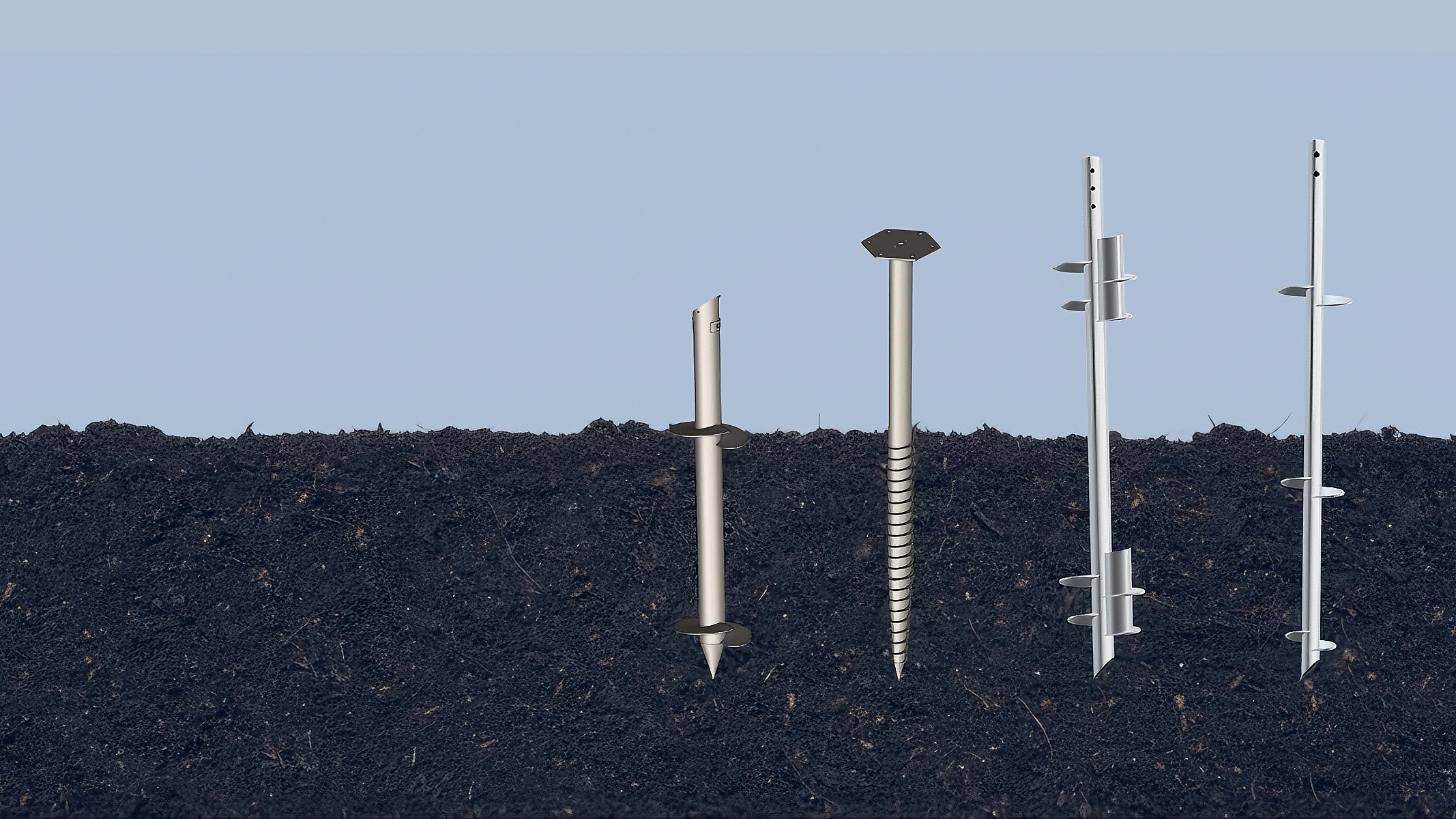
Element zone – screw type, shaft, helix, length, inclination and head/interface.
Installation zone – equipment, procedure, access, refusal/obstruction risk and recorded installation response.
4. Match load directions to project actions
Compression, uplift/tension and lateral tests answer different questions. A solar support, lightweight building or other ground-screw system may be sensitive to more than one direction, and the governing direction can vary by location or load combination. The program should map every proposed test to the demand case it supports and should state when a result will not be used for another direction.
Current ASTM pages separate ASTM D1143/D1143M-26 for static axial compression, ASTM D3689/D3689M-25 for static axial tension and ASTM D3966/D3966M-25 for static lateral loading. Each scope also leaves project-specific additions and interpretation to the responsible engineer. The project must name the adopted edition and any jurisdictional or specification requirements.
If cyclic or combined behaviour matters, define the sequence, conditioning, rest periods and interpretation basis explicitly. Do not append cycles to a static procedure without confirming that the resulting data support the intended design decision. Also record the lateral load application height and ground-surface condition, because those details can materially affect the measured response.
5. Define test roles instead of relying on labels
Projects use terms such as preliminary, design, suitability, verification, proof and production test in different ways. A defensible program defines each role in plain language: when it occurs, whether the element is sacrificial or may remain in service, what it is intended to establish, what maximum demand and response range are sought, and what authority accepts the result.
| Project-defined role | Typical decision purpose | Items that must be stated |
|---|---|---|
| Exploratory / preliminary | Compare concepts, installation responses or ground zones before final release. | Element status, conditions represented and limits on design use. |
| Design / suitability | Support a design assumption or proposed element/configuration in defined conditions. | Basis, target response, representativeness and interpretation method. |
| Verification / proof | Confirm a released configuration, production zone or defined installation population. | Selection rule, acceptance criteria, frequency and response to exceptions. |
| Investigative / retest | Resolve a valid nonconformance, anomaly or invalid test. | Root question, changed condition, retained data and approval for new scope. |
This definition prevents a test performed for concept comparison from being presented later as proof of all production elements. It also prevents production testing from being scheduled before the preliminary evidence and design decisions it depends on are complete.
6. Select test elements and quantities through risk
The program should distinguish purpose-installed test elements from production elements. State whether an element may be reused, whether loading can affect its service performance, how the tested connection or extension differs from the final head, and who decides its final disposition. Record the complete element identity: drawings, material, geometry, coating, extensions, couplings, installation date, equipment and operator or crew as required by the project.
There is no universal test quantity that this guide can prescribe. Quantity and distribution should respond to uncertainty, consequence, site variability, number of element/demand zones, installation changes, prior evidence and the project's adopted standard or specification. Write the selection rule before installation so the program cannot be biased toward convenient or high-performing elements after production data become visible.
If installation torque is recorded, treat it as a process variable. A project-specific correlation may help select or control tests, but torque is not universal capacity proof. The Installation Torque and Ground Screw Capacity guide explains why equipment, soil, screw geometry, rate and measurement method must remain within a verified correlation boundary.
7. Approve the field method and apparatus before mobilization
The load-test program should require a separate approved method statement and apparatus design. At program level, name the required reaction principle, load application path, apparatus capacity, exclusion or influence zones, independent reference system, movement measurements, load measurement, time recording, environmental observations, calibration certificates, data-acquisition method and backup readings. The qualified engineers responsible for the foundation and loading arrangement should approve the details within the adopted basis.
Plan a pre-test readiness review: identify the test element and reaction components; compare installed condition with the approved drawing; confirm calibrations and measurement ranges; verify datum stability; document initial readings; establish communication, hold points and stop authority; and confirm the area is controlled for safety. These requirements define the gate, not the field sequence. A later compression-testing article can address execution and records in greater detail.
Also define what invalidates the measurement without implying that every deviation does so. Examples can include unstable reaction, reference movement, instrument malfunction, exceeded apparatus limits, an undocumented change in element or ground condition, or a load path different from the approved arrangement. The field team must record the event and stop or continue only under the approved authority.
8. Freeze the load schedule and acceptance logic
The approved program should contain or reference the complete load schedule: load steps, hold or observation periods, cycles if applicable, unloading, residual reading requirements, maximum intended load, structural and apparatus limits, stopping rules and criteria for extending or terminating the test. Those values depend on the objective, adopted method, design basis and element; they are deliberately not generalized here.
Acceptance must be written before testing. State the response measure, the interpretation method, serviceability or ultimate limit being checked, any creep or rate observation, the factor or resistance framework applied by the design engineer, and how measurement uncertainty is handled. The raw curve, interpreted result and release decision should remain separate records so the project can see where observation ends and engineering judgment begins.
9. Plan data, deviations and disposition as one workflow
A useful test record ties every reading to the correct element, location, ground zone, installation history, apparatus, calibration and time. Retain raw and processed data, not only the final chart. Identify units, zero/reference readings, corrections, observer, file version and any manual transcription. Photograph the setup from controlled viewpoints and keep a plan showing the test and reaction locations, but do not use photographs as a substitute for dimensions and identifiers.
Write three disposition routes in advance. A valid pass follows the named release action and evidence boundary. A valid nonconformance preserves all data, blocks the affected scope and begins an engineer-approved investigation, design change, expansion or retest route. An invalid test documents why the result cannot support the decision, checks whether any partial information remains useful and defines a controlled repeat without deleting the original record.
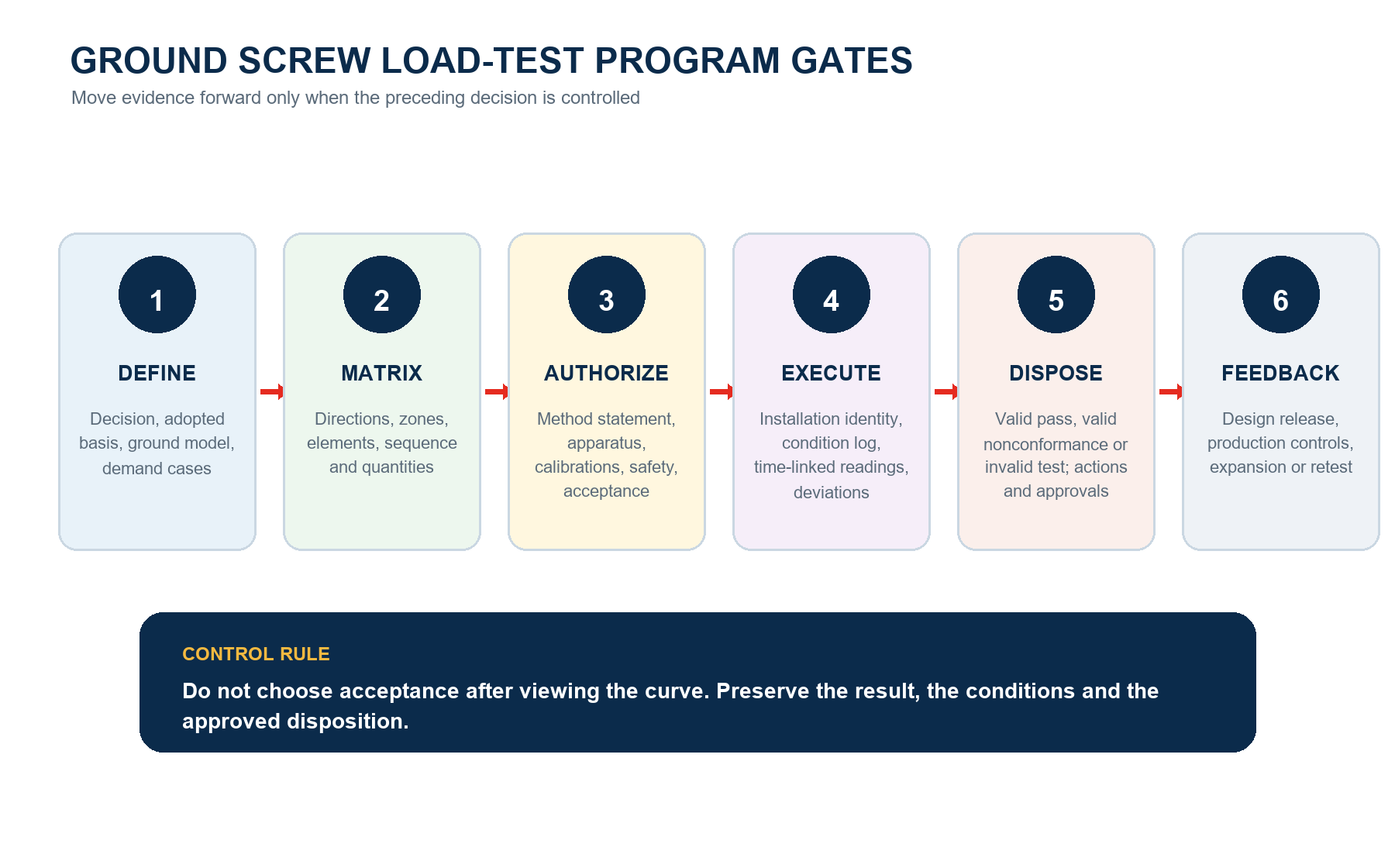
The FHWA Deep Foundation Load Test Database illustrates the value of retaining subsurface, foundation-element, installation and load-test information together. Its database scope does not make every listed pile type or test method applicable to a ground-screw project; the useful lesson is data context and traceability.
10. Assign responsibilities and issue one controlled program
The final program should identify who prepares the ground model, supplies design actions, selects the test locations and elements, designs the loading apparatus, approves the method, supplies and calibrates instruments, installs test elements, performs the test, witnesses hold points, validates the record, interprets results, approves disposition and releases design or production. One person may hold several roles, but no role should be implicit.
Design authority – defines the decision, design demand, interpretation and acceptance basis.
Geotechnical authority – controls the ground model, zoning, representativeness and soil-related interpretation.
Test/apparatus engineer – designs or approves the loading and reaction arrangement and method.
Contractor/test agency – installs, measures, records, protects calibrations and reports deviations.
Witness/quality role – confirms hold points, identities, records and controlled copies.
Release authority – approves the disposition and the bounded scope that may proceed.
Issue the program with a revision, date, status and transmittal. Attach or reference the location plan, zone schedule, element schedule, adopted standards, approved method, apparatus calculation or certification route, calibration register, loading schedules, field forms, acceptance criteria, safety controls and distribution list. When any input changes, assess whether the test matrix, completed results or release boundary also change.
11. Request an engineering review from East Baoyu
For an initial supplier engineering review, send the project location and application, governing jurisdiction and proposed standards, ground investigation and zoning, groundwater and topography, design actions by direction, serviceability limits, ground screw drawings and material/coating requirements, quantities, installation equipment and proposed controls, test objectives, draft matrix, intended programme and the exact decision you need East Baoyu to support.
| Submit | Minimum content |
|---|---|
| Project basis | Application, jurisdiction, adopted standards, design stage and responsible authorities. |
| Ground model | Investigation, zones, variability, groundwater, surface/grade conditions and data limitations. |
| Demand cases | Compression, uplift/tension, lateral or cyclic actions and serviceability/ultimate questions. |
| Element package | Screw geometry, head/interface, material/coating, drawings, extensions/couplings and quantities. |
| Installation plan | Equipment, method, access, records, torque/process controls and exception route. |
| Test matrix | Decision, direction, location, level, data, disposition, dates and requested supplier response. |
Review East Baoyu's Screw Piles, Quality & Manufacturing and Certification & Evidence Center pages before requesting a project-specific response. Public product information and editorial guidance do not replace the approved design, test program or project evidence package.
Request an engineering review
Send the ground model, design actions, proposed ground screw configuration, installation plan and six-question test matrix. East Baoyu can review supplier inputs, drawings, product interfaces and evidence requirements within the agreed scope, while the project's qualified engineers retain control of the adopted method, apparatus, acceptance and release decisions.

Questions? Chat with East Baoyu on WhatsApp. Fast reply on capacity, price, configuration and available product videos.
Open WhatsApp: +86 130 1228 3281
| Contact | Official detail |
|---|---|
| info@eastbaoyu.com | |
| Phone | +86 22 28352066 |
| +86 130 1228 3281 | |
| Website | https://eastbaoyu.com/contact/ |
Frequently asked questions
How many ground screw load tests are required?
There is no universal number in this guide. The design engineer should set quantity and distribution from the adopted standard or specification, ground and demand zones, element variants, uncertainty, consequence, previous evidence and installation variability.
Can one successful test represent an entire site?
Only within a justified evidence boundary. The team must show that the untested area has comparable ground conditions, screw configuration, demand and installation method. Conditions outside that boundary need separate engineering treatment or evidence.
Should test piles be separate from production piles?
The program must decide. Purpose-installed elements can support testing without risking production assets, while production-element tests can verify installed conditions. State reuse, damage, final disposition and any differences in head or extension configuration.
Does installation torque replace a load test?
No universal substitution should be assumed. Torque can be a useful installation variable when a project-specific correlation and measurement procedure are established, but it does not independently prove capacity across different soils, screws, equipment or installation methods.
When should acceptance criteria be agreed?
Before field loading. The program should identify the response measure, interpretation method, serviceability or ultimate question, limits, responsible interpreter and release action. Any later change must be controlled and its effect on use of the result recorded.
What is the difference between a failed test and an invalid test?
A valid nonconformance is a trustworthy result that does not meet the pre-agreed criterion. An invalid test cannot reliably answer the decision because the approved measurement or setup basis was compromised. Both results remain in the record but follow different investigations and dispositions.
Related East Baoyu resources
Ground Screw Selection from Site Investigation
Ground Screw Design Input Checklist for EPC and Procurement Teams
Installation Torque and Ground Screw Capacity
Corrosion Design for Ground Screws, Solar Mounting and Structural Steel
Certification & Evidence Center
Product Documents & Buyer Guides
Engineering Research & Methods
References and scope notes
Sources were checked on 28 July 2026. Standard scopes are paraphrased from current public pages. This article does not reproduce paid requirements, select the governing standard, design a loading frame, set project test quantities or loads, interpret a test, approve a foundation, or release construction. The jurisdiction, contract, adopted editions, approved test documents and designated project authorities remain controlling.
ISO 22477-1:2018 – Static compression load testing of piles
ASTM D1143/D1143M-26 – Static axial compressive load
ASTM D3689/D3689M-25 – Static axial tensile load
ASTM D3966/D3966M-25 – Static lateral load
ICC-ES approved acceptance criteria search – AC358
FHWA – Deep Foundation Load Test Database v2
References, disclosure and change record
References and further verification
- https://www.iso.org/standard/70807.html
- https://eastbaoyu.com/ground-screw-selection-from-site-investigation/
- https://eastbaoyu.com/ground-screw-design-input-checklist-epc-procurement-teams/
- https://store.astm.org/d1143_d1143m-26.html
- https://store.astm.org/d3689_d3689m-25.html
- https://store.astm.org/d3966_d3966m-25.html
- https://eastbaoyu.com/installation-torque-and-ground-screw-capacity/
- https://highways.dot.gov/turner-fairbank-highway-research-center/software/dfltd-2
- https://eastbaoyu.com/screw-piles/
- https://eastbaoyu.com/quality/
- https://eastbaoyu.com/evidence-center/
- https://wa.me/8613012283281
- https://wa.me/8613012283281?text=Hello%20East%20Baoyu%2C%20I%20would%20like%20an%20engineering%20review%20of%20a%20ground%20screw%20load%20test%20program.
- https://eastbaoyu.com/corrosion-design-ground-screws-solar-steel/
- https://eastbaoyu.com/downloads/
- https://eastbaoyu.com/research-methods/
- https://eastbaoyu.com/articles/
- https://eastbaoyu.com/contact/
- https://cdn-v2.icc-es.org/evaluation-report-program/acceptance-criteria/approved-criteria-search-ac-csi/
Disclosure: East Baoyu manufactures and supplies products discussed on this website. Structured drafting tools may assist research and editing, but technical claims, project inputs and release decisions require qualified review under the applicable project responsibilities.
Version 1.0: Initial scheduled publication in the East Baoyu engineering knowledge-base batch.
View the public Content Change Log · Corrections: info@baolaipipes.com