

Authorship, review and evidence boundary
- Technical review
- East Baoyu Product & Quality Review Desk
- Reviewed
- 2026-07-23
- Scope
- General engineering and procurement guidance. This article is not a project design, geotechnical report, capacity statement, certificate, warranty, code interpretation or contract requirement.
Evidence basis: FHWA geotechnical site-characterization guidance, ICC-ES helical-system acceptance criteria, ASTM deep-foundation test-method listings, ISO zinc-coating guidance, and an original East Baoyu input-control framework. Project values require qualified geotechnical and structural review.
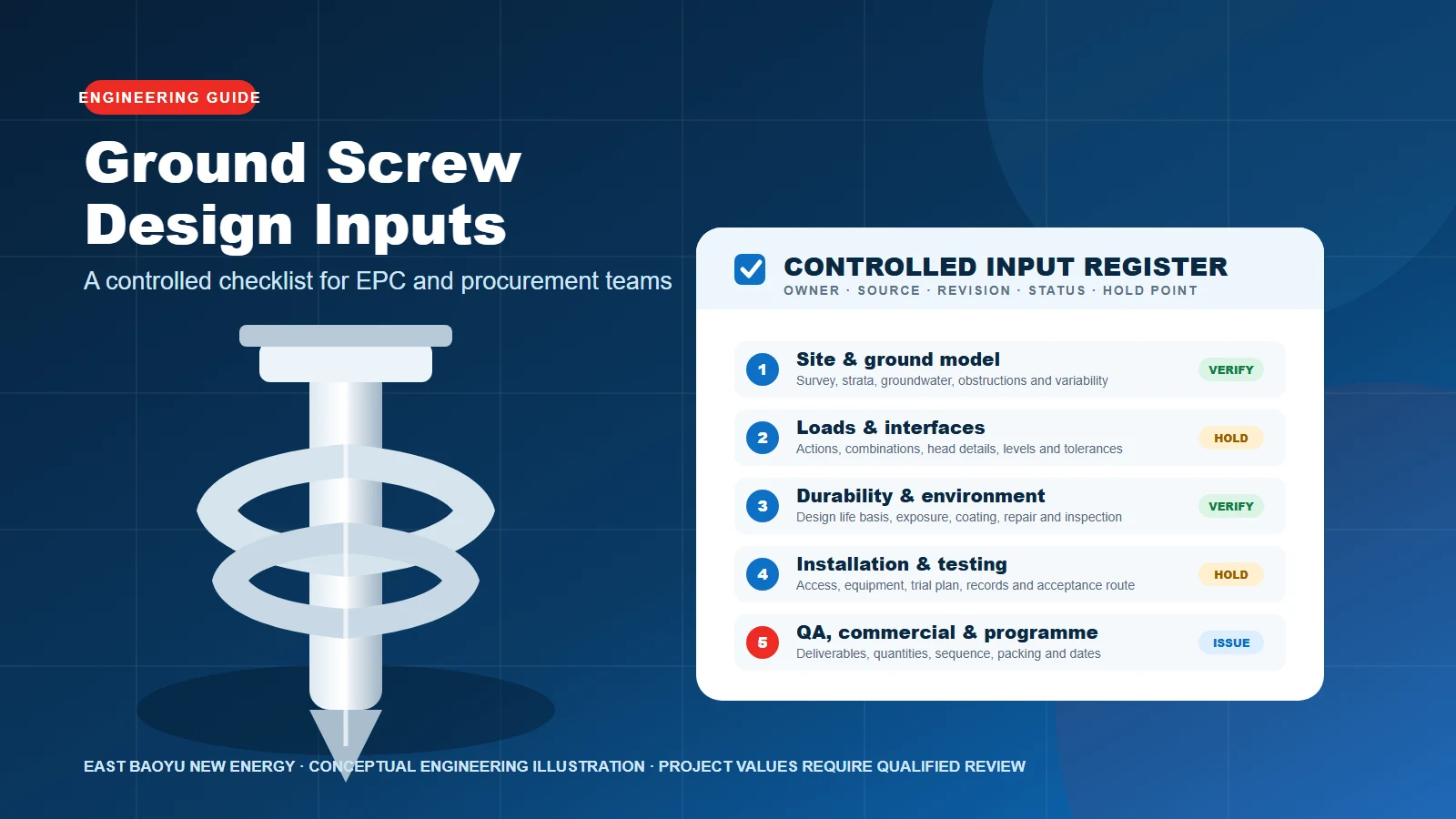
Read the Editorial PolicyShort answer: a usable ground screw design input package is not a folder of drawings. It is a controlled register that identifies each project input, its source and revision, the responsible owner, its approval status, the decision it supports and any hold point created when it is missing. Before quotation or engineering review, the package should cover the project basis, site and ground model, foundation actions and interfaces, durability, installation constraints, test and acceptance requirements, QA deliverables, quantities and programme. Preliminary assumptions may support screening, but they must never be mistaken for released design data.
This checklist is written for EPC teams, civil and geotechnical engineers, procurement managers and contractors preparing a ground screw enquiry. It is deliberately different from choosing a product from a soil report. The site-investigation selection route explains how ground conditions influence a preliminary foundation concept; this article explains how to control the entire multidisciplinary input package before that concept is quoted, designed, tested or released.
What makes a ground screw input package design-ready?
A design-ready package closes five questions. What is being supported? What ground and environmental conditions apply at each foundation zone? Which load cases and movement limits reach each head connection? Can the proposed component be manufactured and installed within the site constraints? How will the project verify and accept both the design basis and the installed work?
The important word is controlled. The package should not mix an early layout with final reactions, a preliminary ground summary with later borehole logs, or a coating note with an undefined design-life assumption. The FHWA Geotechnical Site Characterization guide treats investigation, interpretation and the development of design parameters as connected activities. For an EPC package, that connection must be visible through revision, ownership and decision status.
| Input group | Minimum information to identify | Primary project owner | Decision or output controlled |
|---|---|---|---|
| Project basis | Project location, supported asset, design responsibility, governing documents, issue purpose, design life basis, language and units | Owner / EPC | Scope boundary, assumptions register and submission route |
| Survey and site | Coordinates, grid, levels, contours, drainage, access, utilities, overhead constraints, working platform and exclusion areas | EPC / survey | Layout, pile head elevations, installation access and logistics |
| Ground model | Investigation locations, soil and rock profile, groundwater, obstructions, fill, variability, aggressive ground indicators and geotechnical recommendations | Geotechnical designer | Foundation zones, preliminary geometry, installation risk and verification plan |
| Loads and interfaces | Compression, uplift, shear, lateral load, moment, combinations, load application height, head detail, connection stiffness, tolerances and movement limits | Structural designer | Load path, structural and geotechnical checks, connection and test requirements |
| Durability | Exposure, design life basis, soil or water test data, material interfaces, coating system, repair, inspection and maintenance assumptions | Owner / durability designer | Material and protection specification plus inspection records |
| Installation | Equipment limits, access and working space, utilities, slope, weather, predrilling policy, installation monitoring, stoppage rules and field modification controls | Installer with designer review | Method statement, trial route, production controls and exception process |
| Testing and acceptance | Test objectives, load directions, locations, sample basis, procedures, instrumentation, stages, records, acceptance source and approving party | Responsible designer / EPC | Test plan, inspection points, release and disposition |
| QA and deliverables | Approved drawings, pile schedule, material traceability, welding and coating records where applicable, ITP, installation logs, tests, NCRs and as-builts | EPC quality with supplier | Manufacturing release, site acceptance and handover dossier |
| Commercial and programme | Quantities, zones, options, delivery location, Incoterm, sequence, packing, target dates, approvals and required spares | Procurement / project controls | Comparable quotation, production plan and shipment strategy |
The table is a minimum control structure, not a universal specification. A solar tracker, modular building, carport or temporary structure can need different action combinations, tolerances, interfaces and verification. The project team should add rows when a decision cannot be traced to an existing input.
Separate preliminary inputs from release hold points
Procurement often needs a budget or feasibility response before every design input is final. That can be managed safely if each assumption is labelled and linked to a decision limit. “Preliminary” should mean usable only for the stated screening purpose, not “probably final.”
| Information status | Permitted use | Required control | Do not use it for |
|---|---|---|---|
| Confirmed | The purpose stated in the approved document | Record source, revision, approver and effective date | A different location, load case or design stage without review |
| Preliminary | Feasibility, option comparison or budget range | State the assumption, sensitivity, owner and expiry or confirmation date | Fabrication, installation or final acceptance |
| Missing but non-critical | Continue only where the affected decision is isolated | Open-item number, responsible party and due date | Silently filling the gap from another project |
| Critical hold point | No affected design or release activity | Define exactly what evidence closes the hold point and who approves it | Quotation language that appears to guarantee an unresolved result |
| Conflicting | No use until the controlling source is identified | Technical query, impact assessment and superseded-document control | Selecting the most convenient value |
Typical hold points include unapproved foundation reactions, an undefined load application height, a ground model that does not cover the foundation footprint, missing utility clearance, no stated movement criterion, no approved test objective or a durability requirement that is disconnected from exposure data. Whether a specific item is critical remains a project decision.
Define the responsibilities before requesting a quotation
A supplier can review manufacturability, installation equipment, available component configurations, quality records and logistics. That does not automatically transfer the owner’s, geotechnical designer’s or structural designer’s responsibilities. The quotation should state who supplies each input and who approves the resulting design, method and test plan.
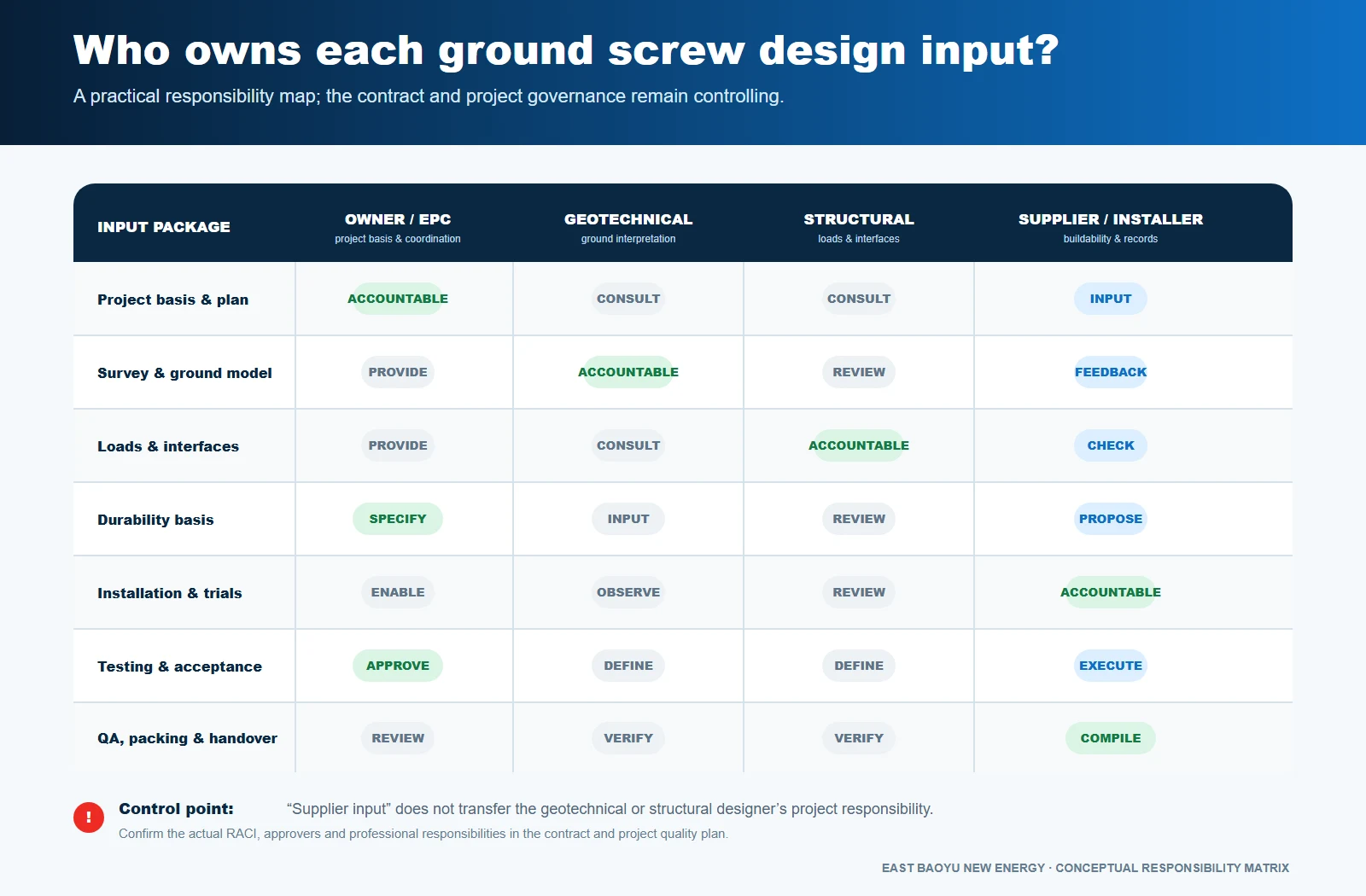
A practical responsibility statement can be short: the EPC issues the controlled project basis and coordinates approvals; the geotechnical designer owns the interpreted ground model and geotechnical criteria; the structural designer owns actions, load combinations, movement limits and the connection load path; the supplier or installer proposes a product and execution route within those inputs and returns defined records. The named approving professional releases any project-specific acceptance criteria.
Eight steps to build the controlled input register
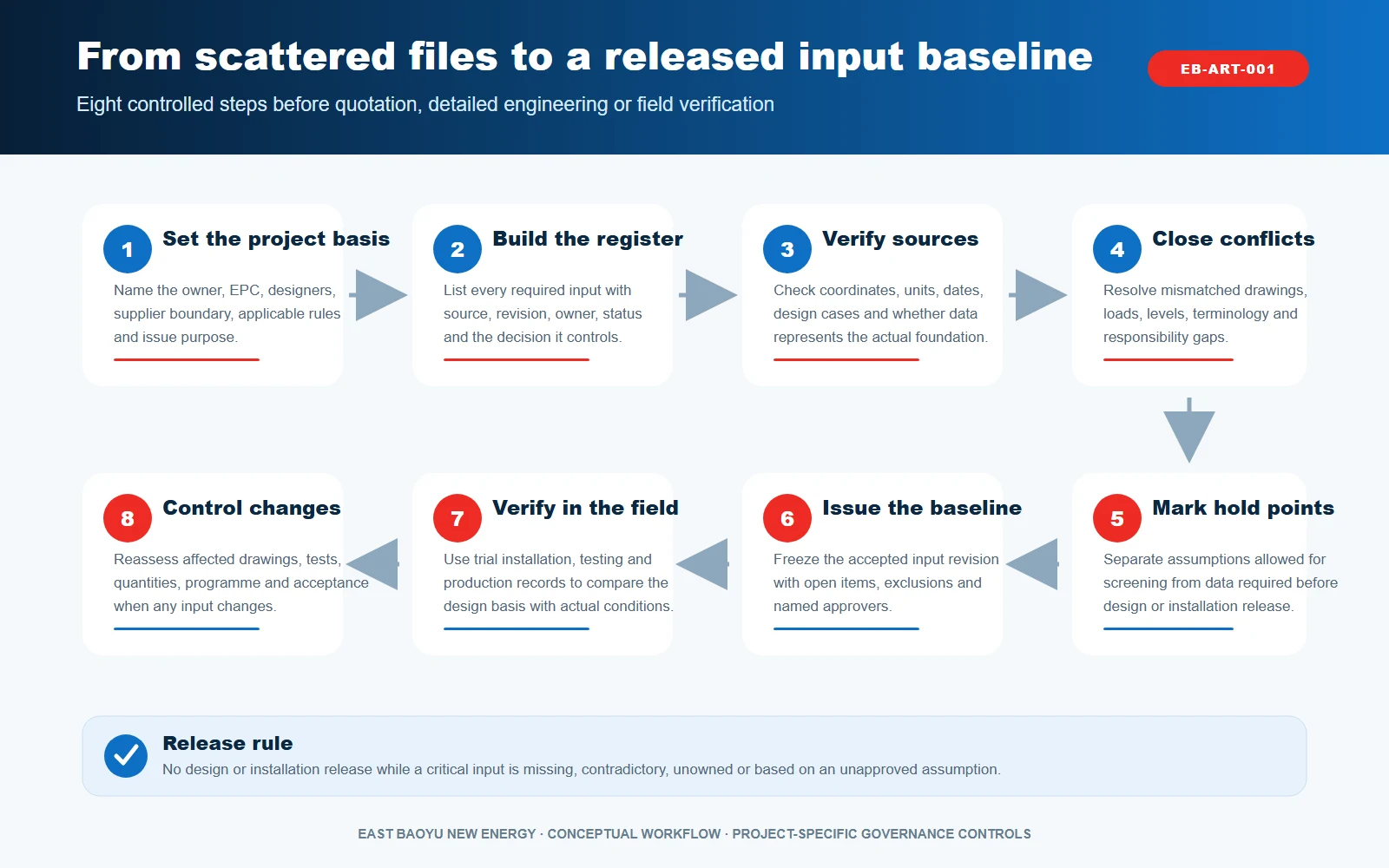
- Set the issue purpose. Mark the package “budget screening,” “technical quotation,” “design development,” “construction release” or another approved status. The same file can be adequate for one purpose and inadequate for another.
- Create one input register. Give every required item an ID, description, document reference, revision, owner, status, due date, decision affected and comment. Link rather than duplicate controlled documents.
- Verify source and scope. Confirm project coordinates, units, datum, foundation zones, drawing revision, load definition and the area represented by ground data. A valid report can still be irrelevant to a particular pile location.
- Check multidisciplinary interfaces. Compare the pile grid with the structural model, finished levels, drainage, utilities, module or building layout, access routes and connection details. Record mismatches as technical queries.
- Mark assumptions and hold points. State which preliminary values can support screening and which missing items stop design, manufacture, trial installation, production or acceptance.
- Issue a baseline. Freeze the agreed input revision together with exclusions, open items and named approvers. The quotation or design submission should reference that baseline, not an uncontrolled email trail.
- Verify against the field. Trial installation, calibrated installation records and project-defined load tests should compare actual conditions with the design basis. The installation torque and capacity guide explains why a torque record alone is not a universal capacity certificate.
- Control every change. If loads, layout, ground interpretation, equipment, geometry, coating, test criteria, quantity or programme changes, assess the affected drawings, calculations, method, records and delivery plan before release.
Ground and site information: what procurement should request
Send the complete geotechnical report and its appendices where available, not only a soil name copied into an RFQ. The useful package normally identifies investigation locations and levels, field and laboratory methods, logs, interpreted strata, groundwater observations, fill and obstructions, spatial variability, construction constraints and the recommendations that apply to the proposed foundation type. The FHWA guide is a useful public reference for the relationship between exploration, measurement interpretation and geotechnical design parameters.
Also provide survey and access information: coordinate system and datum, ground and target head levels, slope, drainage, buried and overhead services, working platform, equipment access, environmental restrictions and seasonal limitations. A theoretically suitable component is not a buildable solution if the installation rig cannot reach the grid, stand safely or operate within clearance constraints.
Do not conceal uncertainty by averaging the site. Divide the foundation footprint into evidence-based zones when ground, loading, level or installation conditions differ. Each zone should link to its supporting data, preliminary component concept and field verification route.
Loads and interfaces: issue more than a single vertical reaction
Ground screw input packages should identify all relevant action effects and their basis: compression, uplift or tension, shear, lateral load, moment, load combinations, duration or cyclic nature where relevant, load application height and whether values are characteristic, factored, allowable or otherwise defined by the governing design method. The structural designer should also state serviceability limits such as settlement, uplift movement, lateral deflection, rotation and differential movement where these control the supported asset.
Show the physical interface. Include the head, flange, bracket or pile-cap geometry; bolt and weld assumptions; elevation and adjustment range; tolerances; load eccentricity; member stiffness; drainage and material interfaces. The load path can be governed by the soil, shaft, helix, coupling, head, connection or supported structure. The ICC‑ES AC358 acceptance criteria is a useful public reference for understanding that helical systems are evaluated as connected structural and soil-supported elements, not by one catalogue number.
Durability inputs: connect exposure, protection and inspection
A phrase such as “hot-dip galvanized” is not a complete durability basis. State the required design life basis, ground and atmospheric exposure, available soil or water chemistry, moisture and groundwater conditions, material combinations, coating standard, coating inspection, handling damage, approved repair route and any inspection or maintenance assumptions.
ISO 1461:2022 specifies general properties and test methods for hot-dip galvanized coatings on fabricated iron and steel articles within its stated scope. ISO 14713‑1:2017 provides general guidance on zinc coatings, design considerations and environments. Neither reference is a project-specific life guarantee. The responsible durability review must connect the selected standard, product detail, coating route, environment, damage and maintenance assumptions.
Installation, testing and acceptance inputs
The installation package should define the proposed equipment and its limits, torque measurement and calibration route, pile identification, depth and verticality records, start and finish levels, time and operator, interruptions, obstructions, early refusal, low response, predrilling policy, damage, field modifications and the approval route for deviations. Any correlation between installation response and geotechnical resistance requires a project-specific basis and engineering review.
The test plan should begin with an objective, not a copied percentage. Is the project validating a preliminary design assumption, establishing a site-specific relationship, proving production workmanship, checking service movement or investigating an exception? Then define representative locations and zones, test direction, reaction and reference system, instrumentation, load sequence, hold and reading requirements, reporting and the acceptance authority.
ASTM’s official D18.11 deep-foundations standards list distinguishes static axial compression, axial tensile and lateral load test methods. The applicable edition, modifications, acceptance criteria and relationship to the project specification must be confirmed by the responsible designer. Do not combine three load directions into an undefined instruction such as “perform a pile test.”
QA, manufacturing and handover deliverables
Agree the records before production or installation. A buyer-ready deliverable schedule can include approved product and shop drawings, a pile schedule, material certificates linked to the supplied items, welding procedures and qualifications where welded details require them, dimensional inspection, coating records, ITP status, equipment calibration or verification records, installation logs, test reports, approved deviations, NCR closure, as-built positions and final release.
Use the Product Data Center to review the controlled public product-family records that are available, and the Ground Screw Project Input Datasheet as a starting intake form. The applicable quotation and contract identify the manufacturing, selling, exporting and warranty entities for the order.
Example input status register
| ID | Input | Source / revision | Owner | Status | Decision affected | Next action |
|---|---|---|---|---|---|---|
| GS-001 | Foundation grid and target head levels | Layout drawing Rev P02 | EPC civil | Preliminary | Quantity, access and length range | Issue surveyed construction grid |
| GS-002 | Compression, uplift, lateral and moment reactions | Structural model issue S03 | Structural designer | Critical hold | Component and connection design | Issue approved reaction schedule with combinations |
| GS-003 | Ground model for Zone B | GI report G01; two locations outside zone | Geotechnical designer | Gap | Preliminary geometry and test locations | Confirm investigation or justified interpolation plan |
| GS-004 | Coating and repair specification | Project specification Rev 0 | Owner / EPC | Confirmed | Manufacturing and inspection plan | Supplier to submit compliant procedure and ITP |
| GS-005 | Trial and proof-test acceptance route | Not issued | Geotechnical + structural designers | Critical hold | Field verification and production release | Define objectives, methods, zones, records and approver |
This example contains no project design values. Its purpose is to show the level of traceability required: an input status must be linked to a decision and a named action, not merely coloured red or green.
Common failure modes in EPC and procurement packages
- Using a general soil description as a ground model. “Clay” or “sand” does not define spatial variation, groundwater, density or strength, obstructions or the design parameters and limitations relevant to the foundation.
- Issuing only a maximum vertical load. This hides uplift, lateral action, moment, eccentricity, combinations, movement criteria and interface effects.
- Requesting a capacity from a product code. A component geometry does not establish project capacity without the site, load path, structural checks, installation basis and verification.
- Copying torque or test criteria from another project. Installation response, correlation, test objectives and acceptance are conditional and must be approved for the actual ground, system and specification.
- Leaving responsibility implicit. When nobody owns the ground model, reactions, durability basis or acceptance plan, the gap normally appears later as a quotation exclusion, variation or site delay.
- Mixing revisions. A final layout with preliminary reactions or a new grid with an old ground interpretation creates a false appearance of completeness.
- Delaying QA requirements until shipment. Material traceability, welding, coating, inspection and installation records may be impossible to reconstruct legitimately after the controlled stage has passed.
- Treating commercial data as separate from engineering. Quantity zones, delivery sequence, package size and programme can change drawing release, production, test timing, packing and installation access.
Issue this package when requesting an engineering review
For an efficient review, submit one controlled package containing:
- project location, application, design stage and responsibility matrix;
- current layout, survey, levels and access or utility constraints;
- complete available geotechnical documents and an interpreted zoning plan;
- foundation reactions, combinations, application heights, movement limits and head interfaces;
- durability, material, coating, repair and inspection requirements;
- installation method constraints, trial objectives, test and acceptance framework;
- quality and handover document schedule;
- quantity by zone, target dates, delivery location, sequence and packing requirements; and
- an assumptions and open-items register showing which decisions are permitted at the current stage.
East Baoyu can then review the ground screw product family, manufacturability, proposed documentation and delivery route against the stated package. The response should record assumptions, exclusions and required confirmations; it should not replace the project geotechnical or structural design.
Questions? Chat with East Baoyu on WhatsApp
Chat with the East Baoyu team about capacity, pricing, configuration and available product videos.
Chat Now
Turn your project files into a controlled input package
Send the location, layout, ground data, reactions, interface, durability requirement, quantity and programme. East Baoyu will identify the available product and supply inputs, the open items and the next project-specific review step.
Frequently asked questions
Can East Baoyu quote before the geotechnical report is complete?
A preliminary commercial or feasibility response may be possible if the available information, assumptions and exclusions are clearly defined. It must not be treated as a released foundation design, guaranteed capacity or final installation basis. The missing ground information should remain a named hold point.
Is installation torque a required design input?
The planned monitoring method, equipment and any approved project-specific relationship may form part of the installation and verification plan. A target value should not be copied from another project or used without the ground, system, calibration, testing and responsible engineering basis required by the actual specification.
Who should define ground screw load-test acceptance criteria?
The project’s responsible geotechnical and structural professionals should define or approve the objective, method, load direction, stages, movement criteria, records and release decision under the applicable project documents. The supplier or installer can provide execution and system information but should not invent the project acceptance basis.
What is the minimum information for a first technical review?
Provide the project location and application, layout and levels, available ground data, reactions and interfaces, durability requirement, installation constraints, quantity and programme. Mark every preliminary or missing item. The review can then return a gap register instead of hiding uncertainty.
Should procurement compare ground screw offers by price per piece?
No. Compare the stated input baseline, design and supply scope, exclusions, geometry and interfaces, durability, test and installation responsibilities, quality records, quantity and delivery sequence. A lower component price is not comparable if required engineering, verification, records or logistics are excluded.
References, disclosure and change record
References and further verification
- FHWA GEC 5: Geotechnical Site Characterization
- ICC-ES AC358: Acceptance Criteria for Helical Pile Systems and Devices
- ASTM D18.11: Deep Foundations Standards
- ISO 1461:2022 — Hot dip galvanized coatings
- ISO 14713-1:2017 — Zinc coatings, design and corrosion resistance
Disclosure: East Baoyu manufactures and supplies products discussed on this website. Structured drafting tools may assist research and editing, but technical claims, project inputs and release decisions require qualified review under the applicable project responsibilities.
Version 1.0: Initial publication with a minimum-input table, preliminary-versus-hold-point rules, an eight-step workflow, responsibility matrix, example register, failure analysis and buyer issue checklist.
View the public Content Change Log · Corrections: info@baolaipipes.com