


Authorship, review and evidence boundary
- Technical review
- East Baoyu Engineering Editorial Team
- Reviewed
- 2026-07-29
- Scope
- General engineering and procurement guidance. This article is not a project-specific design, capacity statement, certificate, warranty, code interpretation or contract requirement.
Evidence basis: Official and public references identified in the article, together with original editorial diagrams. Project values and release decisions require qualified review under the applicable project responsibilities.
Read the Editorial PolicyA solar project wind speed conversion is safe only when it changes units and leaves the engineering definition untouched. For example, 32.0 m/s converts exactly to 115.2 km/h; that arithmetic does not tell the designer whether the source is a three-second gust, a ten-minute mean, a weather-station observation or a code-map value. It also does not preserve the reference height, terrain or exposure, return period, risk category, storm climate, location or adopted standard unless those items are recorded separately.
The practical control is a Wind Input Passport: code and edition; statistical definition; reference height and terrain/exposure; return-period or reliability basis; and units, source and location. Complete that passport before conversion. Then classify the task as either an exact dimensional change or an engineering-definition change. The first can be calculated and logged. The second must follow the adopted standard and the project's responsible engineering route. Unit conversion is not definition conversion. This guide controls the handoff; it does not calculate a design wind speed, pressure, member force, foundation reaction or structural adequacy.
1. Why the number alone is not a design input
A spreadsheet cell labelled “wind speed = 32 m/s” is a value, not yet a controlled structural input. The same number can describe different statistics, measurement periods and reference conditions. Those definitions affect how the governing method develops velocity pressure, aerodynamic actions and combinations. If an EPC team sends only the number, every downstream party may preserve the digits while assuming a different basis. The resulting drawings can look coordinated even though the input chain is not.
2. Build the five-label Wind Input Passport
The passport makes the value traceable before anyone changes format. It travels with the quotation basis, design-input register, calculation issue, tracker or mounting interface, drawing transmittal and change notice. A field may be marked “unknown,” but it may not be silently completed by assumption. Unknown labels create a hold point; they are not a reason to select a conservative-looking number without the governing method.
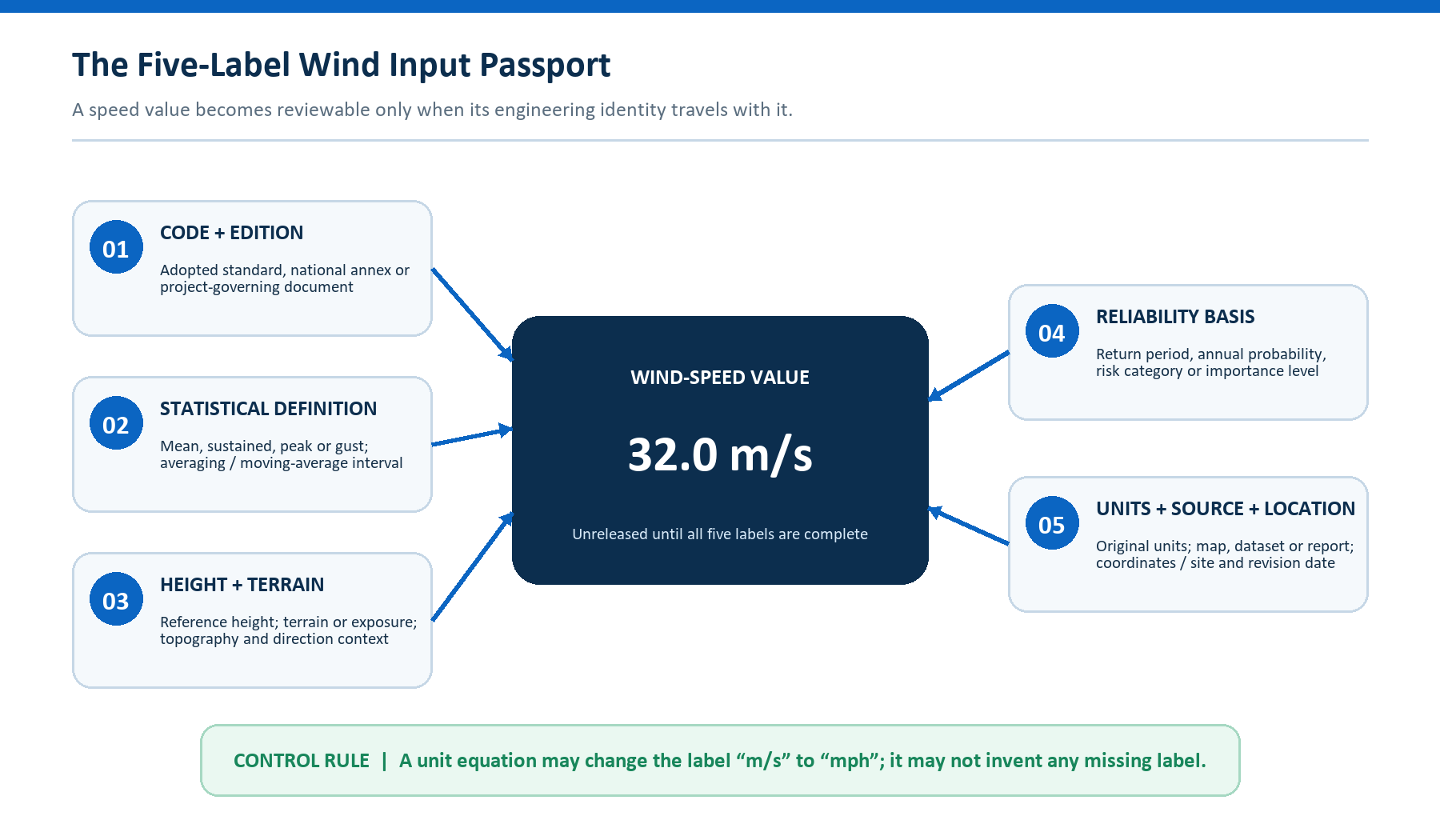
| Passport label | Record before release | Typical failure prevented |
|---|---|---|
| Code + edition | Adopted standard, national annex and project additions | Mixing values from different code routes |
| Statistical definition | Mean, sustained, peak or gust and stated interval | Treating unlike wind statistics as equal |
| Height + terrain | Reference height, exposure/terrain and topography context | Applying a value at the wrong reference condition |
| Reliability basis | Return period, probability, risk category or importance level | Changing reliability while keeping the same units |
| Units + source + location | Original value, units, map/dataset/report, site and revision | Losing provenance or using the wrong location |
3. Separate unit conversion from definition conversion
Dimensional conversion changes only the unit label: metres per second to kilometres per hour, miles per hour or knots. Definition conversion changes what the value represents: gust duration, averaging period, height, terrain/exposure, directionality, return period, risk category, storm type or code methodology. That second operation is not an extension of the first. A complete input log should therefore have separate fields for original value, exact unit factor, rounded result and any engineering transformation approved under the adopted code.
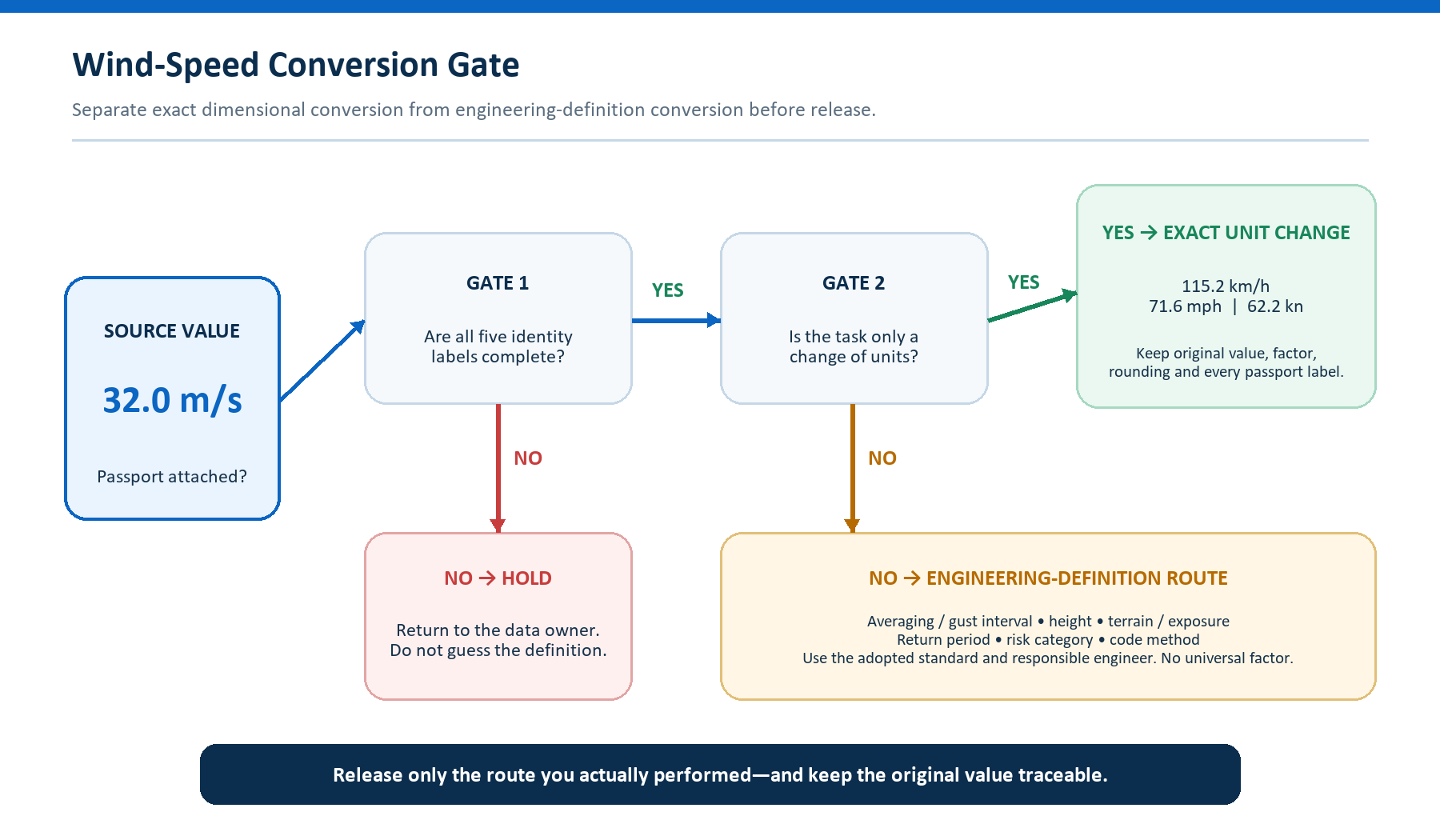
4. Perform exact unit changes and record rounding
Use one direction of conversion, retain the unrounded calculation and round only the reported output. The US National Weather Service publishes conversion tools and formulae for these dimensional changes. The factors below are suitable for changing notation; they do not make two code definitions equivalent.
| Original unit | Target unit | Multiply by | 32.0 m/s example |
|---|---|---|---|
| m/s | km/h | 3.6 | 115.2 km/h |
| m/s | mph | 2.236936 | 71.6 mph (rounded) |
| m/s | knots | 1.943844 | 62.2 kn (rounded) |
| mph | m/s | 0.44704 | Use original mph value × 0.44704 |
A defensible conversion record reads: “32.0 m/s, source value unchanged; converted on 28 July 2026 using 2.236936 mph per m/s; unrounded result 71.581952 mph; reported as 71.6 mph to one decimal place.” It also retains the complete passport, workbook revision and author or system. If the source precision is unclear, do not add false significant figures. Store the original alongside every displayed result.
5. Do not use a universal gust-duration factor
Gust and mean values depend on the statistical model, observation method, storm climate, roughness, height and source data. ASCE's public Hazard Tool describes ASCE 7 wind output as a three-second gust at 33 ft (10 m) above ground for Exposure Category C. WMO's OSCAR describes a wind gust for its observing context as a maximum three-second running average. Those phrases do not authorize a project team to substitute a weather observation for an ASCE design value: the hazard statistics, exposure basis and governing purpose are still different.
Similarly, a ten-minute mean, one-minute sustained wind or instrument peak cannot be translated with a single house factor that is valid for all sites and codes. Record the source definition, then use the conversion route explicitly recognized by the project's adopted standard, licensed references and responsible engineer. If that route is not defined, hold the input.
6. Keep code frameworks separate
A code comparison should map concepts, not force the headline speeds into one universal column. ASCE 7, EN 1991-1-4 and AS/NZS 1170.2 each organize wind hazard, reference conditions, reliability and adjustments through their own framework. ISO 4354:2009 also covers peak- and mean-wind-speed methodologies and different storm types; as of this research date it remains published while a third-edition revision is under development. None of these facts creates a direct conversion factor.
| Framework example | Identity items to preserve | Controlled action |
|---|---|---|
| ASCE 7 / Hazard Tool | Edition, risk category, three-second gust, 10 m, Exposure C and location | Use the selected ASCE edition and hazard output |
| EN 1991-1-4 | National Annex, basic velocity, terrain and route to mean / peak velocity pressure | Use the project's national parameters and full Eurocode chain |
| AS/NZS 1170.2 | Edition, region, probability/importance basis, direction and climate provisions | Use the adopted Australian/New Zealand application route |
| ISO 4354 | Edition, peak or mean methodology and storm type | Use only when adopted and within its stated scope |
Consult the official ASCE Hazard Tool guidance, Eurocode 1 wind-actions overview, Standards Australia wind-actions update and ISO 4354 status page for scope and current status, then use the licensed adopted text and project-specific authority for design.
7. Reliability is part of the value
A return period, annual probability of exceedance, risk category or importance level is not a footnote that may be added later. It determines which hazard level the project is using. ASCE's current Hazard Tool documentation, for example, requires a risk category and reports wind outputs for multiple mean recurrence intervals. Australia's NCC links design events to importance level and annual probability before applying AS/NZS 1170.2. Never move between those reliability levels with a generic multiplier copied from another project. Preserve the original basis and route any change through the governing provisions.
8. Preserve height, terrain, topography and direction
Reference height and terrain/exposure describe the condition to which the speed belongs. They are not the same as the final panel height or the local row geometry. The design method may then apply height-dependent exposure, topographic, directionality and other factors. Moving a number from one height or terrain category to another is therefore an engineering calculation, not a units exercise. Record who classified terrain, which directions were considered, how ridges or escarpments were addressed, and whether the source value already includes any adjustment. This prevents a multiplier being applied twice—or omitted because its status was unclear.
9. Small speed discrepancies can amplify downstream effects
Many wind-pressure formulations contain a velocity-squared term. With the same equation and every other factor held unchanged, a 10% increase in speed changes that term by 1.10² = 1.21, or 21%. This is only a sensitivity illustration; it is not a pressure, load or design result. Actual solar mounting actions also depend on air-density treatment, exposure, topography, directionality, dynamic response, array geometry, aerodynamic coefficients, load combinations and the adopted standard. The example explains why rounding, wrong definitions and duplicated factors deserve formal change control.
10. Reconcile maps, observations and project specifications
A nearby weather station, meteorological dataset, lender study, wind-resource report, code map and employer's requirement can all contain legitimate wind values for different purposes. NOAA notes that observation networks vary in sensor height, averaging period, gust period and reporting frequency. Treat every source as a separate record. Do not select the largest number merely because it appears conservative: it may already contain a different statistic or adjustment and can break the governing calculation chain.
| Source | Use it to answer | Do not assume |
|---|---|---|
| Adopted code / hazard tool | Which code-defined hazard input applies at the project location? | That the output already includes all site and structure factors |
| Project specification | Which edition, risk basis and contractual additions govern? | That a copied numeric value has a complete source identity |
| Weather / resource data | What was observed or modelled under the dataset definition? | That observation or energy-yield wind data is a structural design speed |
| Supplier datasheet | Which product configuration or rating is being offered? | That a product rating selects the governing site wind input |
The reconciliation note should list each value, its passport, intended purpose and disposition: governing, supporting context, superseded, not applicable or unresolved. Conflicts go to the project-named engineer or code authority. The released design basis then cites one controlled source path and records why other values were not used.
11. Assign the release roles
The developer or employer defines the project requirements and authority route. The responsible engineer selects and applies the adopted wind framework, resolves conflicts and approves any definition conversion. The EPC team maintains the input register and distributes revisions. The wind consultant or data provider explains the dataset and limits. The mounting or tracker supplier confirms which released inputs were used and returns reactions, configuration limits and open interfaces. Procurement verifies that quotations reference the same passport rather than comparing prices built on different wind assumptions.
| Release gate | Minimum evidence | Status if missing |
|---|---|---|
| Identity gate | All five passport labels and source revision | Hold input |
| Conversion gate | Original, factor, unrounded result, units and rounding rule | Reject converted value |
| Engineering gate | Adopted method, calculation reference and named approval | No definition change |
| Supplier gate | Configuration, input revision and design/output traceability | No production release |
Change control after release
Once a passport has been released, any change to its value or identity needs a new revision. The change notice should show the previous and proposed values, both passports, the reason for change, affected calculations and deliverables, review authority, effective date and required downstream response. Reissuing only the converted number is not enough. The EPC team should identify which quotations, structural models, tracker settings, drawings, bills of material, foundation reactions and construction packages used the superseded revision. Suppliers should confirm the last accepted input revision in their return documents rather than relying on an email subject line or file timestamp.
For auditability, close the loop with one of three dispositions: no technical effect, recalculation and reissue required, or unresolved pending responsible-engineer review. Keep the original record even when the new value is larger. A higher number is not automatically conservative if it belongs to a different code route or causes inconsistent factors elsewhere. Controlled revision is therefore part of the engineering definition, not an administrative afterthought.
12. Use explicit rejection conditions
Only a speed and unit are provided; the statistical definition or source is missing.
The value was copied from a weather app, station, tender or previous project without a passport.
A gust, mean, height, terrain, return-period or code change is described as a unit conversion.
The converted value cannot be traced to the original precision, factor and rounding rule.
Two calculations use different code editions, risk categories or input revisions.
A module, tracker or mounting rating is presented as proof of the governing site wind input.
13. Keep module and mounting evidence in the correct role

IEC 61215 is a PV-module design-qualification framework, while IEC 61730 addresses module construction and safety testing; IEC also points to additional national or local installation requirements. A module mechanical-load qualification, tracker operating limit or supplier capacity statement can be important product evidence, but it does not select the governing wind hazard or prove the full array, connections, foundations and control strategy adequate. Link product evidence to the released project input and keep every claim within the configuration actually assessed.
14. What to send East Baoyu
For a supplier-side engineering review, send the project location and coordinates; jurisdiction, adopted code, edition and national annex; risk or importance basis; original wind-speed source and full passport; exact unit-conversion log; terrain/exposure and topographic assessment; array type, module dimensions and layout; tracker operating or stow requirements where applicable; geotechnical and topographic inputs; design stage; required deliverables; and the project-named approval authority. Mark unresolved items.
Start with East Baoyu's Solar Mounting and Solar Mounting Design Input Checklist pages. East Baoyu can organize available product configuration, drawing, manufacturing and interface information against the released inputs. The project's responsible engineer and adopted-code authority retain responsibility for the governing wind speed, transformations, structural design and approval.
Request an engineering review
Send the Wind Input Passport, array configuration, project specification and open interfaces. East Baoyu will identify which supplier-side inputs are available and which questions must return to the EPC team or responsible engineer before quotation, design or manufacturing release.

Questions? Chat with East Baoyu on WhatsApp. Fast reply on capacity, price, configuration and available product videos.
Open WhatsApp: +86 130 1228 3281
| Contact | Official detail |
|---|---|
| info@eastbaoyu.com | |
| Phone | +86 22 28352066 |
| +86 130 1228 3281 | |
| Website | https://eastbaoyu.com/contact/ |
Email the wind-input package: info@eastbaoyu.com
Frequently asked questions
Is 32 m/s always equal to 115.2 km/h for solar design?
It is an exact unit conversion, but it is not automatically the same design input across codes or sources. The code edition, gust or mean definition, reference height and terrain, reliability basis, source and location must remain identical.
Can I convert a ten-minute mean wind speed to a three-second gust with one factor?
Not with a universal factor. The conversion route depends on the adopted standard, statistical model, storm climate, height, roughness and source data. Use the project's governing method and responsible engineering approval.
Can a nearby weather-station maximum be used as the design wind speed?
Not automatically. Confirm the instrument height, terrain, averaging and gust periods, quality control, record length, storm coverage, location and intended use, then compare it through the adopted code route.
Are ASCE, Eurocode and AS/NZS wind speeds directly comparable?
No direct universal factor is appropriate. Each framework has its own hazard, reference conditions, reliability and adjustment procedure. Map the complete definitions and use the code adopted for the project.
Why must the original value be kept after conversion?
It preserves provenance, precision and auditability. Reviewers can reproduce the calculation, detect double conversion or rounding drift, and return to the source when the code basis or project revision changes.
Does a module mechanical-load rating prove the solar mounting structure is adequate?
No. Module qualification and safety testing are different from project-specific wind design of the array, rails, posts, connections, foundations and controls. The released wind input and configuration still require the governing engineering assessment.
Related East Baoyu resources
Solar Mounting | Solar Mounting Design Input Checklist
Solar Tracker Wind Load and Stow Strategy | Fixed vs Tracking PV Structures
Flexible PV Mounting Structure Design | Engineering Articles
Certification & Evidence Center | Product Documents & Buyer Guides
Engineering Research & Methods | Quality & Manufacturing
References and scope notes
Official public sources were checked on 28 July 2026. They are paraphrased for scope, terminology and status; paid clauses, maps, tables and equations are not reproduced. Project teams must verify the adopted edition, national annex and licensed text. ISO 4354:2009 was published and under revision at the research date. This article is an input-control guide, not a design calculation, code-equivalence certificate, wind-tunnel report, tracker stow study, member design, safety plan or approval.
ASCE Hazard Tool – official guidance | ASCE Hazard Tool API documentation
JRC Eurocode 1 – actions on structures | JRC EN 1991-1-4 worked example
ISO 4354:2009 – wind actions on structures | AS/NZS 1170.2:2021 – Standards Australia update
Australian NCC structural provisions | NOAA/NWS meteorological conversions
NOAA marine observations and wind context | WMO OSCAR – wind gust definition
IEC 61215-1-1:2021 – PV module qualification | IEC 61730-2:2023 – PV module safety testing
References, disclosure and change record
References and further verification
- https://www.asce.org/publications-and-news/asce-hazard-tool/about/
- https://eurocodes.jrc.ec.europa.eu/EN-Eurocodes/eurocode-1-actions-structures
- https://www.standards.org.au/news/update-to-the-go-to-combined-wind-actions-standard
- https://www.iso.org/standard/38882.html
- https://eastbaoyu.com/solar-mounting/
- https://eastbaoyu.com/solar-mounting-design-input-checklist-epc-procurement/
- https://wa.me/8613012283281
- https://wa.me/8613012283281?text=Hello%20East%20Baoyu%2C%20I%20would%20like%20an%20engineering%20review%20of%20solar%20project%20wind-speed%20inputs.
- https://eastbaoyu.com/solar-tracker-wind-load-and-stow-strategy/
- https://eastbaoyu.com/fixed-versus-tracking-pv-energy-comparison/
- https://eastbaoyu.com/flexible-pv-mounting-span-pretension-dynamics/
- https://eastbaoyu.com/articles/
- https://eastbaoyu.com/evidence-center/
- https://eastbaoyu.com/downloads/
- https://eastbaoyu.com/research-methods/
- https://eastbaoyu.com/quality/
- https://eastbaoyu.com/projects/
- https://eastbaoyu.com/contact/
- https://www.asce.org/-/media/asce-images-and-files/publications-and-news/hazard-tool/hazard-tool-api-documentation.pdf
- https://eurocodes.jrc.ec.europa.eu/sites/default/files/2022-06/SX016a-EN-EU.pdf
- https://ncc.abcb.gov.au/editions/ncc-2022/adopted/housing-provisions/2-structure/part-22-structural-provisions
- https://www.weather.gov/ama/conversions
- https://marinenavigation.noaa.gov/observations.html
- https://space.oscar.wmo.int/variables/view/wind_gust
Disclosure: East Baoyu manufactures and supplies products discussed on this website. Structured drafting tools may assist research and editing, but technical claims, project inputs and release decisions require qualified review under the applicable project responsibilities.
Version 1.0: Initial scheduled publication in the East Baoyu engineering knowledge-base batch.
View the public Content Change Log · Corrections: info@baolaipipes.com