


Authorship, review and evidence boundary
- Technical review
- East Baoyu Engineering Editorial Team
- Reviewed
- 2026-07-29
- Scope
- General engineering and procurement guidance. This article is not a project-specific design, capacity statement, certificate, warranty, code interpretation or contract requirement.
Evidence basis: Official and public references identified in the article, together with original editorial diagrams. Project values and release decisions require qualified review under the applicable project responsibilities.
Read the Editorial PolicyA procurement team may receive a steel offer whose minimum yield strength looks close to the project specification. A commercial cross-reference may then label the proposed grade as an equivalent. That comparison is useful for starting a review, but it is not a release decision. The two standards may apply to different product forms, thickness ranges, test orientations, dimensional tolerances, chemistry limits, toughness qualities or delivery conditions. A grade that is acceptable for one plate thickness and welded detail may be unacceptable for a different section, temperature, fatigue category or execution route.
This guide turns steel grade equivalence into a controlled engineering question. It shows how to define one proposed substitution, compare the specified requirements on the same basis, evaluate fabrication consequences, close evidence and obtain a decision from the authority named by the contract. It is not a conversion chart and does not declare any pair of international grades interchangeable. The contract, jurisdiction, adopted design and welding codes, project specification and selected standard editions remain controlling.
1. Define one proposed substitution before comparison
Begin with a substitution request, not a generic question such as “Is Grade X equal to Grade Y?” Name the specified material and the proposed material exactly. Record each standard designation and edition, product form, nominal dimensions, thickness range, grade or quality suffix, delivery condition, quantity, intended member or component, design use, service environment and required decision date. If the proposed material will serve several products or thicknesses, split the request into separate comparison lines.
The decision stage also matters. A preliminary sourcing screen can identify promising options, but it cannot authorize purchasing or fabrication. A purchase-stage review needs the actual mill or supplier route and evidence that can be tied to the proposed supply. A fabrication-stage deviation needs downstream impact checks, material segregation and a documented disposition. Define the requested status so a spreadsheet marked “similar” is not mistaken for approval.
| Substitution field | Minimum controlled content |
|---|---|
| Specified basis | Standard, edition, designation, grade/quality, product form and delivery condition |
| Proposed supply | Actual standard/edition, mill route, product, size/thickness range, quantity and availability |
| Project use | Member/component IDs, design function, service environment, joints, coating and critical limit states |
| Decision | Screening, conditional procurement, fabrication release or field disposition; named authority and due date |
2. Use the eight-control equivalence route
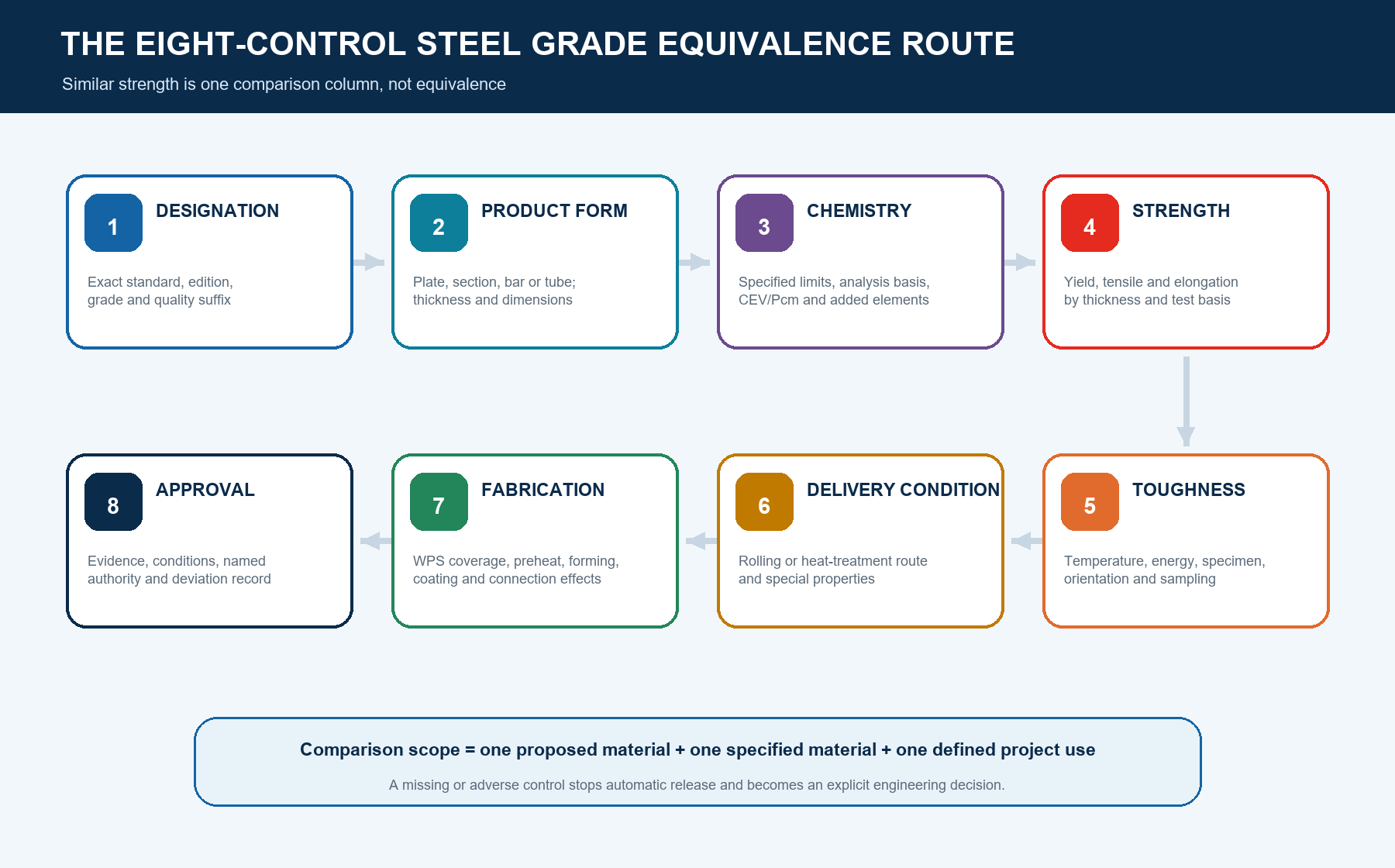
The eight controls create a repeatable route without pretending that unlike standards share one vocabulary. Designation establishes what documents are being compared. Product Form sets the physical and dimensional scope. Chemistry and Strength compare specified property requirements on their own bases. Toughness and Delivery Condition capture behaviour that a yield-strength headline omits. Fabrication checks whether the proposed material changes welding, forming, coating or connection controls. Approval converts the findings into a bounded project decision with an owner and status.
A control can be satisfied, adverse, conditional or unknown. Unknown does not mean equal; it means evidence or engineering work is missing. An adverse difference does not automatically mean rejection either. The named authority may determine that the difference is irrelevant to the defined use, impose a condition, request a calculation or test, or reject the proposal. Similar strength is only one comparison column, not equivalence.
3. Freeze designation, edition and product form
A designation is incomplete without its standard edition and full suffix. Standards are revised, confirmed, amended or withdrawn; project specifications may intentionally retain an earlier edition. Record the edition required by the contract and the edition offered by the supplier. Do not silently compare a current catalog entry with an earlier project basis. Where the order or product standard adds requirements, capture them as separate comparison rows rather than assuming the base grade name includes them.
Then confirm product scope. Plate, wide-flange section, angle, bar, hollow section, pipe and cold-formed product can sit under different product standards even when strength labels look familiar. ISO 630-1 identifies flat and long products, while its specific parts define grade and quality applicability. ASTM A6/A6M provides general requirements for specified rolled structural products and defers conflicts to the applicable product specification. The lesson is practical: compare the offered product as manufactured, not an abstract grade family.
4. Compare dimensions, tolerances and thickness applicability
Product geometry is part of the substitution. Compare the controlling dimensional standard, nominal size series, mass or weight basis, permitted variations, straightness, flatness, squareness, section geometry, edge condition and surface requirements that affect fit-up or design. Inch-pound and SI provisions may be separately standardized rather than exact conversions. Keep one unit system as the governing comparison basis and show any conversion only as a transparent calculation.
Property limits often change by nominal thickness or product group. A proposal therefore needs a thickness-by-thickness check, including the as-ordered thickness and any range created by detailing. Confirm whether a certificate's tested product and thickness represent the proposed supply. If increased plate thickness is proposed, also check self-weight, connection geometry, weld volume, through-thickness behaviour, clearances and downstream drawing revisions rather than treating “more steel” as automatically acceptable.
5. Compare chemistry and weldability evidence
Build a chemistry matrix from the exact product standards and order requirements. Identify whether each limit applies to heat analysis, product analysis or both; note permitted variations; include required alloying, microalloying, deoxidation or grain-refining elements; and flag residual or intentionally added elements relevant to welding, toughness, coating or service. Do not substitute typical mill values for specified maxima or minima.
Carbon equivalent or Pcm can support a weldability review, but the formula, applicable composition range, product thickness, hydrogen control, heat input, restraint, ambient temperature and adopted welding code still matter. AISC's ordering FAQ explains that ASTM A992 and A572 Grade 50 can be similar while differing in chemistry and mechanical-property controls. AWS's 2025 D1.1 update illustrates a broader principle: introducing a base metal can affect grouping, matching electrodes and preheat categories. A familiar strength level does not preserve the welding basis by itself.
6. Compare mechanical properties on the same test basis
Compare specified yield or proof strength, tensile strength, elongation and any required ratios or upper limits. State whether each value is minimum, maximum or range. Map the property to product form, thickness, test-piece location, orientation, gauge length and test method. ISO 377 emphasizes the identification, location and preparation of samples and test pieces; those details can prevent two valid results from being directly comparable.
Use the project design model to assess differences, not a stronger-is-better shortcut. A higher actual or specified yield level can change capacity, stiffness assumptions do not increase with yield strength, and some systems depend on ductility, yield-to-tensile ratio, connection behaviour or hierarchy of resistance. Where the governing code lists approved materials or assigns properties by specification, the responsible engineer must confirm how the proposed material enters that design route.
| Property | Comparison basis | Frequent mistake |
|---|---|---|
| Yield / proof | Definition, min/max, thickness band, product form, orientation and test method | Comparing one headline minimum |
| Tensile | Required range or minimum, specimen basis and relation to yield | Ignoring upper or ratio controls |
| Elongation | Gauge length, specimen geometry, thickness and orientation | Comparing percentages with unlike specimens |
| Design use | Adopted code, limit state, member/joint behaviour and project restrictions | Assuming higher strength resolves every check |
7. Compare toughness and special properties
Impact toughness needs its own matrix. Compare whether testing is mandatory, optional or order-specific; test temperature; required absorbed energy; specimen type and size; orientation; sampling location; thickness applicability; number of specimens; and acceptance basis. ISO/TS 7705 exists specifically to guide Charpy V-notch prescriptions, which shows why a suffix or energy number cannot be interpreted without its test context.
Add other project properties where relevant: through-thickness performance, ultrasonic quality, improved deformation properties, atmospheric corrosion resistance, fatigue or fracture requirements, elevated- or low-temperature use, seismic detailing, fire design, surface condition, lamellar-tearing controls and coating compatibility. These are not standard columns for every project; they are triggered by the specified material, detail, service environment and risk assessment.
8. Check delivery condition and manufacturing route
Record the required and proposed delivery condition exactly. As-rolled, normalized or normalizing rolled, thermomechanically rolled, quenched and tempered, and other routes can produce similar nominal strength through different microstructures and controls. Do not infer the route from the grade number, certificate appearance or a hardness reading. Confirm what the product standard permits, what the order requires and what the manufacturer declares for the actual product.
Manufacturing route can influence heat treatment after fabrication, hot forming, cold forming, flame straightening, galvanizing, welding heat input and repair options. If the project depends on a specific route or special property, make it an order requirement and a traceability field. A conditional approval may restrict temperature, forming radius, heat input or post-fabrication treatment, but the basis and owner of that condition must be documented.
9. Revalidate fabrication and connection interfaces
The proposed grade must pass through the fabrication plan. Check whether the adopted welding code recognizes the base metal and whether existing WPS/PQR coverage, filler classification, preheat/interpass control, heat input, consumable storage and repair procedure remain valid. A material group under ISO 15608 is a grouping tool for welding and related purposes; it is not a declaration that two grades are equivalent or that every procedure is qualified.
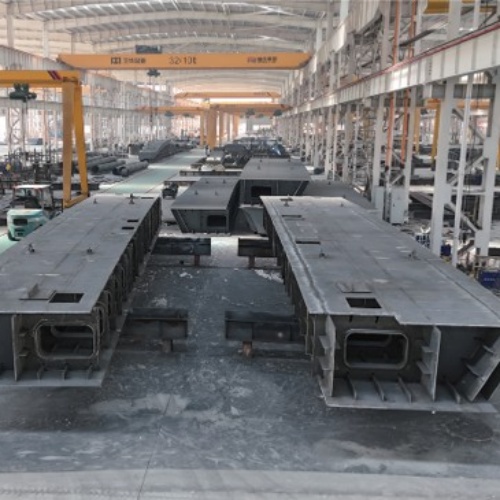
Review cutting, drilling, machining, cold or hot forming, straightening, galvanizing or paint preparation, bolted-joint faying surfaces, weld access and inspection. Check whether drawings, bills of material, nesting, CNC files, weld maps, inspection plans and coating documents use the proposed identity and approved conditions. Supplier engineering can assemble and explain these effects within its scope; the contract-named design and welding authorities decide the acceptability of the project change.
| Fabrication interface | Questions to close before release |
|---|---|
| Welding | Code recognition, WPS/PQR range, grouping, filler, preheat, heat input, repair and inspection |
| Forming / heat | Permitted route, forming temperature/radius, straightening, heat treatment and property retention |
| Surface / coating | Preparation, galvanizing or paint compatibility, repair method and traceability after processing |
| Digital / documents | Drawings, BOM, CNC/nesting, weld maps, ITP, marking and revision references updated |
10. Define evidence, certificates and traceability
An inspection document records declared or tested information according to the order and applicable delivery framework. ISO 10474 defines types of inspection documents, but the document type alone does not establish grade equivalence. Review the content: manufacturer, product, dimensions, heat or lot, actual designation, delivery condition, chemical results, mechanical results, specified tests, signatures or validation route and linkage to the physical material.
Additional evidence should close a named gap. It may include relevant licensed standard extracts, a manufacturer declaration, independent laboratory testing, retesting permitted by the order, WPS/PQR review, design checks, dimensional verification or a controlled sample plan. Portable PMI can help identify alloying elements when properly specified, but it does not establish strength, toughness, delivery condition or full standard compliance. Hardness testing has similar limits. Record what each item proves and what it does not prove.
| Evidence item | Identity link | Question it can answer | Limit to record |
|---|---|---|---|
| Inspection certificate | Mill, product, heat/lot and order | Declared/tested results for the supplied material | Not approval by document type alone |
| Standard comparison | Exact editions and clauses | Specified similarities and differences | Does not prove the actual supply |
| Added test | Sample plan and material identity | Defined missing property or verification | Coverage and acceptance must be approved |
| Engineering disposition | Request, revision, component IDs | Project decision and conditions | Valid only for the stated scope |
11. Convert the comparison into a decision
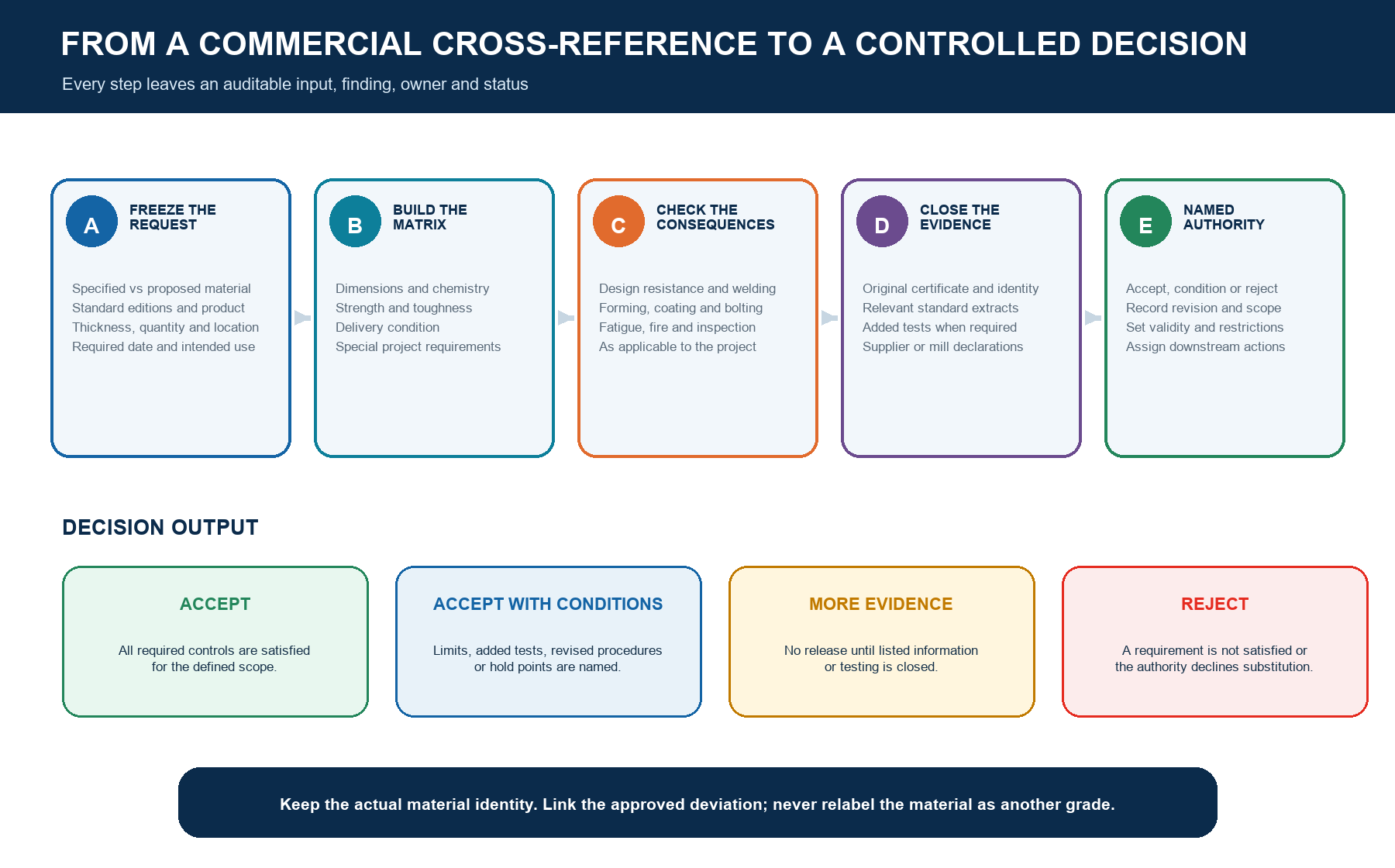
A comparison matrix is an input to a decision, not the decision itself. Route the package to the authority identified by the contract, which may include the engineer of record, owner, designer, welding engineer or another named party depending on the issue. Record one of four outcomes: Accept; Accept with conditions; More evidence required; or Reject. Avoid ambiguous labels such as “technically similar” when they do not authorize a downstream action.
Conditional acceptance should name the exact boundary: product and thickness range, member IDs, quantity or heat, required tests, revised WPS, added hold point, marking rule, design limitation, expiry or revalidation trigger. More-evidence status must block purchase or fabrication when that is the project rule. Rejection should identify the unmet requirement so procurement can search for a different proposal rather than repeatedly resubmitting the same incomplete comparison.
12. Preserve identity and control the deviation
Keep the material's actual designation on certificates, tags, stock records, cutting plans, piece marks and manufacturing records. Link the approved deviation or substitution number to those records; never relabel the material as the requested grade. Where a producer has legitimately multi-certified material, the certificate should show compliance with each listed specification. AISC notes that multi-certification means the material satisfies the requirements of more than one standard, not that a buyer may assign another identity.
Segregate unresolved material from released stock and prevent obsolete decisions from being used. If a heat, product form, thickness, mill route, standard edition or project use changes, reopen the comparison. Update drawings, bills, material registers, weld and inspection documents, coating records and the final manufacturing dossier. The record should let a future reviewer trace the specified requirement, actual supplied material, comparison, conditions, approving authority and affected components without reconstructing the decision.
13. Assemble a concise approval package
A useful approval package is short enough to review but complete enough to audit. Lead with the requested decision and a one-page executive comparison. Attach the full matrix, relevant source extracts or licensed references, actual or proposed supply evidence, technical impact reviews, open-item register and a draft disposition. Highlight differences and unknowns; do not bury them in attachments or color-code them without a text status.
State the requested decision, affected components and required date on the first page.
Show every difference, unknown and condition in text as well as color or symbols.
Link each finding to the exact standard edition, certificate, test or engineering review.
Name the approver, decision status, permitted downstream action and revalidation trigger.
| Package section | Required content |
|---|---|
| Request | Specified vs proposed identity, reason, components, quantity, schedule and decision sought |
| Comparison | Eight controls, exact standard editions, findings, differences, unknowns and source references |
| Consequences | Design, welding, forming, coating, bolting, inspection, drawings and programme impacts |
| Evidence | Certificate/sample identity, declarations, added tests, calculations and closure owner |
| Disposition | Outcome, conditions, approver, date, revision, validity, downstream actions and superseded status |
14. What to send East Baoyu
For a supplier-side technical review, send the current drawings and specifications, exact material clause, governing standard editions, component and thickness schedule, required delivery condition, welding/coating requirements, service environment, quantity, programme and the proposed grade or available mill route. Include any certificate, datasheet or supplier comparison already received, but identify whether it represents stock, a production proposal or a previous project.
| Submission | Minimum content |
|---|---|
| Project basis | Country, jurisdiction, codes/standards, stage, units, design use and requested decision |
| Specified material | Full designation/edition, product, thickness, quality, delivery condition and special requirements |
| Proposed supply | Actual designation/edition, product range, mill/supplier route, quantity, date and evidence status |
| Fabrication | Drawings, joints, WPS basis, forming, coating, inspection, marking and traceability requirements |
| Decision control | Named authority, status labels, due date, open items and permitted procurement/fabrication action |
Review East Baoyu's Steel Structures, Quality & Manufacturing, Certification & Evidence Center and Engineering Articles pages before requesting a project-specific review. East Baoyu can organize available supplier-side drawings, material information, manufacturing implications and evidence within an agreed scope. The project's qualified authorities retain responsibility for design interpretation, material approval, welding qualification and construction release.
Share drawings and specifications
Send the specified clause, proposed material, product/thickness schedule, drawings, standard editions, delivery condition, welding and coating basis, programme and exact review question. East Baoyu will identify the supplier-side information available, visible differences and evidence gaps so the project-named authority can make a controlled decision.

Questions? Chat with East Baoyu on WhatsApp. Fast reply on capacity, price, configuration and available product videos.
Open WhatsApp: +86 130 1228 3281
| Contact | Official detail |
|---|---|
| info@eastbaoyu.com | |
| Phone | +86 22 28352066 |
| +86 130 1228 3281 | |
| Website | https://eastbaoyu.com/contact/ |
Email drawings and specifications: info@eastbaoyu.com
Frequently asked questions
Is S355 the same as ASTM A572 Grade 50 or Q355?
No project decision should be made from those names alone. They come from different standard systems, and applicability can change with edition, product form, thickness, quality suffix, chemistry, strength controls, toughness, delivery condition and special requirements. Compare the exact specified and proposed products, then obtain approval from the authority named by the project.
Is matching yield strength enough to prove steel grade equivalence?
No. Yield strength is one property and may use different definitions, thickness bands or test bases. Tensile range, elongation, yield-to-tensile controls, chemistry, toughness, dimensions, delivery condition, fabrication behaviour and code recognition can also affect the decision.
Can a mill certificate prove that two steel grades are equivalent?
A certificate can provide identity and declared or tested results for the supplied material when properly linked to the product. Its document type or appearance does not approve a substitution. The results must be compared with the exact project requirements, and missing properties or special requirements still need closure.
Does a matching carbon equivalent confirm weldability?
It is useful evidence but not a complete welding decision. Confirm the calculation basis, composition range, thickness, adopted welding code, base-metal grouping, WPS/PQR coverage, hydrogen control, heat input, preheat, restraint, ambient conditions and repair route for the proposed material and joint.
Can PMI or hardness testing identify an equivalent structural steel grade?
Those tools can answer limited questions when used under an approved plan. PMI may identify selected alloying elements, while hardness can support a defined investigation. Neither test by itself proves tensile properties, toughness, delivery condition, product standard compliance or project approval.
Who should approve an international steel material substitution?
The contract should identify the authority. Depending on the project and issue, that may include the engineer of record, owner, designer, welding engineer or another named party. The supplier or fabricator should not assume approval power unless the agreed scope explicitly assigns it.
Related East Baoyu resources
Steel Structures | Steel Fabrication ITP
Project Acceptance and Manufacturing Data Records | Export Packing for Solar and Steel Components
Quality & Manufacturing | Certification & Evidence Center
Product Documents & Buyer Guides | Engineering Research & Methods
Engineering Articles | Projects
About East Baoyu | Contact East Baoyu
References and scope notes
Sources were checked on 28 July 2026. Official public scopes and guidance are paraphrased; paid standard tables and clauses are not reproduced. ASTM A6/A6M-26a and AWS D1.1/D1.1M:2025 were current official listings at the research date. ISO lists ISO 630-1:2021 and ISO 630-2:2021 under review, so users must verify the project-selected edition. This coordination guide is not a material approval, design calculation, welding qualification, inspection certificate, procurement release or construction authorization.
ISO 630-1:2021 – General delivery conditions for hot-rolled structural steel | ISO 630-2:2021 – Structural steels for general purposes
ISO 404:2013 – General technical delivery requirements | ISO 10474:2013 – Inspection documents
ISO 377:2017 – Samples and test pieces for mechanical testing | ISO/TS 7705:2017 – Charpy V-notch prescription guidance
ISO 15608:2025 – Grouping system for metallic materials | ASTM A6/A6M-26a – General requirements for rolled structural steel
ASTM – Active steel standards | AISC Engineering FAQ 1.3 – Ordering steel
ANSI/AISC 303-22 – Code of Standard Practice | AISC – Unlisted Materials, Part 1
AWS – D1.1/D1.1M:2025 release | AWS – 2025 base-metal grouping and preheat update
References, disclosure and change record
References and further verification
- https://eastbaoyu.com/steel-structures/
- https://eastbaoyu.com/quality/
- https://eastbaoyu.com/evidence-center/
- https://eastbaoyu.com/articles/
- https://wa.me/8613012283281
- https://wa.me/8613012283281?text=Hello%20East%20Baoyu%2C%20I%20would%20like%20to%20share%20drawings%20and%20specifications%20for%20a%20steel%20material%20grade%20comparison.
- https://eastbaoyu.com/steel-fabrication-itp-mtc-wps-ndt-coating/
- https://eastbaoyu.com/project-acceptance-and-manufacturing-data-records/
- https://eastbaoyu.com/export-packing-for-solar-and-steel-components/
- https://eastbaoyu.com/downloads/
- https://eastbaoyu.com/research-methods/
- https://eastbaoyu.com/projects/
- https://eastbaoyu.com/about/
- https://eastbaoyu.com/contact/
- https://www.iso.org/standard/73841.html
- https://www.iso.org/standard/73842.html
- https://www.iso.org/standard/56861.html
- https://www.iso.org/standard/53736.html
- https://www.iso.org/standard/72529.html
- https://www.iso.org/fr/standard/65584.html
- https://www.iso.org/standard/88796.html
- https://store.astm.org/a0006_a0006m-26.html
- https://store.astm.org/products-services/standards-and-publications/standards/steel-standards.html
- https://www.aisc.org/aisc/solutions-center/engineering-faqs/13-ordering-steel/
Disclosure: East Baoyu manufactures and supplies products discussed on this website. Structured drafting tools may assist research and editing, but technical claims, project inputs and release decisions require qualified review under the applicable project responsibilities.
Version 1.0: Initial scheduled publication in the East Baoyu engineering knowledge-base batch.
View the public Content Change Log · Corrections: info@baolaipipes.com