


Authorship, review and evidence boundary
- Technical review
- East Baoyu Engineering Editorial Team
- Reviewed
- 2026-07-29
- Scope
- General engineering and procurement guidance. This article is not a project-specific design, capacity statement, certificate, warranty, code interpretation or contract requirement.
Evidence basis: Official and public references identified in the article, together with original editorial diagrams. Project values and release decisions require qualified review under the applicable project responsibilities.
Read the Editorial PolicyA supplier receives an inquiry for several thousand ground screws. The quantity is clear, the requested response date is tomorrow, and a product diameter appears in the email. Yet there is no structural load schedule, no ground-investigation reference, no connection drawing, no design-life basis and no named acceptance authority. A quotation can still display precise prices and dimensions, but its technical basis would remain undefined.
A ground screw project input sheet prevents that false precision. It gives the buyer one controlled place to identify the project, site, loads, interfaces, installation route, durability requirements, testing, evidence and release responsibilities. The purpose is not to transfer the buyer's design duties to a supplier. It is to make the known facts, assumptions and missing decisions visible before a commercial or engineering response is treated as project-specific.
1. Download the form, then choose the release gate
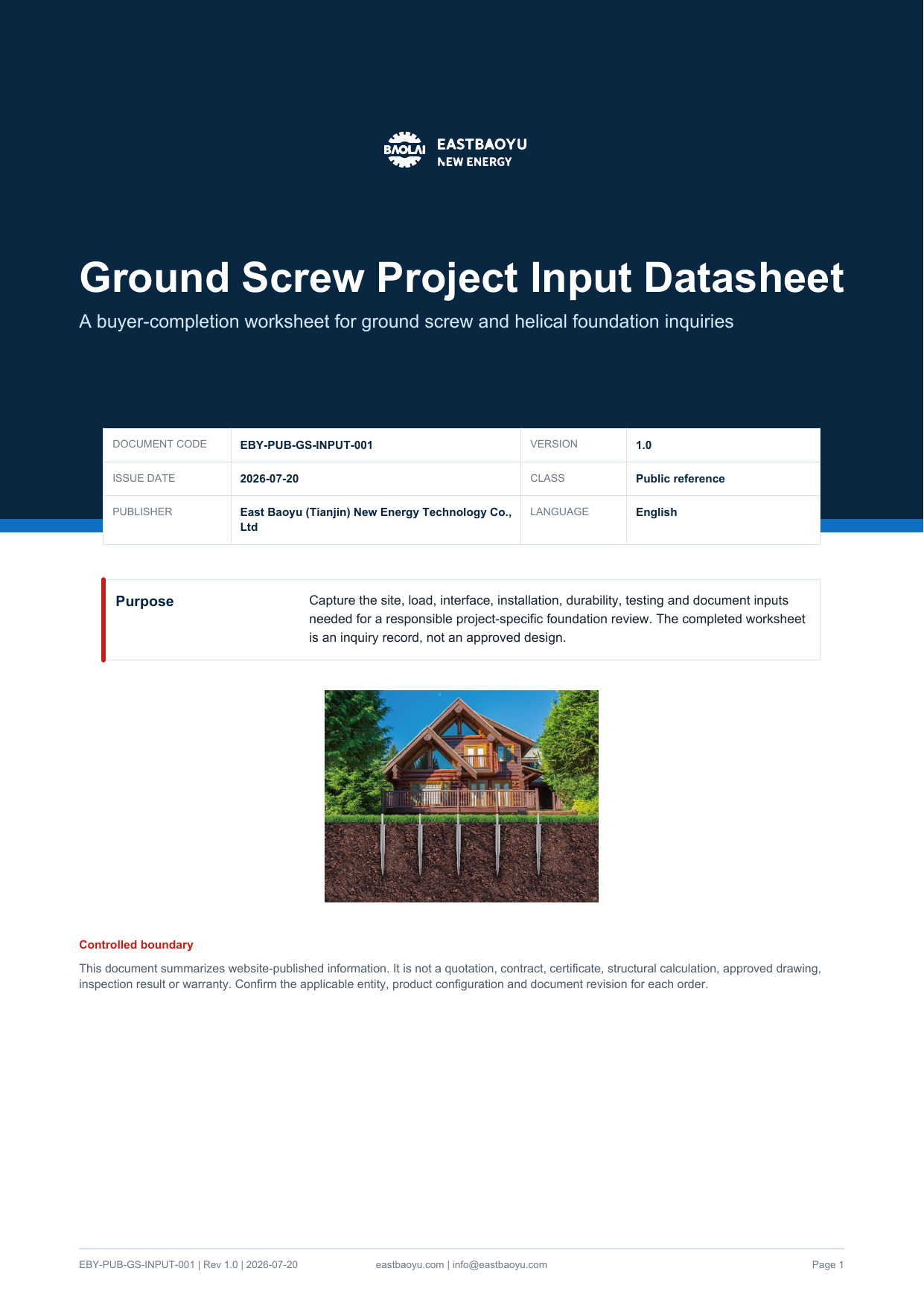
East Baoyu publishes a five-page Ground Screw Project Input Datasheet under document code EBY-PUB-GS-INPUT-001. It covers project contact, site and ground data, a foundation load schedule, structure and interface fields, installation and testing, material and corrosion requirements, requested documents, responsibilities and release gates. Buyers can use it as the front sheet to a controlled inquiry package, while attaching the detailed reports, drawings and schedules referenced in the form.
Download the public Ground Screw Project Input Datasheet (PDF). The completed worksheet is an inquiry record, not an approved design, quotation, certificate, calculation, drawing, inspection result or warranty. Confirm the current revision and the applicable contractual documents for each order.
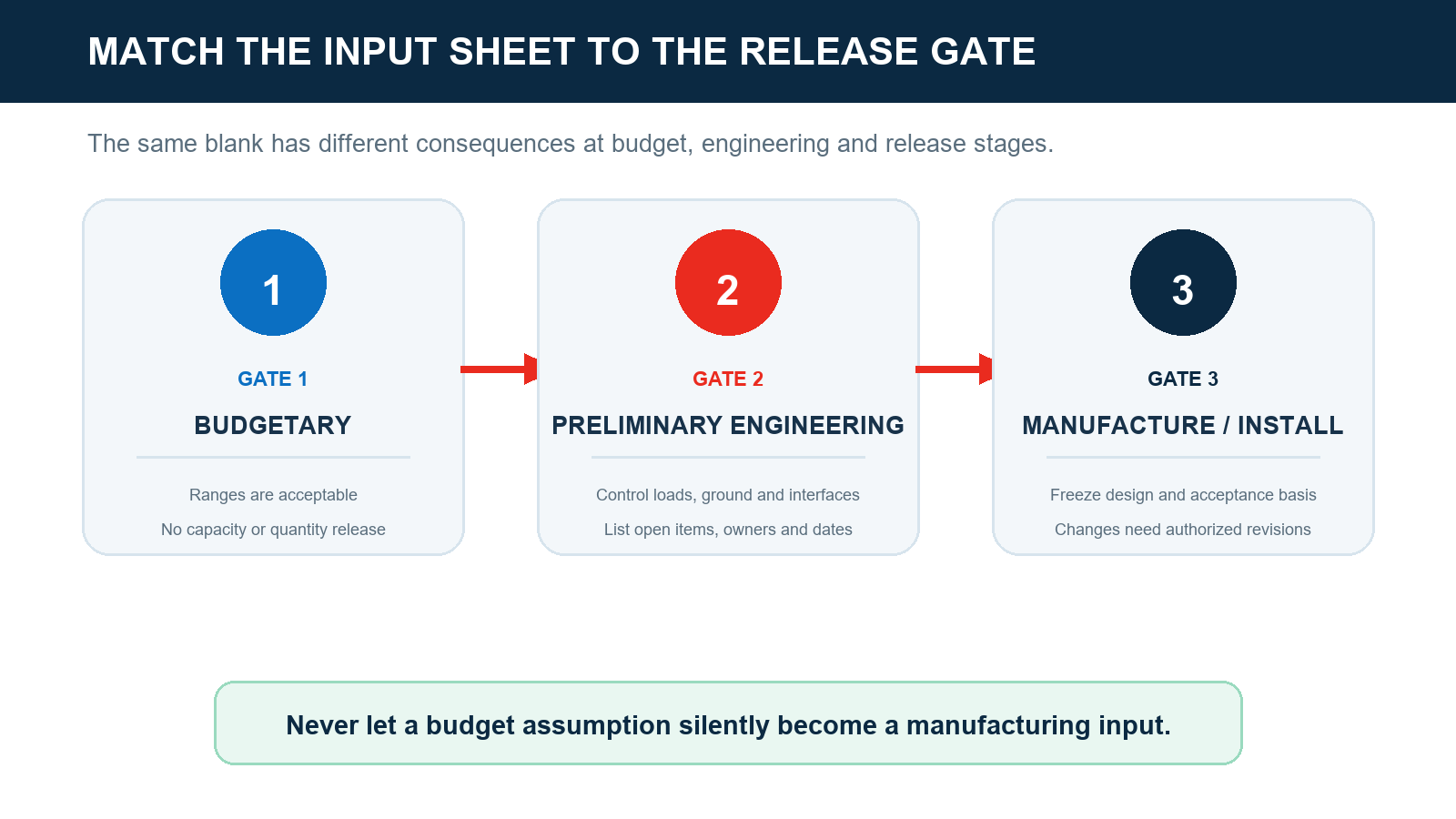
Before filling fields, state what decision the package must support. A budgetary inquiry may use ranges and clearly marked assumptions. Preliminary engineering needs controlled loads, ground data and interfaces with open items listed. Manufacture or installation release needs the approved design basis, frozen interfaces, acceptance route and authorized revisions. The same blank has different consequences at each stage.
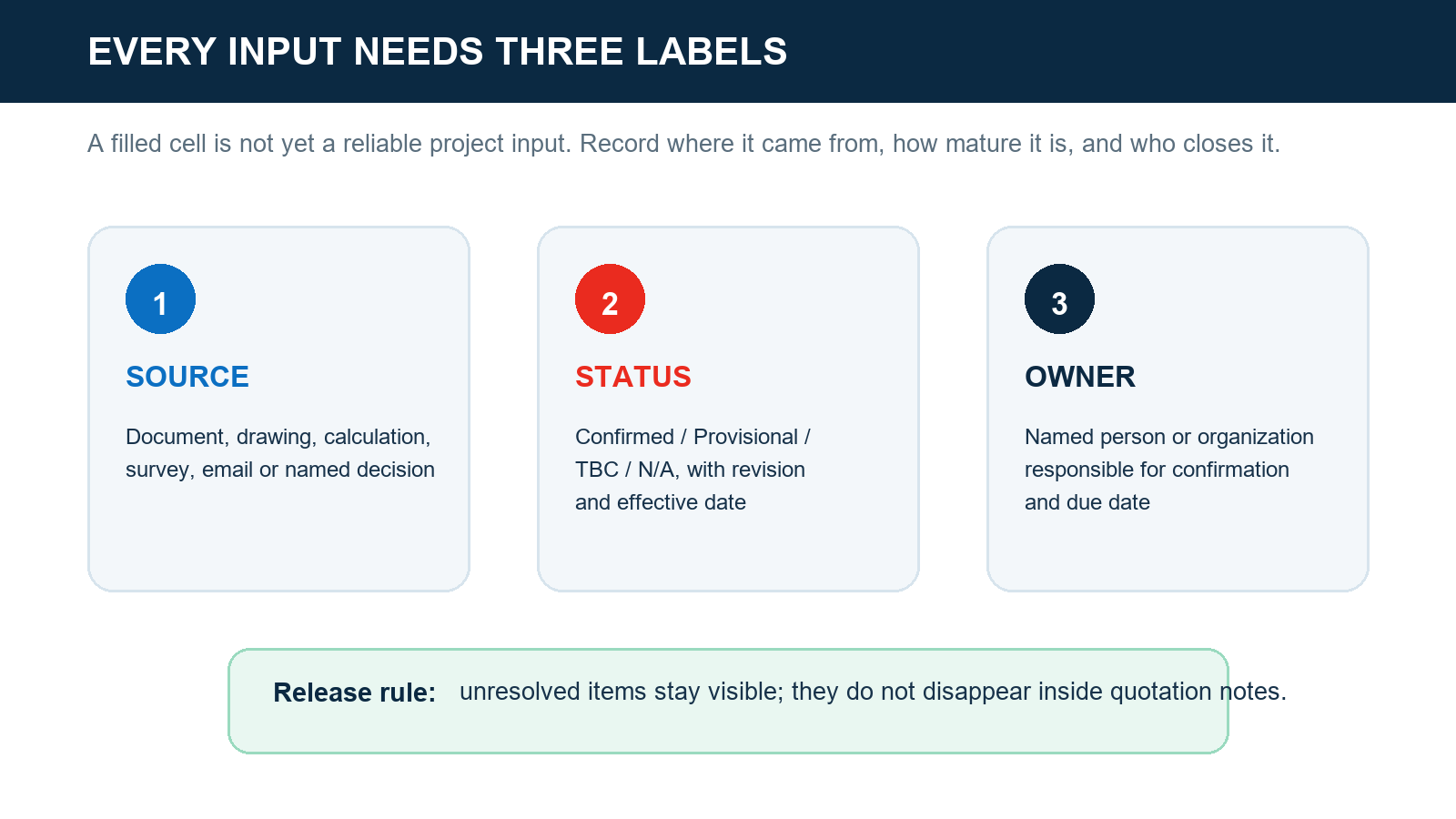
2. Give every entry a source, status and owner
A completed cell is not automatically a reliable input. "Wind load: 25" is unusable without units, direction, load level, combination, location and source. "Soil: medium" does not replace a ground model or investigation reference. "Galvanized" does not state the governing specification, coating requirement, environment, design life or inspection method. Add provenance and maturity beside the value, even when the form provides only one writing line.
| Status | Use it when | Required companion information |
|---|---|---|
| Confirmed | The designated authority has issued the controlling value. | Source, document revision and effective date. |
| Provisional | A value is usable only for the stated preliminary purpose. | Assumption, range, consequence and expiry gate. |
| TBC | The input is required but not yet available or accepted. | Owner, due date and blocked decision. |
| N/A | The field does not apply to the defined scope. | Reason and person accepting that interpretation. |
Do not hide missing inputs inside a supplier's exclusions paragraph. Maintain an open-item list that names the unresolved field, required decision, owner, due date and downstream effect. A provisional value may support a comparison or trial plan, but it should automatically return for confirmation before the next release gate.
3. Complete the project and contact fields for the decision
The first section looks administrative, but it determines which project, entity, revision path and deadline the response addresses. Use a stable project name or code, country and site, buyer/EPC/owner identities, inquiry date, required response date, target delivery or installation date, and any NDA or secure-transfer requirement. Name the contact's role as well as the person; a commercial buyer, structural designer and site construction manager may answer different questions.
Add the requested supplier scope: product supply only, preliminary selection support, project calculations, drawing development, test planning, installation support or another defined service. If the supplier is expected to propose a value, say who will approve it and by when. Avoid sending confidential, export-controlled or personal information through a public form or ordinary email before the secure transfer route is agreed.
Decision requested – state whether the response is budgetary, technical, approval-related or release-related.
Response deadline – distinguish a commercial return date from an engineering approval date.
Scope boundary – identify what the buyer supplies, what the supplier proposes and what a designated engineer approves.
File-control route – provide document numbers, revisions and a secure location rather than unlabeled email attachments.
4. Reference the ground model, not a soil label
For site and ground information, reference the geotechnical report title, date and revision; investigation locations and coverage; strata and variability; groundwater level and seasonal range; fill, obstructions, cobbles, rock and buried services; contamination or aggressive ground; frost, scour, erosion, flooding or seismic issues; access and working-platform conditions; and the proposed trial area. Attach plans and logs so the supplier can see where each observation applies.
ISO 22475-1:2021 describes principles for sampling soil, rock and groundwater as part of geotechnical investigation. The Eurocode 7 overview separates geotechnical design from ground investigation and testing, while the JRC's ground-model guidance emphasizes a site-specific compilation of maps, sections, reports and ground information. These sources illustrate why provenance and coverage matter; the project's adopted code and geotechnical authority remain controlling.
If no final ground model exists, do not invent one to complete the form. Mark the information provisional or TBC, provide the available source data and propose the decision route – additional investigation, trial installation, load testing, zoning or a combination. The related East Baoyu guide on
Ground Screw Selection from Site Investigation explains that technical route in more depth. This article stays focused on the buyer's submission package.
5. Issue a load schedule with level, direction and limits
The form provides columns for compression, tension, shear and moment by load case or location. Use one row for each controlling combination, zone or structural support condition that the supplier must distinguish. State units, coordinate directions, reference elevation, design level, eccentricity and whether values are service, ultimate, accidental, construction, fatigue, cyclic or test demands. Include settlement, uplift, rotation or displacement limits when they govern the decision.
| Do not submit only | Add the missing control context |
|---|---|
| "25 kN vertical" | Compression or tension; service or ultimate; combination; support location; units and source. |
| "Wind governs" | Adopted wind basis, return period or risk category as applicable; pressure/reaction source; operating or stow state. |
| "Factor of safety 2" | What demand and resistance are being compared; governing code; design method and approving authority. |
| "Test to 150%" | Test objective, load direction, reference demand, stages, hold time, measurements, acceptance and approval route. |
Possible design-basis references include ASCE/SEI 7-22 for projects adopting that U.S. loading framework or IEC 62548-1:2023 where its PV-array scope is contractually relevant. Listing these examples does not select a code for the project. The buyer's designer should issue the controlling reactions and combinations under the adopted basis.
6. Freeze the structure and interface before quantity release
Identify the supported structure and application, foundation grid and quantity, head plate or bracket interface, bolt pattern, holes, welds or clamps, elevation and adjustment range, installation tolerances, temporary and permanent stability assumptions, drainage, inspection access and design-life basis. Attach the controlling interface drawing. A product family name or photograph cannot define the connection.
Separate a preliminary quantity from a released bill of materials. The final quantity can change with grid revision, pile zoning, trial results, access constraints, spares, rejected positions and the installation plan. If multiple interfaces exist, map each drawing revision to the relevant location and quantity. An approved structural drawing may still require a separate product/manufacturing drawing release under the project's responsibility matrix.
For the detailed engineering-input route, use the companion Ground Screw Design Input Checklist for EPC and Procurement Teams. The present ground screw project input sheet is the supplier-facing cover and status record, not a replacement for calculations or approved interface drawings.
7. Define installation observations, tests and acceptance authority
State who supplies the installer and equipment, the proposed installation tool, access and working-platform constraints, torque-measurement route, position and inclination tolerance, termination criteria, refusal or obstruction procedure, extension or splice control, log fields, calibration records, trial-installation plan, verification-test method and quantity, acceptance criteria, approving engineer, and nonconformance or retest route.
Installation torque is an observation from a particular tool, setup, ground condition and installation event. It should not be treated as a universal capacity value. If the project uses a torque-capacity relationship, identify the project-specific basis, calibration or validation evidence, limits, data-quality requirements and approving authority. Keep installation acceptance separate from product dimensional or coating acceptance.
ISO 22477-1:2018 covers maintained static axial compression load tests for piles. It does not define every tension, lateral, cyclic, rapid or project-specific ground-screw test. ICC-ES AC358 is relevant where an ICC-ES evaluation route for helical pile systems and devices is adopted; it is not a universal requirement for every ground screw inquiry.
The separate East Baoyu article on Installation Torque and Ground Screw Capacity explains the correlation, control and testing issue in greater depth.
8. Connect corrosion and requested documents to the order
Complete the material grade and specification, coating or galvanizing requirement, corrosion allowance where applicable, environment and soil data, coating inspection and sampling, traceability level, mark-transfer rule, mill/material certificates, dimensional reports, welding or NDT records where applicable, installation and test reports, packing and shipment documents, record retention and final-submission format. Request only evidence that has a defined purpose and scope.
ISO 1461:2022 specifies general properties and test methods for hot dip galvanized coatings on fabricated iron and steel articles. It does not by itself establish project service life, buried-soil corrosion performance or maintenance. ISO 9223:2012 classifies atmospheric corrosivity and explicitly does not characterize every special service atmosphere; it is not a buried-soil classification method. Use the project's actual environment, product configuration and corrosion-design basis.
Use East Baoyu's Corrosion Design for Ground Screws, Solar Mounting and Structural Steel for the wider durability workflow and the Certification & Evidence Center to distinguish public information, project-specific submittals and controlled evidence. A certificate from another product, lot, entity or date must not be used as proof for the current order.
9. Close the responsibility and release-gate section
The final page asks who accepts the ground model, freezes loads and interfaces, approves selection or calculation, approves the trial or test route, releases drawings and the ITP, releases production or installation, and accepts final records. Fill those rows with organizations or named roles and the required approval record. A supplier cannot infer the buyer's authority map from an email recipient list.
At each gate, compare the current input sheet with the attachments and open-item list. A gate is ready only when the required inputs are confirmed or the designated authority has accepted a recorded exception for that specific purpose. If a provisional field remains, state what work can proceed and what must stop. Never allow an assumption used for a budget price to appear later as an approved manufacturing input simply because it was not challenged.
| Gate review | Minimum evidence | Release question |
|---|---|---|
| Budgetary | Input sheet, ranges, assumptions, exclusions and response scope. | Can offers be compared on the same stated basis? |
| Preliminary engineering | Controlled loads, ground references, interfaces, design basis and open items. | Can options and verification work be developed responsibly? |
| Manufacture / installation | Approved drawings, specifications, acceptance route, quantities and authorized revisions. | Is the exact product and field activity released? |
10. Run a ten-minute submission check
Identity – project, site, entities, contact roles, response date and secure-transfer route are clear.
Decision – the requested supplier output and current release gate are named.
Provenance – every technical value points to a document, drawing, calculation, survey or named decision.
Maturity – confirmed, provisional, TBC and N/A entries are distinguished.
Ownership – each open item has an owner, due date and blocked decision.
Attachments – reports, layouts, load schedules and interface drawings use controlled filenames and revisions.
Units and levels – loads, dimensions, elevations, tolerances and dates are unambiguous.
Evidence – requested certificates and reports identify product, lot, entity, revision and approval purpose.
Release – the responsible parties and required approval records are defined.
Confidentiality – sensitive files use the agreed secure route and are not placed in a public form.
11. Submit the package to East Baoyu
Send the completed datasheet with its attachments through the agreed quotation or secure project route. Reference EBY-PUB-GS-INPUT-001 and identify the form revision. East Baoyu can review the package for missing supplier inputs, clarify available product information and propose the next technical or evidence step within the agreed scope. Final design, code adoption, product suitability, quantities, acceptance criteria and statutory approvals remain with the designated project parties.
| Submit | Minimum content |
|---|---|
| Input sheet | Completed fields, status labels, source references, owners and release gate. |
| Technical attachments | Ground report, layout, load schedule, interface drawings and specifications. |
| Programme | Decision dates, trial window, required delivery/installation dates and constraints. |
| Evidence request | Document type, applicable product/lot, purpose, revision and required approval date. |
| Open-item register | Missing input, responsible party, due date, consequence and proposed route. |
| Requested response | Quotation, selection review, drawing, calculation, test plan, evidence pack or meeting. |
Open the screw-pile quotation route, review the Screw Piles product family, or check the Engineering Research & Methods page before naming a test or evidence request.
Request the relevant evidence pack
Send the project code, application, site and ground references, load schedule, interface drawing, corrosion basis, testing route, quantities, programme and the exact evidence required. The response can then address the current decision instead of guessing from a generic product description.

Questions? Chat with East Baoyu on WhatsApp. Fast reply on capacity, price, configuration and available product videos.
Open WhatsApp: +86 130 1228 3281
| Contact | Official detail |
|---|---|
| info@eastbaoyu.com | |
| Phone | +86 22 28352066 |
| +86 130 1228 3281 | |
| Website | https://eastbaoyu.com/evidence-center/ |
Frequently asked questions
Can East Baoyu quote before the geotechnical report is final?
A budgetary or conditional response may be possible when the available ground information, assumptions, exclusions and release limits are explicit. Final product suitability, capacity, quantity and installation acceptance cannot be confirmed from an unfinished ground basis.
Should the buyer fill every field before making an inquiry?
No. Mark unknown required fields TBC, assign an owner and due date, and state which decision is blocked. Use N/A only when the defined scope genuinely makes the field inapplicable and the responsible party accepts that interpretation.
Is the input sheet a design calculation?
No. It is a controlled inquiry and handoff record. Calculations, approved drawings, geotechnical interpretations and acceptance decisions remain separate controlled documents issued by the designated parties.
Can installation torque be entered as the required capacity?
Not by default. Torque is an installation observation. Any torque-capacity relationship needs a project-specific basis, applicable limits, reliable measurement, validation or calibration evidence and an agreed approval route.
Which code should be written in the form?
Write the code and edition adopted by the contract, jurisdiction and responsible designer for the relevant decision. Do not select a code merely because it appears in a supplier article or example reference list.
What is the most important field in the sheet?
The release gate is the organizing field because it defines how mature the other inputs must be. Source, status and owner then make each value or blank auditable against that gate.
Related East Baoyu resources
Ground Screw Project Input Datasheet – public PDF
Ground Screw Design Input Checklist for EPC and Procurement Teams
Ground Screw Selection from Site Investigation
Installation Torque and Ground Screw Capacity
Corrosion Design for Ground Screws, Solar Mounting and Structural Steel
Certification & Evidence Center
Product Documents & Buyer Guides
References and scope notes
Sources were checked on 28 July 2026. Standard scopes and public guidance are paraphrased. This article does not reproduce paid standard requirements, select a governing code, establish capacity or replace project specifications, calculations, testing plans or approval decisions.
ISO 22475-1:2021 – Sampling of soil, rock and groundwater
ISO 22477-1:2018 – Static compression load testing of piles
ISO 1461:2022 – Hot dip galvanized fabricated articles
ISO 9223:2012 – Atmospheric corrosivity classification
ASCE/SEI 7-22 – Minimum design loads and associated criteria
IEC 62548-1:2023 – PV array design requirements
European Commission JRC – Eurocode 7 overview
JRC – Assembling the ground model and derived values
ICC-ES AC358 – Helical pile systems and devices
References, disclosure and change record
References and further verification
- https://eastbaoyu.com/wp-content/uploads/2026/07/east-baoyu-ground-screw-project-input-datasheet.pdf
- https://www.iso.org/standard/71002.html
- https://eurocodes.jrc.ec.europa.eu/EN-Eurocodes/eurocode-7-geotechnical-design?page=1
- https://eurocodes.jrc.ec.europa.eu/publications/assembling-ground-model-and-derived-values
- https://eastbaoyu.com/ground-screw-selection-from-site-investigation/
- https://www.asce.org/publications-and-news/asce-7
- https://webstore.iec.ch/en/publication/64171
- https://eastbaoyu.com/ground-screw-design-input-checklist-epc-procurement-teams/
- https://www.iso.org/standard/70807.html
- https://icc-es.org/wp-content/uploads/acceptance-criteria/AC358.pdf
- https://eastbaoyu.com/installation-torque-and-ground-screw-capacity/
- https://www.iso.org/standard/81435.html
- https://www.iso.org/standard/53499.html
- https://eastbaoyu.com/corrosion-design-ground-screws-solar-steel/
- https://eastbaoyu.com/evidence-center/
- https://eastbaoyu.com/get-a-quote/?product=screw-pile
- https://eastbaoyu.com/screw-piles/
- https://eastbaoyu.com/research-methods/
- https://wa.me/8613012283281
- https://wa.me/8613012283281?text=Hello%20East%20Baoyu%2C%20I%20would%20like%20to%20submit%20a%20ground%20screw%20project%20input%20sheet.
- https://eastbaoyu.com/downloads/
- https://eastbaoyu.com/articles/
- https://eastbaoyu.com/contact/
Disclosure: East Baoyu manufactures and supplies products discussed on this website. Structured drafting tools may assist research and editing, but technical claims, project inputs and release decisions require qualified review under the applicable project responsibilities.
Version 1.0: Initial scheduled publication in the East Baoyu engineering knowledge-base batch.
View the public Content Change Log · Corrections: info@baolaipipes.com