


Authorship, review and evidence boundary
- Technical review
- East Baoyu Engineering Editorial Team
- Reviewed
- 2026-07-29
- Scope
- General engineering and procurement guidance. This article is not a project-specific design, capacity statement, certificate, warranty, code interpretation or contract requirement.
Evidence basis: Official and public references identified in the article, together with original editorial diagrams. Project values and release decisions require qualified review under the applicable project responsibilities.
Read the Editorial PolicyA drawing can carry an approval mark and still be unsafe to issue to the shop. The mark may belong to the wrong revision. A reviewer may have written “approved as noted” while a connection comment remains open. The 2D drawing may be updated while the bill of materials, CNC file or erection drawing still reflects the earlier geometry. In each case the visible approval is real, but the production release is not controlled.
The practical solution is to treat steel fabrication drawing approval as a traceable chain. The chain starts with the contract baseline and named decision owners. It continues through documented checking, a formal transmittal, project-defined review statuses and evidence-based comment closure. It ends only when a release gate confirms the correct revision and every affected downstream record. This guide gives structural engineers, EPC teams, fabricators and procurement teams a working model for that chain.
1. Define what approval releases—and what it does not
Approval is a contractual decision, not a universal stamp vocabulary. For projects that adopt ANSI/AISC 303-22, approval, approval subject to corrections noted and similar approvals can release the fabricator to begin work using the approved submittal. The same provision states that approval does not relieve the fabricator of responsibility for detailed dimensional accuracy or the general fit-up of field-assembled parts. AASHTO/NSBA G1.1-2020 applies the same boundary to bridge shop detail drawings: acceptance verifies apparent consistency with the contract but does not transfer the fabricator’s dimensional and conformance duties.
Therefore, the project should define two different decisions. The reviewer decides whether the submittal is consistent with design intent and the contract within the reviewer’s assigned scope. The fabricator decides whether the checked, current and fully incorporated package is ready to enter production. Neither decision should be assumed from an informal email.
| Role | Core responsibility | Decision that must be explicit |
|---|---|---|
| Owner / EPC / contractor | Establish contract baseline, submittal route, schedule, interfaces and commercial change path | Who may instruct or accept a change |
| ODRD / design authority | Review design intent, connection design information and engineering interfaces within assigned scope | Approval status and unresolved design holds |
| ODRC / construction authority | Review construction interfaces, sequencing and site coordination within assigned scope | Construction-related disposition and release |
| Fabricator | Prepare accurate approval documents, perform final check and control the shop release | Production release after all conditions are met |
| Detailer / connection engineer | Translate the contract basis into checked details without exceeding delegated design authority | Technical response or escalation owner |
| QA / document control | Track revisions, comments, transmittals, distribution and obsolete issues | Evidence that the latest controlled issue reached every user |
2. Freeze a responsibility and status matrix before the first submittal
The first approval meeting should resolve four questions: who reviews each subject, which status labels may be used, what each status permits, and whether corrected drawings must be resubmitted. AISC 303-22 recognizes approved and approved subject to corrections noted; its commentary explains that the design authority may or may not require a record resubmission after noted corrections. That is why a generic “approved as noted” box cannot safely carry the same meaning on every project.
| Example status | Meaning to define | Fabrication effect | Required record |
|---|---|---|---|
| For review | Formal submission awaiting authorized review | No release | Transmittal, index, issue date and due date |
| Approved | Reviewer accepts the submitted revision within assigned scope | Eligible for release gate | Approved file, status/date and reviewer identity |
| Approved as noted | Reviewer accepts subject to incorporating identified notes | Only as the project procedure permits | Comment response, corrected issue and resubmission decision |
| Revise and resubmit | Submittal is not accepted for production | Hold | Revised document, response register and new transmittal |
| Superseded / void | Document is no longer current | Prohibited | Withdrawal log and distribution confirmation |
3. Build a complete drawing package before submission
AISC 207-25, effective 1 February 2026, requires a documented final-check process for fabrication and erection documents and a documented method for controlling approval documents. Its checking list is a useful package audit even when certification is not specified. The contract still governs, but a fabricator should be able to show that the following subjects were deliberately checked rather than left for the reviewer to discover.
Baseline and interfaces — drawing/specification revision, design model precedence, grids, levels, surveys, embeds, adjacent trades and site constraints.
Member identity and geometry — member marks, quantities, profiles, plate sizes, holes, copes, cambers, tolerances and field splice locations.
Connection and design references — connection option, delegated design scope, reactions/loads, calculations and the authority for technical changes.
Materials and fastening — grades, standards, bolt assemblies, substitutions, traceability and shop bills.
Welding and inspection — complete welding symbols, applicable welding code/edition, WPS references, access and specified NDT or hold points.
Surface protection — preparation, coating or galvanizing system, masked areas, repair route and interfaces that affect detailing.
Erection information — orientation, piece marks, assembly relationships, sequence notes, temporary requirements assigned by the contract and field instructions.
Controlled submittal — drawing index, purpose, revision history, checker identity, model/2D relationship, transmittal number and requested return date.
4. Run a seven-step approval and comment-closure workflow
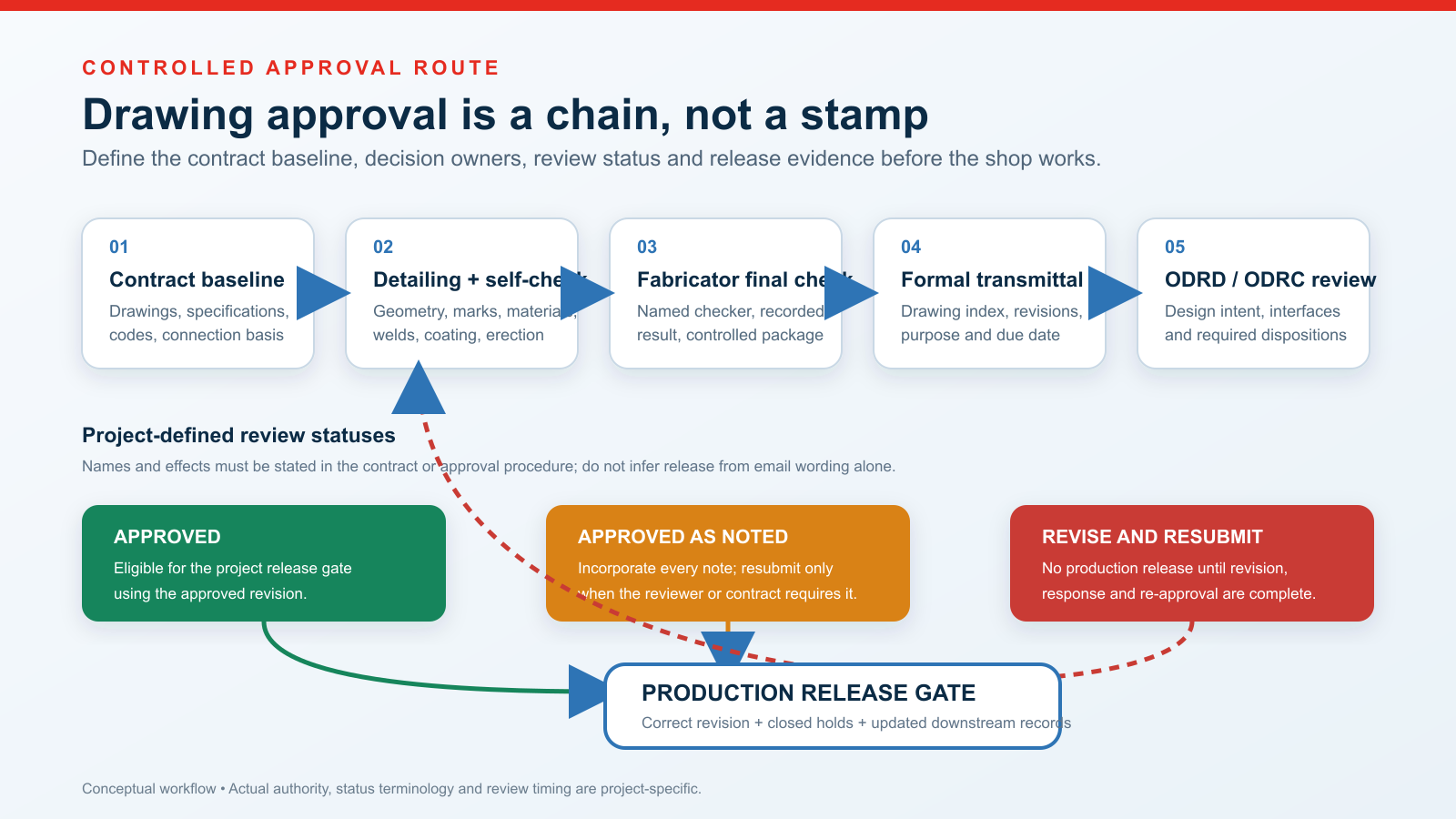
Freeze the baseline. Record the governing contract drawings, specifications, addenda, model files, codes/editions and outstanding RFIs in a baseline register.
Complete the detailer self-check. Check every sheet or model package against the baseline, not against memory or a marked-up uncontrolled PDF.
Perform and record the fabricator’s final check. Use an independent checker where required, identify the checker and make the check record retrievable.
Submit one controlled package. Transmit a drawing index, revision, purpose, supporting calculations or connection information and the requested review date.
Classify every review comment. Separate design-intent decisions from drafting corrections, constructability queries, material issues and commercial changes.
Resolve, incorporate and close. Answer the comment, revise the drawing or escalate it, then record the evidence and every downstream item affected.
Pass the production release gate. Issue only the approved, checked and fully incorporated revision; withdraw superseded shop copies and notify all affected functions.
5. Route comments to the person who owns the decision
A comment register becomes misleading when every row is assigned to “detailer.” Many comments contain decisions the detailer is not authorized to make. The register should name a discipline and a decision owner so a drafting correction is closed quickly while a design or contract change is escalated.
| Comment class | Typical example | Decision owner | Closure evidence |
|---|---|---|---|
| Drafting / presentation | Missing dimension, mark or note that follows an agreed rule | Detailer + checker | Revised detail and check record |
| Design intent | Changed member, load path, stiffness, connection behavior or tolerance | Named design authority | Approved response and revised design information |
| Connection design | Bolt group, weld size, plate geometry or calculation criterion | Contract-assigned connection engineer / ODRD | Calculation or substantiating information plus approved detail |
| Constructability | Access, sequence, lifting, field assembly or shop process conflict | Fabricator / erector with required engineering approval | Accepted method and coordinated drawing |
| Material / procurement | Grade, availability or proposed substitution | Procurement + engineering + contract authority | Approved substitution and updated BOM/MTC requirements |
| Welding / inspection | Weld symbol, WPS range, access, NDT or hold point | Welding/QA authority and engineer as required | Updated drawing, WPS/ITP and approval record |
| Coating / interface | Masked zone, slip-critical surface, galvanizing venting or repair | Coating/engineering interface owner | Revised detail, specification response and shop instruction |
6. Close comments with evidence, not colored clouds
A revision cloud only shows where a drafter changed a document. It does not show why the change was accepted, who had authority, whether the reviewer’s condition was satisfied, or whether the same change reached the model, BOM, CNC data, WPS, ITP and erection package. A controlled comment row should preserve that chain.
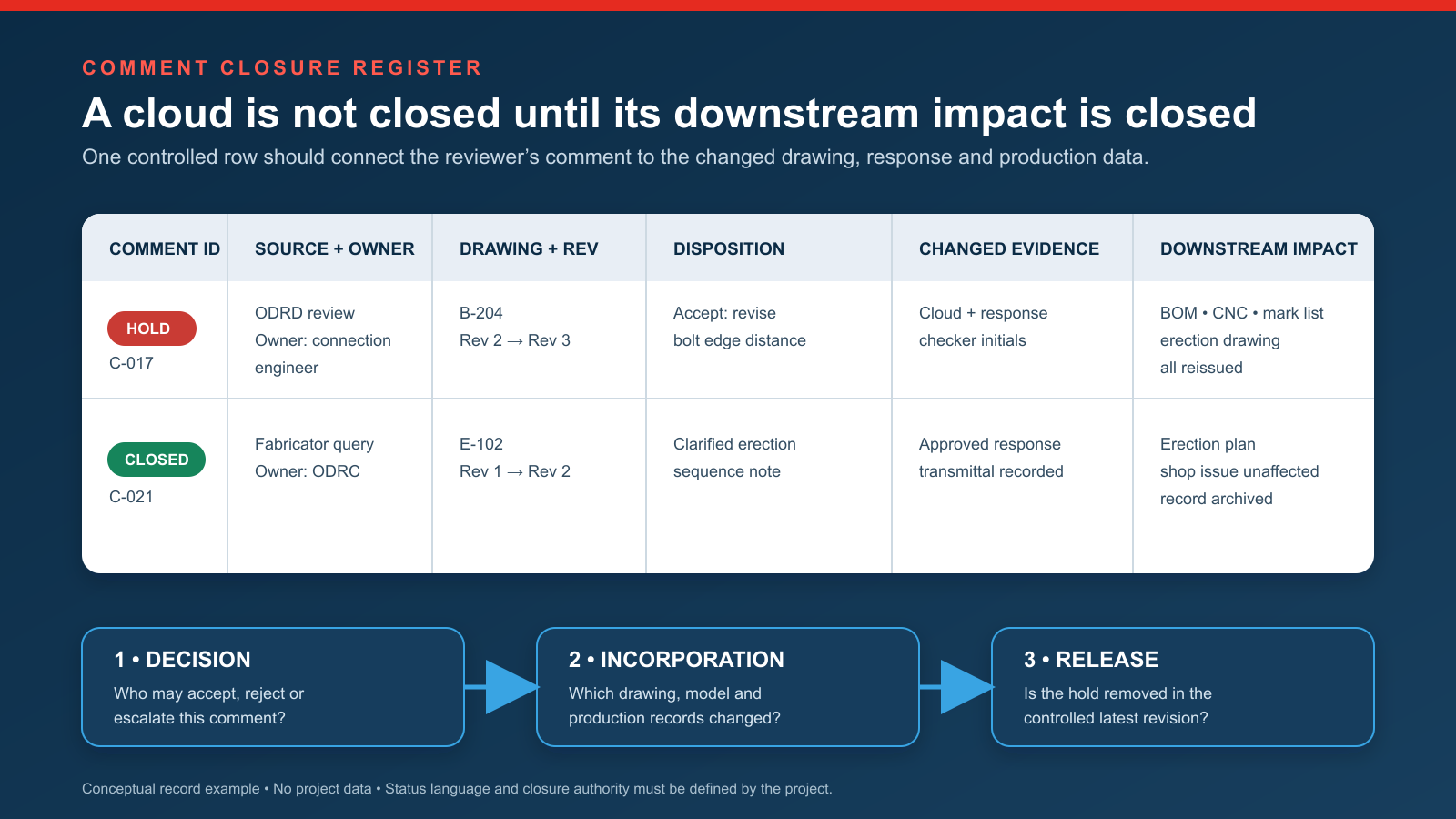
At minimum, record the comment ID, source, date, drawing/model and revision, discipline, owner, hold classification, disposition, response, revised item, supporting evidence, downstream impacts, closure authority and closure date. Preserve rejected alternatives when they explain why the final disposition was selected. The record should remain linked to the formal transmittal rather than living only in personal email.
7. Use a production release gate after approval
The release gate converts reviewer approval into a controlled fabrication package. It belongs to the fabricator’s management system because AISC 207-25 requires project-document tracking, identifiable revisions and controls that prevent obsolete documents from being used inadvertently. The gate should be signed or electronically approved by the roles named in the project procedure.
The drawing/model number, sheet set, member marks and revision match the approved transmittal.
The review status permits fabrication under the project’s status matrix.
Every hold comment is closed; every “approved as noted” correction is incorporated.
The drawing and model are coordinated, including any declared precedence between them.
Affected calculations, BOMs, material orders, CNC/nesting files, shop bills and mark lists are updated.
Affected WPS references, inspection/NDT points, ITP steps and coating instructions are updated.
Superseded shop copies and files are removed or made inaccessible; the latest issue is identifiable.
Production planning, subcontractors, suppliers and erection/document-control teams receive the release.
Open changes that do not block release are separately logged with scope, owner and due date.
8. Control every change after release
A released drawing is not frozen forever, but a change after release must travel through the same authority and impact controls. Start with a numbered RFI, engineering change, nonconformance disposition or contract instruction. Determine whether the change affects design intent, cost, schedule, material already purchased, work in progress or erection. Then identify every dependent record before issuing the new revision.
| Change trigger | Immediate hold | Impact review | Required re-release |
|---|---|---|---|
| Revised contract drawing / addendum | Affected marks and purchasing | Geometry, connections, quantities, schedule and interfaces | Approval documents plus affected production data |
| RFI or design response | Related detail until authority is confirmed | Calculations, drawing/model, BOM, CNC and erection | Controlled response and revised issue |
| Material substitution | Purchase/use of the substitute | Strength, weldability, coating, traceability and commercial effect | Approved substitution and updated documents |
| Shop nonconformance | Nonconforming item | Repair/use-as-is authority, WPS/NDT, dimensions and records | Approved disposition and as-built/quality record |
| Site variance | Affected fabrication or erection interface | Survey, fit-up, tolerance, temporary works and sequence | Approved field change and coordinated revision |
9. Detect the failure modes before the shop does
The most damaging approval failures are usually coordination failures rather than missing signatures. Watch for an approved PDF stored beside a later unapproved revision; a comment marked closed without a response; a revised plate detail with an old CNC file; two active member-mark lists; an informal design change embedded in a cloud; or a model and 2D drawing that disagree. Another warning is a production instruction that cites only a filename, because filenames can be changed without preserving document identity.
Procurement should also avoid using approval status as a substitute for technical completeness. A fabricator may have approval for a drawing but still be waiting for a material substitution, WPS qualification, coating decision or inspection hold point. Those controls belong in the ITP and manufacturing data route. They connect to drawing release, but they are not the same record.
For the downstream quality route, see East Baoyu’s Steel Fabrication ITP: Linking MTC, WPS, NDT, Dimensions and Coating Records and Project Acceptance and Manufacturing Data Records.
10. What to send East Baoyu for a drawing-workflow review
A useful inquiry is a controlled package, not a folder of unrelated files. State whether the request is for budget review, detailing/fabrication coordination, drawing review support or production planning. Then provide the project baseline and identify which items are preliminary.
Contract drawings, specifications, addenda and the governing model/drawing precedence.
Applicable design, execution, welding and coating standards with editions and project amendments.
Responsibility matrix for structural design, connection design, detailing, approval and construction coordination.
Approval-status legend, review/resubmission rules, required turnaround and submittal schedule.
Member/connection scope, reactions or design criteria, material grades, bolts, welding and NDT requirements.
Surface preparation/coating or galvanizing requirements, masked zones and repair rules.
Drawing/model files, numbering convention, document register, existing comments/RFIs and required deliverables.
Procurement, fabrication, inspection, packing and erection milestones that the release sequence must support.
Use the East Baoyu Steel Structures page for product context, review the Quality & Manufacturing page, or share drawings and specifications through the formal contact route. Project-specific engineering remains subject to the contract and responsible qualified professionals.

Frequently asked questions
Does an approved shop drawing remove the fabricator’s dimensional responsibility?
No. Under ANSI/AISC 303-22, approval does not relieve the fabricator of responsibility for detailed dimensional accuracy or general field fit-up. The fabricator’s documented checking and production-release controls still apply.
Can fabrication start from an “approved as noted” drawing?
Only when the project’s status matrix permits it and every required note is incorporated. The reviewer or contract may require a corrected record resubmission. Hold comments and affected downstream data must be closed before release.
How long should a steel drawing review take?
The contract and agreed submittal schedule govern. ANSI/AISC 303-22 uses 14 calendar days as a planning assumption when the contract states no different period. This is not an East Baoyu service promise and may be modified for project complexity or connection information.
Who approves connection design changes?
The person or entity assigned by the contract and connection-design option. A detailer or fabricator should not accept a change outside delegated authority. When design intent is involved, the comment should be escalated to the named design authority.
Can a 3D model replace fabrication drawings?
Only if the contract authorizes the model-based deliverable and defines precedence, access, checking, revision identification, ownership and downstream use. Model and 2D outputs must not silently diverge.
What is the minimum evidence for production release?
Identify the approved drawing set and revision, approval transmittal/status, closed holds, downstream records updated, release issuer/date and distribution. The shop must be able to identify the latest authorized issue and avoid obsolete documents.
References and application notes
The project contract and legally adopted codes control. The references below are authoritative workflow sources or scope context; they do not establish East Baoyu certification and should be checked for current editions, errata and project amendments before use.
ANSI/AISC 303-22 — Code of Standard Practice for Steel Buildings and Bridges
AISC 207-25 — Standard for Certification Programs
AASHTO/NSBA G1.1-2020 — Shop Detail Drawing Review/Approval Guidelines
ISO 10013:2021 documented-information overview
ISO 9001:2015 published standard project page
AWS D1.1/D1.1M:2025 — Structural Welding Code—Steel
EN 1090-2:2018+A1:2024 catalog scope
Research checked: 28 July 2026. AISC 207-25 is the current certification-program standard at this research date; the current published AISC Code of Standard Practice remains ANSI/AISC 303-22. Confirm the contract-adopted edition and current errata before project use.
Editorial image record
| Filename | Source / rights | Alt text | Caption and use |
|---|---|---|---|
| steel-fabrication-drawing-approval-workflow-hero.png | AI-generated 2026-07-28; East Baoyu editorial use; conceptual only | Conceptual steel drawing review desk with generic revision marks, measuring tools and workshop background. | Hero. Must be labeled conceptual; never present as an East Baoyu project or approval record. |
| steel-drawing-approval-status-workflow.png | Original East Baoyu editorial diagram, 2026-07-28 | Controlled steel drawing approval route through checking, transmittal, review status and release gate. | Technical figure explaining the status and release chain. |
| drawing-comment-closure-register.png | Original East Baoyu editorial diagram, 2026-07-28 | Conceptual comment register linking decision ownership to revisions, evidence and downstream impact. | Conceptual record example; contains no project data. |
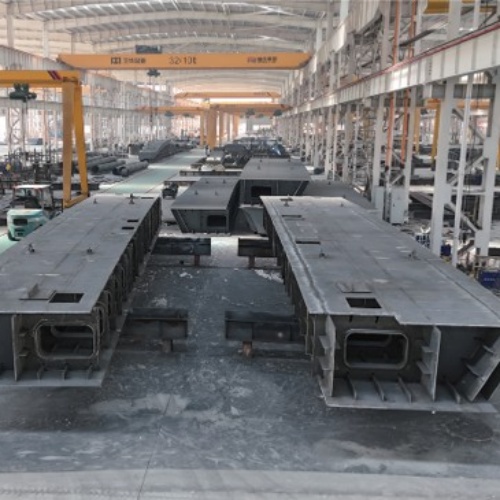
| east-baoyu-fabricated-steel-box-girders-workshop.jpg | East Baoyu WordPress media attachment ID 493; owned website image | Fabricated steel box-girder components arranged in a structural steel workshop. | Fabrication environment only; not approval, inspection or project-performance evidence. |
| east-baoyu-whatsapp-cta.png | Original East Baoyu editorial UI graphic, 2026-07-28 | Light green WhatsApp contact bar with East Baoyu contact message and green Chat Now button. | Linked contact CTA styled to the user-provided reference. |
References, disclosure and change record
References and further verification
- https://eastbaoyu.com/steel-fabrication-itp-mtc-wps-ndt-coating/
- https://eastbaoyu.com/project-acceptance-and-manufacturing-data-records/
- https://eastbaoyu.com/steel-structures/
- https://eastbaoyu.com/quality/
- https://eastbaoyu.com/contact/
- https://wa.me/8613012283281
- https://www.aisc.org/globalassets/aisc/publications/standards/a303-22w.pdf
- https://www.aisc.org/aisc/publications/current-standards/aisc-207/
- https://www.aisc.org/aisc/publications/revisions-and-errata/
- https://www.aisc.org/globalassets/nsba/aashto-nsba-collab-docs/g-1.1-2020-shop-detail-drawing-review-approval-guidelines.pdf
- https://committee.iso.org/sites/tc176/home/news/content-left-area/news-and-updates/release-of-iso-100132021-quality.html
- https://committee.iso.org/sites/tc176sc2/home/projects/published/iso-9001-2015.html
- https://pubs.aws.org/p/2264/d11d11m2025-structural-welding-code-steel
- https://standards.iteh.ai/catalog/standards/cen/0ca58a93-b883-40b6-8830-1b959bd16637/en-1090-2-2018a1-2024
Disclosure: East Baoyu manufactures and supplies products discussed on this website. Structured drafting tools may assist research and editing, but technical claims, project inputs and release decisions require qualified review under the applicable project responsibilities.
Version 1.0: Initial scheduled publication in the East Baoyu engineering knowledge-base batch.
View the public Content Change Log · Corrections: info@baolaipipes.com