


Authorship, review and evidence boundary
- Technical review
- East Baoyu Engineering Editorial Team
- Reviewed
- 2026-07-29
- Scope
- General engineering and procurement guidance. This article is not a project-specific design, capacity statement, certificate, warranty, code interpretation or contract requirement.
Evidence basis: Official and public references identified in the article, together with original editorial diagrams. Project values and release decisions require qualified review under the applicable project responsibilities.
Read the Editorial PolicyA steel model can look complete on screen and still be unsafe to release for fabrication. Members may be accurately located, yet connection design is open. Plates may contain holes, yet the bolt class, slot direction or edge preparation is missing. A reviewer may have commented on the model, yet no one has stated which version is approved for which use. If that model drives shop drawings, bills of material or machine data, visual detail can create false confidence.
Structural steel fabrication LOD should therefore be treated as an agreed information-delivery requirement, not a beauty score and not a single number stamped on an entire file. The project team must define what each model element contains, what it can be relied on for, which supporting documents remain controlling, who owns each decision, and what review action permits fabrication to start.
1. LOD is a contract definition, not a visual impression
The current BIMForum Level of Development Specification describes LOD as a way to communicate model-element content and reliability at different stages. It also says the specification does not prescribe which LOD must be achieved at a particular project point and does not replace the BIM execution plan. The AIA G204-2022 Model Element Table similarly assigns LOD values to individual model elements at named milestones and identifies the responsible model element author.
Use the BIMForum 2025 LOD Specification and the AIA G204-2022 summary as communication frameworks, then write the project-specific requirements into the contract documents, BIM execution plan and exchange schedule. Do not assume that the phrase "LOD 400" has identical content, author, liability, file format or approval meaning on every project.
A whole-model label is especially weak for steel. Main framing, secondary steel, stairs, embeds, connection components and temporary items may mature at different times and may be authored by different parties. The receiving fabricator needs an element-by-element statement of required use and reliability, not a single headline number.
2. Separate four lanes of fabrication readiness
ISO 7817-1:2024 establishes concepts for specifying the level of information need and the detail and extent of information to be delivered. A practical steel handoff can apply that discipline through four lanes. Geometry covers the physical representation. Information covers alphanumerical attributes and identity. Documentation covers drawings, specifications, calculations and procedures that remain linked to the model. Authorization covers status, revision, responsibility and permitted downstream use.
ISO 7817-1:2024 is broader than one LOD number and supports consistent specification of information needs. The four-lane model below is an East Baoyu editorial control device for applying that principle to fabrication; it is not a replacement for the standard or a contractual model element table.
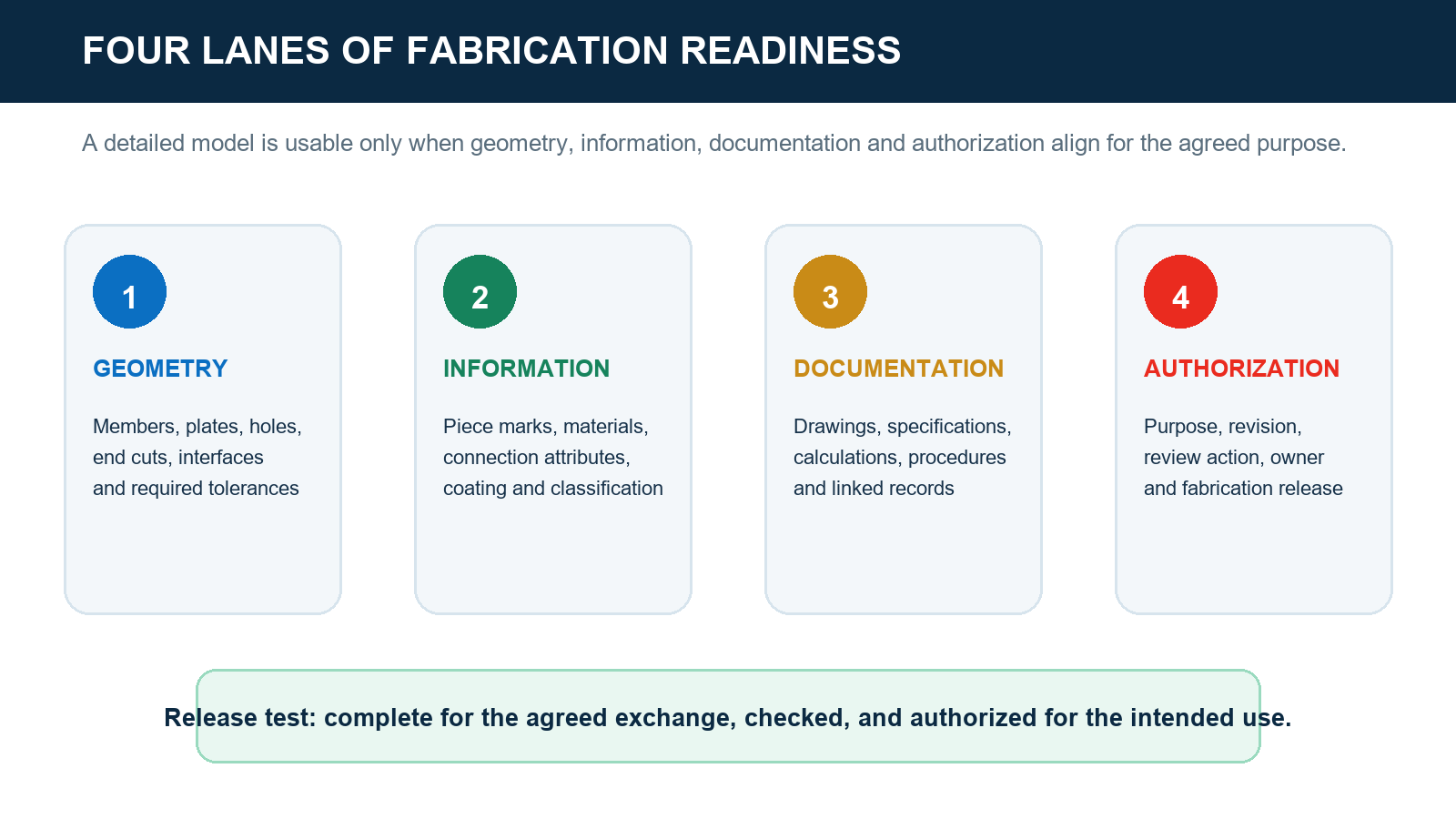
| Lane | Typical steel content | Failure when missing |
|---|---|---|
| Geometry | Members, plates, holes, cuts, cambers, interfaces and required modeled tolerances. | A plausible shape cannot be manufactured or coordinated reliably. |
| Information | Piece marks, materials, connection attributes, coating, classification and assembly identity. | Objects cannot be purchased, traced, scheduled or interpreted consistently. |
| Documentation | Specifications, calculations, drawings, procedures and linked exceptions. | The model lacks the basis needed to check or supplement it. |
| Authorization | Purpose, revision, review action, owner, open-item status and release. | Downstream users cannot know what reliance is permitted. |
3. Define member geometry at the level the use requires
For member-level fabrication, state whether the model must contain final section size, material orientation, work points, offsets, slope, rotation, length, end cuts, copes, notches, holes, camber, sweep, splice location and shipping split. Define the coordinate system, origin, units and relationship to grids and elevations. A beam located for coordination may not yet include the exact end preparation required by a saw, drill line or plate processor.
Do not model tolerances as random geometric offsets. Instead, identify which dimensions are nominal, which interfaces are critical and where fabrication or erection tolerances are stated in the specifications and approval documents. The model should also distinguish design geometry from fabrication compensation, such as camber, weld shrinkage allowances or preset, when those features are part of the agreed scope.
Member identity – stable object ID, piece mark, assembly mark and revision relationship.
Physical form – section, orientation, length, end condition, penetrations and plates required for the agreed use.
Location – project coordinates, work points, offsets, grids, elevations and shipping/erection zones.
Nominal versus allowed variation – modelled geometry plus the document that controls tolerances and fit.
4. Treat connections and interfaces as controlled decisions
Connections are where a coordinated design model most often becomes a fabrication model. For every connection family, identify who designs it, what loads and design basis apply, which party supplies reactions or forces, and who reviews the result. Model the required plates, stiffeners, bolts, welds, holes, slots, backing, access zones and erection aids only to the maturity that the agreed exchange requires.
Interface information must extend beyond the steel-to-steel joint. Check base plates, anchors, embeds, façade supports, equipment, cable trays, precast, concrete openings, fire protection and coating clearances. Name the controlling reference and the party responsible for each non-steel interface. A clash-free model does not prove that bolt access, welding sequence, inspection access or field erection is practical.
| Connection question | Required handoff answer |
|---|---|
| Who designs it? | Design authority, delegated scope if any, calculation/submittal route and review action. |
| What is modeled? | Plates, bolts, weld representation, holes, slots, stiffeners, copes and temporary/erection items by agreed use. |
| What remains in documents? | Forces, design assumptions, weld symbols, acceptance notes, tolerances and exceptions not reliably carried in the model. |
| What controls release? | Approved model version plus named drawings/specifications and closed or accepted open items. |
The AISC Model Review and Approval guide highlights early agreement on model configuration, coordinates, metadata, file types, 2D supplements, review actions, version tracking and storage. It is best-practice guidance, not a substitute for the project's contract documents.
5. Make attributes useful for procurement and traceability
Geometry cannot tell a purchasing or quality team everything it needs. Define required attributes for material specification and grade, section or plate description, bolt assembly, weld process reference, surface preparation, coating or galvanizing system, fire-protection interface, mass, phase, sequence, lot or heat traceability level, inspection class and document links. Use controlled names, units and allowed values rather than free text where repeatable data matters.
Attribute completeness should be checked against the agreed exchange, but the check must not be confused with engineering validation. A property can be present and still be wrong. Material grade can be populated but inconsistent with the approved specification. A bolt class can be valid text but incompatible with the connection design. Automated checks find missing or malformed information; competent review confirms technical suitability.
buildingSMART Information Delivery Specification (IDS) provides a computer-interpretable way to define information requirements for IFC objects, classifications, materials and properties. An IDS check can strengthen completeness control, but it does not approve the connection, material selection or fabrication method.
6. Agree the exchange format and its permitted use
The exchange schedule should name native authoring software and version, neutral formats, coordinate reference, model federation approach, file naming, classification, property mapping, units, update frequency and validation report. It should also state whether the receiver may derive shop drawings, quantities, bills of material, nesting data or machine files from the exchange.
ISO 16739-1:2024 defines IFC as an open international BIM data schema and explains that model view definitions can identify the subset needed for particular information deliveries. IFC improves interoperability; it does not guarantee that every proprietary fabrication feature, connection rule or machine parameter transfers without loss.
Perform a round-trip or receiver-side test before production depends on the exchange. Compare object count, coordinates, section and material mappings, hole and plate geometry, assembly relationships, properties, revision identifiers and document links. Record known exclusions. If a native fabrication model is controlling, state how other parties access, review and archive it. If a PDF or signed drawing controls, state that precedence explicitly.
7. Control shop drawings, bills and NC/CNC data as derived outputs
A model can generate shop drawings, erection drawings, bills of material, cut lists and NC/CNC files, but each output needs its own production and checking route. Define which model version generated it, which software and post-processor were used, how revisions propagate, who checks the output and what approval releases it. A machine-readable file should never bypass the drawing, material and change-control basis simply because it was generated automatically.
For machine data, verify section mapping, material stock, unit conventions, face and axis orientation, hole type, slot direction, scribing, cope and contour interpretation, kerf or tool compensation, marking and part identity. Retain the link between the released model, derived file, machine program and finished piece. Where automated production data cannot carry a requirement, attach the controlled supplemental instruction rather than hiding the exception in an operator message.
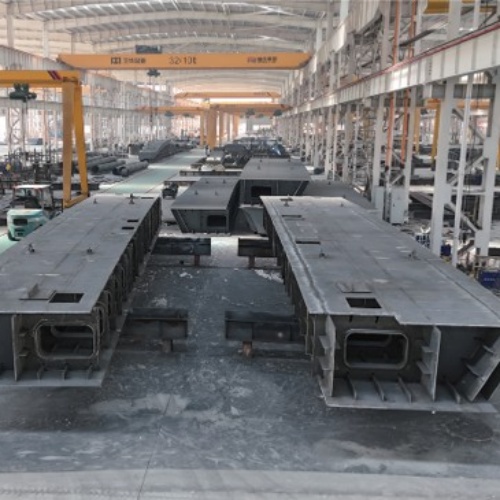
Once production begins, connect the released model basis to the Steel Fabrication ITP so material certificates, welding procedures, dimensional inspection, NDT, coating and final records remain traceable to the correct drawing and model revision.
8. Make review action and revision status machine-visible and human-readable
ISO 19650-1 frames information management around exchange, recording, versioning and organization, while ISO 19650-2 addresses the delivery-phase management process and information exchanges. A steel model handoff should therefore carry container status, suitability or permitted use, revision, issue date, originator, checker, approver and supersession relationship in the agreed common data environment or transmittal process.
Review the current published pages for ISO 19650-1:2018 and ISO 19650-2:2018. Both pages note that revisions are under development. The project should name the adopted edition and information-management procedure rather than silently following a draft.
Use review actions that clearly state what was reviewed and what may proceed. "Approved" without scope is ambiguous: approved for coordination, approved as noted for resubmission, accepted as a fabrication submittal, or released for a particular production lot are different states. Link comments to objects or assemblies, preserve comment closure, and never overwrite a superseded model without retaining the audit trail.
ANSI/AISC 303-22 requires project-specific clarity on the role of design models and approval documents. Its model-related provisions also make clear that access to design-document copies does not remove the fabricator's responsibility for checking and coordination. Apply the code only when it is part of the governing project basis.
9. Use four model handoff gates
A practical programme separates coordination, detail development, fabrication release and record-model gates. At coordination, location and interfaces may be reliable while pieces and machine data are not. During detail development, connection components and attributes mature, but open design decisions remain visible. Fabrication release freezes the authorized production basis. The record model then captures accepted changes within a stated evidence boundary; it should not be called as-built unless the update and verification process supports that claim.
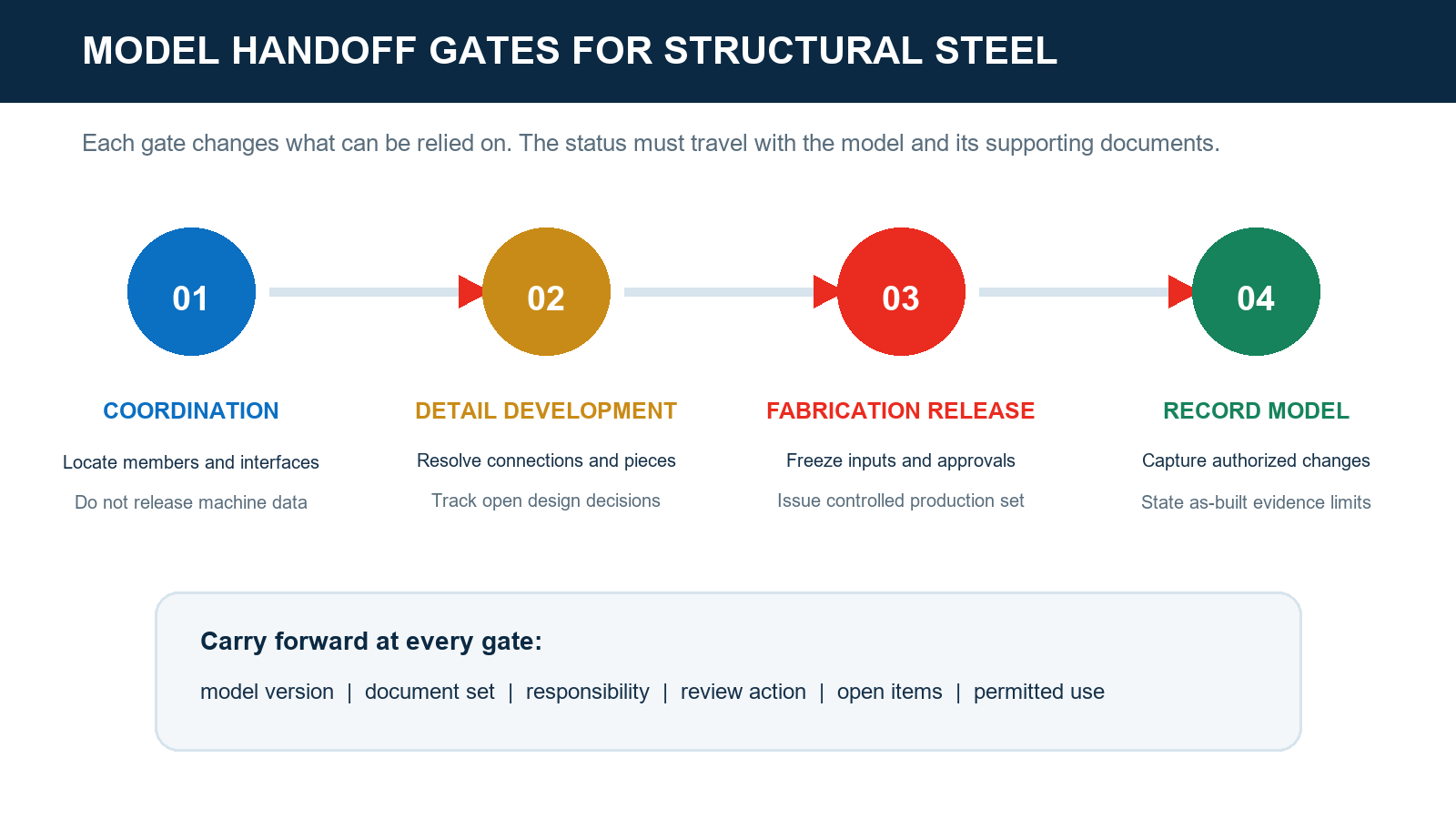
| Gate | Minimum question before issue | Explicit prohibition |
|---|---|---|
| Coordination | Are members and interfaces reliable for the stated coordination purpose? | Do not derive fabrication or machine data unless separately authorized. |
| Detail development | Are connection ownership, open items and model-author responsibilities current? | Do not hide unresolved design inputs inside modeled detail. |
| Fabrication release | Are geometry, attributes, documents and approvals aligned on one controlled revision? | Do not mix superseded models, drawings or unapproved changes. |
| Record model | Which authorized changes and inspections support the recorded condition? | Do not imply field verification beyond the retained evidence. |
10. Build a model exchange responsibility matrix
Before detailing starts, create a matrix for each steel system or model-element group. Name the requested use, milestone, LOD or level of information need, model author, design authority, checker, reviewer, exchange format, controlling companion documents, review action, permitted downstream use and final record owner. Add due dates and open-item consequences. The matrix should be a live control document, not a meeting note.
Element group – main framing, secondary steel, connections, miscellaneous metals, embeds or temporary items.
Purpose and milestone – coordination, quantity, approval, fabrication, erection or record use.
Required content – geometry, attributes, documents and exclusions stated separately.
Responsibility – model author, design authority, checker, reviewer and release authority.
Exchange – software/version, native or neutral format, coordinates, property mapping and validation.
Status – revision, permitted use, comment closure, supersession and change effective date.
The detailed AIA G204-2022 instructions show how model elements, milestone LOD values, model element authors and notes can be organized. Do not reproduce the copyrighted table; use the official document or a project-authorized matrix.
11. Share drawings and specifications with East Baoyu
For an initial structural steel fabrication review, provide the project code, structure type, design status, model purpose, software and version, native and neutral files if available, coordinate basis, drawings and specifications, connection responsibility, material and coating requirements, tolerance basis, required derived outputs, inspection and document requirements, quantities, programme and the exact decision requested. Include a transmittal that names the current revision and permitted use.
| Submit | Minimum content |
|---|---|
| Model package | Native/neutral format, software version, origin, coordinates, units, object scope and known exclusions. |
| Controlled documents | Design drawings, specifications, connection basis, schedules, calculations or approved references as applicable. |
| Responsibility matrix | Authors, design/check/review roles, deliverables, milestones, model uses and release authority. |
| Fabrication output request | Shop drawings, BOM, NC/CNC, nesting, erection information, MDR or other deliverables and formats. |
| Open-item register | Unresolved input, owner, due date, affected elements and blocked downstream use. |
| Programme | Review windows, approval milestones, production release, shipping split and delivery priorities. |
Review East Baoyu's Steel Structures, Quality & Manufacturing and Certification & Evidence Center pages before requesting a project-specific fabrication or evidence response. Public examples do not replace the approved project package.
Share drawings and specifications
Send the model purpose, files, drawings, specifications, connection-responsibility split, material and coating basis, requested fabrication outputs, quantities and programme. East Baoyu can then review file usability and missing supplier inputs within the agreed scope instead of inferring release status from visual model detail.

Questions? Chat with East Baoyu on WhatsApp. Fast reply on capacity, price, configuration and available product videos.
Open WhatsApp: +86 130 1228 3281
| Contact | Official detail |
|---|---|
| info@eastbaoyu.com | |
| Phone | +86 22 28352066 |
| +86 130 1228 3281 | |
| Website | https://eastbaoyu.com/contact/ |
Frequently asked questions
Does LOD 400 always mean a structural steel model is fabrication-ready?
No. The label must be tied to the project's adopted definition, model elements, milestone, responsible author, required information, supporting documents and permitted use. A visually detailed model can still lack approval, attributes or controlling design inputs.
Should the fabrication model replace shop drawings?
Only when the contract and review procedure define the model as the approved fabrication submittal and explain how information, comments and review actions are conveyed. Many projects still need 2D drawings, schedules or sketches to supplement the model.
Can an IFC model be used directly for CNC production?
Not automatically. Validate schema/version, model view, geometry, properties, assemblies and coordinate mapping, then separately verify the receiver software, post-processor, machine conventions and production release. Record known exchange losses.
Who owns connection information in the model?
The project responsibility matrix should identify the design authority, model author, checker, reviewer and release authority for each connection group. Responsibility must not be inferred from who first placed a modeled component.
What is the difference between model completeness and approval?
Completeness asks whether the agreed geometry, information and documents are present. Approval or release asks whether the designated authority has accepted a particular revision for a stated downstream use. Both are required before fabrication depends on the model.
What should block fabrication release?
Unresolved design responsibility, missing controlling loads or interfaces, conflicting model and drawing revisions, incomplete material or connection attributes, unvalidated exchange loss, open review comments, or no authorized permitted-use status should stop the affected work.
Related East Baoyu resources
Steel Fabrication ITP: Linking MTC, WPS, NDT, Dimensions and Coating Records
Project Acceptance and Manufacturing Data Records: A Buyer Checklist
Corrosion Design for Ground Screws, Solar Mounting and Structural Steel
Certification & Evidence Center
Product Documents & Buyer Guides
Engineering Research & Methods
References and scope notes
Sources were checked on 28 July 2026. Standard and guidance scopes are paraphrased. This article does not reproduce paid requirements, choose a governing code, allocate design liability, approve a model, validate a connection or release fabrication. The contract, jurisdiction, adopted standards and designated project authorities remain controlling.
ISO 7817-1:2024 – Level of information need
ISO 19650-1:2018 – Information-management concepts and principles
ISO 19650-2:2018 – Delivery-phase information management
ISO 16739-1:2024 – Industry Foundation Classes data schema
buildingSMART – Information Delivery Specification
BIMForum – 2025 Level of Development Specification
AIA G204-2022 – Model Element Table summary
AIA G204-2022 – Model Element Table instructions
ANSI/AISC 303-22 – Code of Standard Practice
AISC – Model Review and Approval for Structural Steel
AISC – BIM & VDC resources for structural steel
References, disclosure and change record
References and further verification
- https://bimforum.org/resource/lod-level-of-development-lod-specification/
- https://help.aiacontracts.com/hc/en-us/articles/7354549087379-Summary-G204-2022-Model-Element-Table
- https://www.iso.org/standard/82914.html
- https://www.aisc.org/globalassets/aisc/publications/references/model_reviewapproval_guide_2022.pdf
- https://www.buildingsmart.org/standards/bsi-standards/information-delivery-specification-ids/
- https://www.iso.org/standard/84123.html
- https://eastbaoyu.com/steel-fabrication-itp-mtc-wps-ndt-coating/
- https://www.iso.org/standard/68078.html
- https://www.iso.org/standard/68080.html
- https://www.aisc.org/globalassets/aisc/publications/standards/a303-22w.pdf
- https://help.aiacontracts.com/hc/en-us/articles/7356824341651-Instructions-G204-2022-Model-Element-Table
- https://eastbaoyu.com/steel-structures/
- https://eastbaoyu.com/quality/
- https://eastbaoyu.com/evidence-center/
- https://wa.me/8613012283281
- https://wa.me/8613012283281?text=Hello%20East%20Baoyu%2C%20I%20would%20like%20to%20share%20a%20structural%20steel%20BIM%20model%2C%20drawings%20and%20specifications.
- https://eastbaoyu.com/project-acceptance-and-manufacturing-data-records/
- https://eastbaoyu.com/corrosion-design-ground-screws-solar-steel/
- https://eastbaoyu.com/downloads/
- https://eastbaoyu.com/research-methods/
- https://eastbaoyu.com/articles/
- https://eastbaoyu.com/contact/
- https://www.aisc.org/aisc/solutions-center/bim-vdc-resources/
Disclosure: East Baoyu manufactures and supplies products discussed on this website. Structured drafting tools may assist research and editing, but technical claims, project inputs and release decisions require qualified review under the applicable project responsibilities.
Version 1.0: Initial scheduled publication in the East Baoyu engineering knowledge-base batch.
View the public Content Change Log · Corrections: info@baolaipipes.com