


Authorship, review and evidence boundary
- Technical review
- East Baoyu Engineering Editorial Team
- Reviewed
- 2026-07-29
- Scope
- General engineering and procurement guidance. This article is not a project-specific design, capacity statement, certificate, warranty, code interpretation or contract requirement.
Evidence basis: Official and public references identified in the article, together with original editorial diagrams. Project values and release decisions require qualified review under the applicable project responsibilities.
Read the Editorial PolicyA vendor submittal schedule prevents late document approval by working backward from the date when approved information is needed for procurement, fabrication, inspection, packing or shipment. The schedule must include vendor preparation and internal checking, the first submission, the project-defined review window, a realistic resubmission allowance, approval for the stated use and a release buffer before the downstream milestone. An upload date by itself is not a plan.
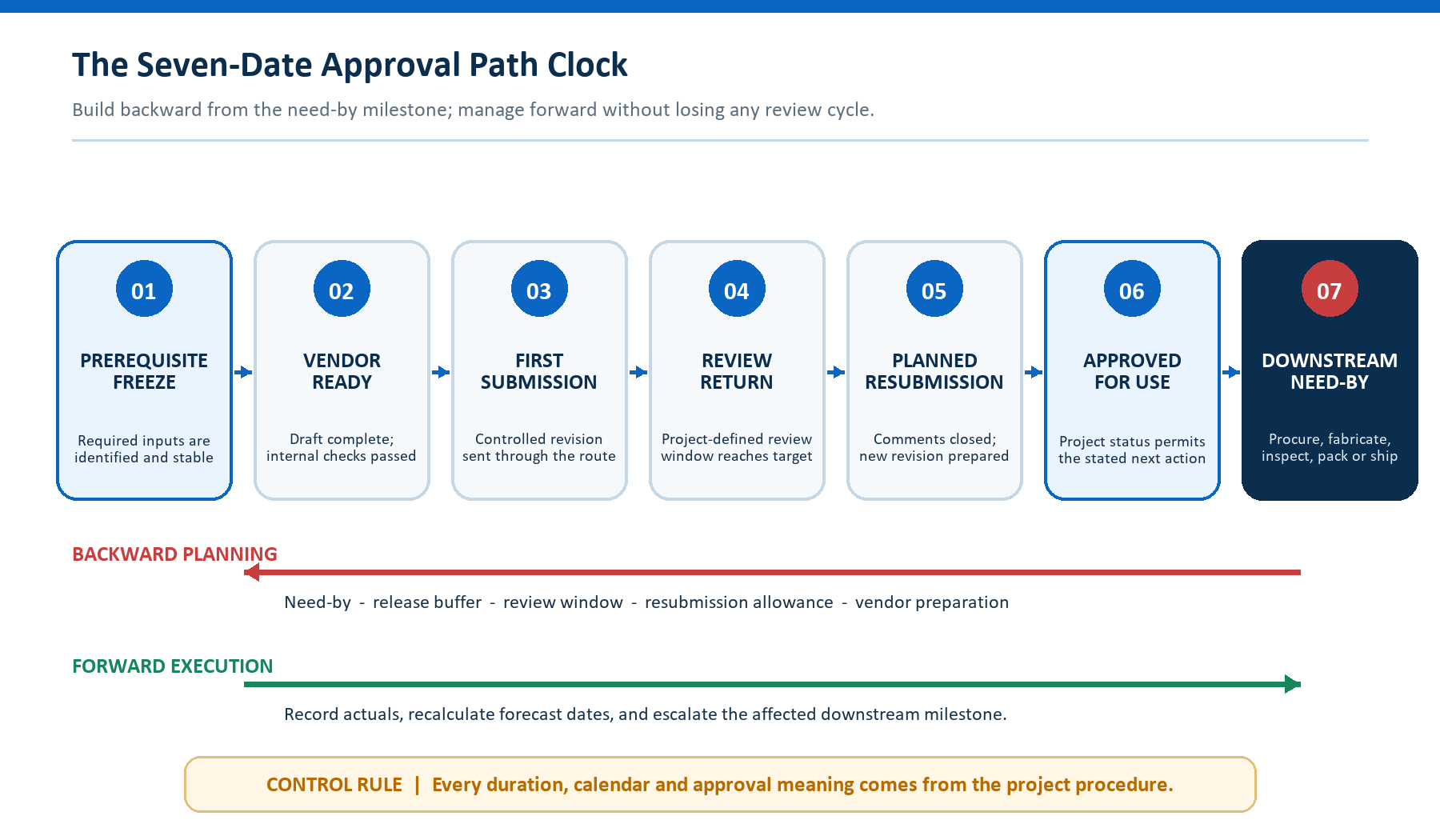
The controlling idea is simple: schedule the approval, not the upload. Build a seven-date Approval Path Clock for every time-critical document or package, then keep baseline, current forecast and actual dates in separate fields. When an input arrives late or comments require another cycle, move the forecast, show the variance and escalate the affected milestone. Every duration, working calendar, review status and approval meaning must come from the applicable contract, specification and agreed procedure. This guide does not set universal review periods or interpret contractual entitlement.
1. A document register is not a submittal schedule
A controlled project needs both. The document register answers what the document is: number, title, revision, status, transmittal and distribution. The vendor submittal schedule answers when each approval path must happen, which prerequisite controls it and which downstream milestone it protects. A production schedule then shows the work that can proceed after the required release. Combining all three into one uncontrolled spreadsheet usually hides either revision traceability or time logic.
| Control | Primary question | Do not use it to replace |
|---|---|---|
| Document register | What is the controlled document, revision and status? | Approval timing and downstream milestone logic |
| Submittal schedule | When must preparation, review and approval occur? | Revision, transmittal and distribution control |
| Production schedule | When will procurement, fabrication, inspection and delivery occur? | Formal document review and status authority |
2. Start with the downstream need-by milestone
Do not begin with the date the vendor hopes to send a file. Begin with the first activity that is not permitted, practical or commercially sensible without the required approval. Name that activity precisely: release a material purchase order, issue cutting data to the shop, open an inspection hold point, approve a packing method or release a shipment dossier. Then identify the exact document and project status that permits that action. If the contract allows different releases for procurement and fabrication, keep those milestones separate instead of using one vague 'approved' date.
Need-by milestone: the first downstream action that requires approved information.
Approval-for-use: the project-defined status that permits that specific action.
Release buffer: project-approved time between document status and operational release.
The need-by milestone must be observable and owned. Replace 'needed soon' with a named event, responsible function and schedule reference. If a drawing is required before cutting, link it to the fabrication release activity rather than the final shipment date. If a quality plan is required before a witness point, link it to the inspection notice and planned hold point. A precise anchor lets the team test whether a forecast change affects real work or only an administrative preference. It also prevents excessive early submission of documents that will become obsolete before the underlying design or interface is stable.
3. Build the seven-date Approval Path Clock
The Approval Path Clock exposes the work hidden between an input and a milestone. It starts with prerequisite freeze, followed by vendor readiness, first submission, planned review return, planned resubmission, approval-for-use and downstream need-by. Not every project will use those exact labels, but every required interval must have an owner, calendar and source. A missing interval does not disappear; it becomes unplanned schedule risk.
| Date field | Meaning | Evidence at update |
|---|---|---|
| Prerequisite freeze | Required project inputs are identified and stable enough to proceed | Input list, revision and open-item owner |
| Vendor ready | Draft is complete and internal engineering/QA checks are closed | Internal check record or release |
| First submission | Controlled revision enters the agreed transmittal route | Transmittal and receipt |
| Review return | Project-defined review period reaches its planned return point | Procedure, calendar and receipt date |
| Resubmission | Comments are resolved and the next controlled revision is due | Comment log and revision plan |
| Approved for use | Returned status permits the stated next action | Named authority and project status |
| Need-by | Protected procurement, fabrication, inspection, packing or shipment milestone | Integrated project or production schedule |
Run the backward pass once for the baseline and again whenever the remaining logic changes. If the first review returns without approval, replace the unused allowance with the actual comment-close and resubmission forecast. If prerequisites move, recalculate vendor readiness before changing the first-submission forecast. If approval arrives early, retain the actual date but do not assume that every downstream activity may start; the release buffer and named operational gate still apply. This event-by-event method keeps the schedule explanatory: a reviewer can see why the date moved, which assumption changed and which milestone is exposed.
4. Use project-defined durations and calendars
The schedule basis should identify where each duration comes from: contract clause, specification, approved document procedure, kickoff agreement or named project instruction. Record whether the duration uses working or calendar days, the applicable holidays and time zone, when the review clock starts, and whether an incomplete package stops or restarts it. The UFGS submittal-procedure example coordinates submittal processing with the work and treats resubmittals as additional review cycles; its editable durations illustrate why a number should not be copied into another project as a universal rule.
If the governing documents are silent, raise the missing rule before baselining. A private assumption can support an internal forecast, but it should be labelled as an assumption and must not be presented as an agreed client review commitment.
Store the calendar and duration basis with the schedule, not only in meeting minutes. Minimum fields include the source reference, date basis, submission receipt rule, permitted pause conditions, number of cycles included in the plan and the person who accepted the assumption. For international projects, state the time zone that determines receipt and due dates. A file sent after the receiver's cutoff may be recorded on a different project day even though the sender's system shows a successful upload. These details prevent avoidable disputes in the working forecast without attempting to decide contractual entitlement.
5. Freeze prerequisites before vendor preparation starts
A document can be late before anyone begins drafting it. Typical prerequisites include the latest project specification, design criteria, interface drawings, approved material route, equipment data, inspection responsibility, document template, numbering convention and comment history. Put every prerequisite on the same logic path with a required date and owner. 'Awaiting client input' is not a complete schedule status; it must identify the specific input, requested date, current forecast and downstream consequence.
Do not mark a package vendor-ready while mandatory interfaces remain open.
Do not consume review allowance to compensate for unplanned internal checking.
Do not silently revise the prerequisite basis after the submittal is released.
6. Link document families to operational release gates
Not every document protects the same event. Map each family to the first downstream gate that needs it, then test whether related packages must be reviewed together. The examples below are planning prompts; the contract and approved project procedure define the real gate.
| Document family | Possible protected milestone | Scheduling question |
|---|---|---|
| Vendor drawings / calculations | Procurement or fabrication release | Which status permits purchase, cutting or welding? |
| Material data / certificates | Material approval and receipt | Must approval precede order placement or only use? |
| Quality plan / ITP / procedures | Manufacturing or inspection hold point | Which witness and approval actions precede work? |
| Inspection notifications / reports | Hold-point release or shipment | What notice and review period applies? |
| Packing method / shipping documents | Packing, dispatch or customs handoff | Which documents must be accepted before release? |
| MDR index / final dossier | Final acceptance or handover | Is approval progressive, final or both? |

7. Schedule complete packages and interface reviews
A fast first submission is not useful if the reviewer cannot evaluate the whole interface. Define package completeness: drawing, calculation, datasheet, deviation list, referenced procedure and any companion document needed for one decision. Split a package only when the project authority accepts the boundary and the partial approval has a clear permitted use. Otherwise, fragmented submissions create parallel comment cycles, inconsistent revisions and an approval date that is impossible to forecast.
Package-level scheduling does not eliminate document-level control. Each file retains its number, revision and status in the register; the package provides the review dependency and decision milestone in the submittal schedule.
An interface package should also declare what is outside its boundary. A connection drawing may depend on client reactions, a material proposal may depend on coating exposure, and an inspection procedure may depend on an approved welding route. Show those links even when the documents sit in different disciplines. Where parallel review is allowed, identify the common decision that reunites the paths before release. Without that join point, one discipline can appear approved while another still carries a comment that changes the shared geometry, material or inspection basis.
8. Keep baseline, forecast and actual dates separate
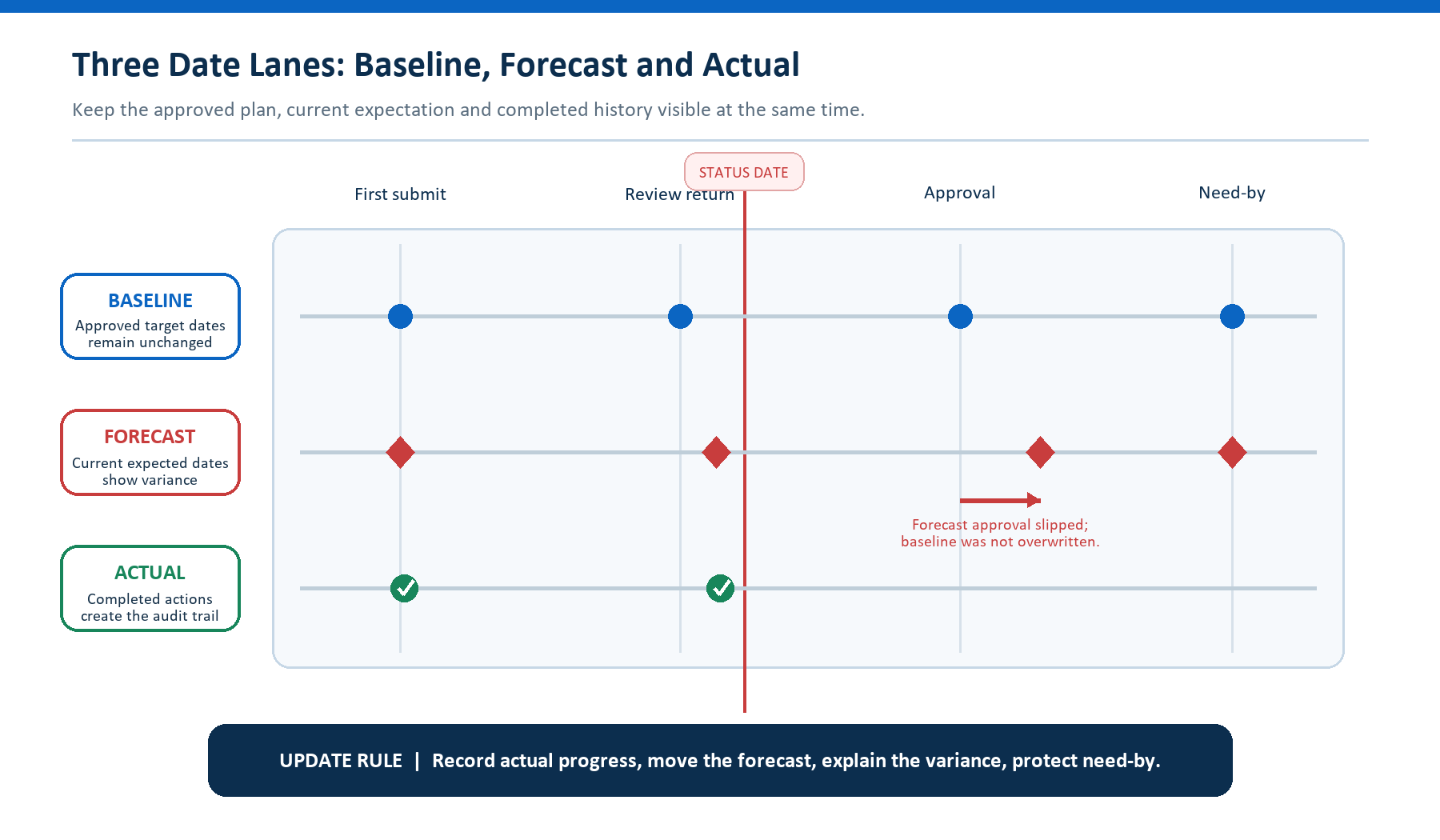
A baseline records the approved plan. A forecast records the current expected outcome. An actual records what happened. Overwriting the baseline with each update makes every late approval appear on time and removes the evidence needed for management action. The GAO Schedule Assessment Guide and NASA schedule-management material both emphasize a controlled baseline, current status and meaningful date updates. Apply that discipline at the submittal-package level.
| Field | Update rule | Management use |
|---|---|---|
| Baseline date | Change only through the approved change-control route | Measures variance against the agreed plan |
| Forecast date | Recalculate from remaining logic at each status date | Shows the expected effect on approval and need-by |
| Actual date | Enter only from a controlled event record | Provides traceability and future planning evidence |
| Status date | Use one declared cutoff for the update | Separates completed history from remaining work |
For each update, freeze the status date first. Record actual events up to that cutoff, calculate the remaining path, compare forecast approval and need-by against their baselines, and write a short variance reason. Use the same data date across the submittal schedule, document register and integrated project schedule. Otherwise, an approval can look current in one report and overdue in another simply because the reports were prepared from different cutoffs. Keep prior updates archived so the team can see whether a forecast is stabilizing, recovering or slipping repeatedly.
9. Treat review return as a decision point, not completion
A returned submittal may be approved for a stated use, approved with comments, rejected, returned for revision or assigned another project-specific code. Never infer the operational meaning from the label alone. Record the named authority, returned revision, date, code, unresolved comments, required response and whether the downstream gate remains held. A comment log should link every comment to an owner, disposition, affected document, target revision and planned resubmission date.
If a comment changes scope, basis or interface, route it through the approved change process. Closing the comment in a spreadsheet does not authorize a technical or commercial change.
10. Run a short-horizon approval look-ahead
The monthly schedule preserves the record; a short-horizon look-ahead protects execution. Review the approval paths that reach a prerequisite freeze, first submission, review return, resubmission or need-by milestone before the next meeting cycle. Focus discussion on evidence and decisions rather than percentages. The GSA project-planning example similarly places submittal tracking in recurring monthly or weekly management.
| Condition | Evidence to show | Required management action |
|---|---|---|
| Prerequisite forecast is late | Missing input, owner, requested and forecast dates | Resolve, resequence or formally move the path |
| Vendor-ready date threatened | Remaining work, checker and internal release date | Add accountable resources or escalate scope conflict |
| Review return overdue | Receipt, agreed clock and follow-up record | Confirm status with the named review authority |
| Comments exceed allowance | Open comment log and affected interfaces | Prioritize decisions and recalculate approval forecast |
| Approval forecast reaches need-by | Current logic and downstream consequence | Escalate recovery or approved change immediately |
Useful measures are event-based: packages with prerequisites due before the next status date, first submissions due, reviews expected, resubmissions due, approvals forecast after need-by and paths with no accountable next action. Review-cycle count and comment aging can reveal where the plan is consuming its allowance, but they should be read with package complexity and scope change. A high percentage-complete value is less useful than one clear statement: which decision is missing, who owns it, when it is forecast and which downstream milestone will be affected if it does not arrive.
11. Recover a threatened path without hiding variance
Recovery begins with the remaining logic, not a cosmetic date change. Possible actions include closing prerequisite decisions, adding a defined internal checker, prioritizing interface comments, agreeing an acceptable partial package, resequencing unaffected production or using the formal project change route. Each action needs an owner, due date and stated effect on the forecast. Do not compress a contractual review window unilaterally, assume approval, release work against an unauthorized status or delete the original baseline.
12. Assign responsibilities and release gates
| Role | Schedule responsibility | Release boundary |
|---|---|---|
| Vendor engineering | Prepare technical content and close technical comments | Does not assign client approval status |
| Vendor QA/QC | Check required quality documents and inspection dependencies | Does not waive project hold points |
| Vendor document control | Maintain register, transmittals, dates and comment trace | Does not reinterpret technical approval |
| Procurement / project controls | Integrate submittal dates with supply and production milestones | Does not overwrite approved baselines |
| Client / engineer / named reviewer | Return the project-defined review status | Authority is only what the contract assigns |
Before each downstream release, confirm the controlled revision, returned project status, closed or accepted comments, approved deviations and the exact permitted use. Submission, review completion and approval-for-use are different events unless the project procedure explicitly says otherwise.
13. What to send East Baoyu
For a supplier-side documentation review, send the contract document list or specification extract, project document procedure, status-code definitions, working calendar, downstream procurement and manufacturing milestones, current document register, comment log, open interfaces, required review roles and latest forecast. Identify which dates are approved baselines and which are internal assumptions. Do not send confidential, export-controlled or sensitive personal information until an appropriate transfer route is agreed.
Use East Baoyu's Quality & Manufacturing, Evidence Center and Contact pages to frame the supplier-side request. East Baoyu can organize available drawings, quality documents, manufacturing interfaces and order milestones for the agreed scope; the contract-named project authorities retain review and approval responsibility.
Request a documentation review
Send the document list, downstream milestones, review procedure and current open items. East Baoyu will identify the supplier-side preparation path, missing project inputs and which approval dates need to be connected to procurement, production, inspection or shipment.

Questions? Chat with East Baoyu on WhatsApp. Fast reply on capacity, price, configuration and available product videos.
Open WhatsApp: +86 130 1228 3281
| Contact | Official detail |
|---|---|
| info@eastbaoyu.com | |
| Phone | +86 22 28352066 |
| +86 130 1228 3281 | |
| Website | https://eastbaoyu.com/contact/ |
Email the documentation package: info@eastbaoyu.com
Frequently asked questions
What is the difference between a submittal schedule and a document register?
The register controls document identity, revision, status, transmittal and distribution. The submittal schedule controls planned, forecast and actual dates, dependencies, review cycles and the downstream milestone protected by approval.
Which date should control the vendor submittal schedule?
Start with the downstream date when approved information is required, then calculate backward through release buffer, review, possible resubmission and vendor preparation. The applicable contract and procedure define every duration.
How many days should be allowed for document review?
There is no universal allowance. Use the contract, specification, approved document procedure and agreed working calendar. If no duration is defined, identify that gap before baselining instead of presenting an internal assumption as a commitment.
Can fabrication start when a document is 'approved as noted'?
Only if the project's status definition and named authority permit fabrication for that revision and the relevant comments, deviations and hold points are resolved as required. The label alone is not enough.
Should partial or rolling submittals be used to save time?
They can help only when the review authority accepts the package boundary, interfaces are clear and the permitted use of each partial approval is recorded. Otherwise, partial submittals often create conflicting revisions and more review cycles.
How should late approvals be measured?
Keep the baseline, current forecast and actual dates separately. Measure variance at one declared status date, identify the remaining logic and show the effect on the protected need-by milestone. Do not erase the baseline to make the update appear on time.
Related East Baoyu resources
Quality & Manufacturing | Engineering Articles
Certification & Evidence Center | Product Documents & Buyer Guides
Engineering Research & Methods | Steel Fabrication ITP
Project Acceptance and Manufacturing Data Records | Export Packing for Solar and Steel Components
Steel Structures | Solar Mounting
References and scope notes
Official public sources were checked on 28 July 2026 and are paraphrased for scheduling, quality-planning and documented-information principles. The UFGS and USACE material is used as an example framework, not as the governing contract for an East Baoyu order. ISO public pages describe scope and quality-management context; they do not make this schedule a certificate of conformity. Project teams must verify the applicable contract, licensed standards, procedure, status codes, calendars and named approval authorities. This article is a process guide, not legal advice, contract interpretation or a project-specific programme.
WBDG – UFGS 01 33 00 Submittal Procedures | UFGS 01 33 00 official PDF
USACE ER 415-1-10 | GSA Project Planning Guide
GAO Schedule Assessment Guide | NASA Schedule Management Overview
NASA PP&C Glossary | ISO 9001:2015 official page
ISO guidance on documented information | ISO 10005:2018 quality plans
References, disclosure and change record
References and further verification
- https://eastbaoyu.com/quality/
- https://eastbaoyu.com/evidence-center/
- https://eastbaoyu.com/contact/
- https://wa.me/8613012283281
- https://wa.me/8613012283281?text=Hello%20East%20Baoyu%2C%20I%20would%20like%20a%20review%20of%20our%20vendor%20submittal%20schedule.
- https://eastbaoyu.com/articles/
- https://eastbaoyu.com/downloads/
- https://eastbaoyu.com/research-methods/
- https://eastbaoyu.com/steel-fabrication-itp-mtc-wps-ndt-coating/
- https://eastbaoyu.com/project-acceptance-and-manufacturing-data-records/
- https://eastbaoyu.com/export-packing-for-solar-and-steel-components/
- https://eastbaoyu.com/steel-structures/
- https://eastbaoyu.com/solar-mounting/
- https://eastbaoyu.com/projects/
- https://www.wbdg.org/dod/ufgs/ufgs-01-33-00
- https://www.wbdg.org/FFC/DOD/UFGS/01%2033%2000.pdf
- https://www.publications.usace.army.mil/Portals/76/Publications/EngineerRegulations/ER_415-1-10.pdf
- https://www.gsa.gov/system/files/Project_Planning_Guide_2_of_4.pdf
- https://www.gao.gov/products/gao-16-89g
- https://www.nasa.gov/ocfo/ppc-corner/schedule-management-overview/
- https://www.nasa.gov/ocfo/ppc-corner/ppc-glossary/
- https://www.iso.org/standard/62085.html
- https://www.iso.org/iso/documented_information.pdf
- https://www.iso.org/standard/70398.html
Disclosure: East Baoyu manufactures and supplies products discussed on this website. Structured drafting tools may assist research and editing, but technical claims, project inputs and release decisions require qualified review under the applicable project responsibilities.
Version 1.0: Initial scheduled publication in the East Baoyu engineering knowledge-base batch.
View the public Content Change Log · Corrections: info@baolaipipes.com