


Authorship, review and evidence boundary
- Technical review
- East Baoyu Product & Quality Review Desk
- Reviewed
- 2026-07-23
- Scope
- General engineering and procurement guidance. This article is not a project design, geotechnical report, certificate, warranty, code interpretation or contract requirement.
Evidence basis: Cited acceptance and geotechnical guidance, established foundation engineering principles, and East Baoyu product/manufacturing context. No universal cost, carbon or capacity value is claimed.
Read the Editorial PolicyShort answer: screw piles can replace reinforced-concrete foundations when the ground profile, structural loads, corrosion exposure, installation access and verification plan support a helical or ground-screw solution. Concrete remains preferable where shallow mass, a continuous slab, high lateral stiffness or local construction practice makes it the lower-risk system. The right comparison is therefore project-specific: compare two verified foundation concepts at the same load cases, service life, acceptance level and site boundary.
This guide gives EPC, structural, geotechnical and procurement teams a controlled route for comparing screw piles with concrete foundations. It is not a universal claim that one system is cheaper, faster or more sustainable. Those outcomes depend on the investigation, design basis, equipment route, quantity, logistics, testing and reinstatement scope.
Screw piles versus concrete: the decision in one table
| Decision factor | Screw pile route | Concrete route | Evidence needed |
|---|---|---|---|
| Ground response | Capacity is developed through shaft, helix or toe interaction and must be compatible with installation. | Capacity is developed through bearing, sliding resistance, mass and reinforcement. | Ground model, groundwater, obstructions and design calculations. |
| Programme | Can move directly from installation to frame connection when acceptance is achieved. | Usually includes excavation, formwork, reinforcement, placement and curing stages. | Resource-loaded schedule including testing and weather allowances. |
| Quality control | Installation depth, alignment, torque or other defined parameters plus proof or verification testing. | Excavation approval, reinforcement inspection, concrete delivery records, cube/cylinder results and as-built survey. | Approved ITP with hold and witness points. |
| Site disturbance | Often lower excavation and spoil volume, but access for installation plant still matters. | Usually greater excavation, spoil and wet-trade activity; can provide robust mass and stiffness. | Logistics plan and reinstatement quantities. |
| Removal or reuse | Some systems may be removable if the connection, corrosion condition and extraction method permit. | Removal normally requires breaking, lifting and waste handling. | Decommissioning concept; do not assume full reuse without inspection. |
| Commercial certainty | Depends on early ground information and a defined treatment for refusal or low installation response. | Depends on quantities, excavation conditions, material supply and curing constraints. | Comparable bill of quantities and risk register. |
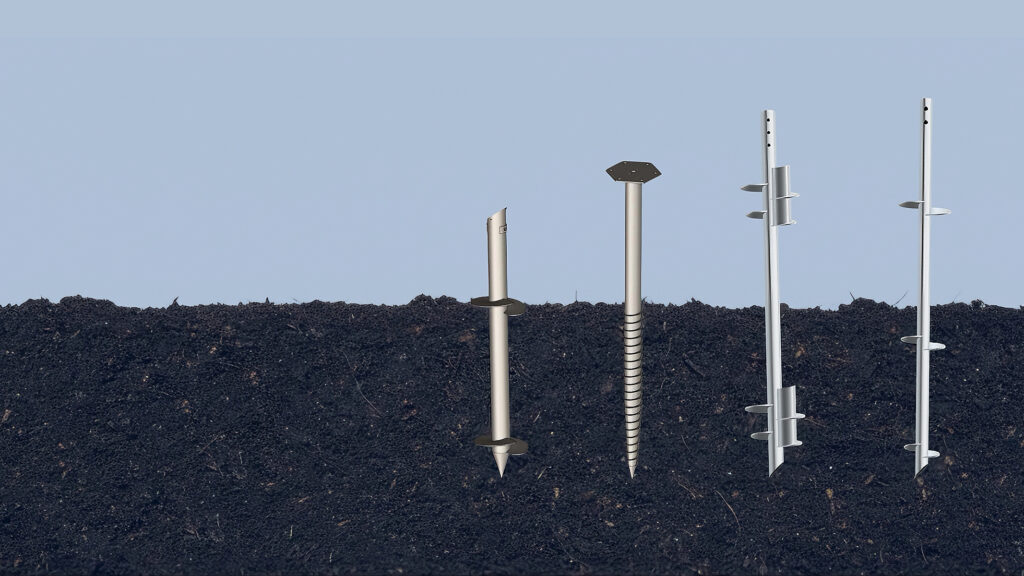
Start with one common design basis
A fair comparison begins with the same structural reactions. Record compression, tension, shear and moment for ultimate, serviceability, erection and accidental situations where applicable. State whether loads are per support, per row, per equipment unit or for the complete foundation. Include connection eccentricity and tolerances because they can materially change bending demand.
The serviceability criteria are equally important. A foundation can have adequate ultimate resistance while allowing movement that the steel frame, tracker drive, module table, equipment pipework or cladding cannot accept. Define total settlement, differential settlement, lateral displacement, rotation and cyclic performance at the interfaces that matter.
Then align the design life, exposure and maintenance assumptions. A low first cost based on a shorter life, unverified coating or inaccessible replacement is not comparable with a more durable alternative. Likewise, a conservative concrete concept should not be compared with a preliminary screw-pile quantity that excludes testing, corrosion allowance or refusal risk.
Use the ground investigation to test constructability
The investigation should describe more than allowable bearing pressure. For a screw-pile route, the designer and installer need stratigraphy, strength or density indicators, groundwater, aggressive ground chemistry where relevant, fill history, cobbles or boulders, buried services and depth to rock. These inputs affect whether the proposed geometry can reach the design zone without damage or unacceptable deviation.
For concrete, the same information governs excavation stability, water control, founding level, bearing response, sliding resistance and temporary works. Weak near-surface material may require replacement or deeper construction. High groundwater can change the method and environmental controls. The comparison should price those consequences instead of treating the geotechnical report as a pass/fail attachment.
Compare the complete installed systems
For screw piles, include pile supply, connection plates, welding or mechanical joints, corrosion protection, installation equipment, setting-out, preproduction trials, test piles, verification tests, cut-off or extension work, survey and records. Add a defined response for early refusal, excessive penetration, low measured response, obstructions and damaged coating.
For concrete, include survey, excavation, disposal or reuse of spoil, blinding, formwork, reinforcement, embedded items, concrete placement, finishing, curing, testing, backfill, compaction, temporary protection and reinstatement. If the concept uses precast elements, include lifting, transport, bearing preparation and grouting.
Use the same commercial boundary for both. If fencing, internal roads, drainage diversions, crane access, winter protection or remote-site accommodation are excluded from one option, show the exclusion explicitly. A headline material comparison does not represent installed project cost.

Build quality control around the failure modes
Screw-pile inspection and test plan
The ITP should identify approved pile type and revision, material traceability, dimensional checks, weld and coating records, calibrated installation equipment, setting-out, verticality or designed inclination, installation depth, measured installation response, termination rule and as-built coordinates. Preproduction installations are especially useful where the investigation cannot fully describe installation variability.
Acceptance must not rely on a single number without context. A torque reading, for example, needs a calibrated measurement route, defined sampling frequency, consistent equipment configuration and a rule for transient peaks. The record should show what happened along depth, not only the final value. Proof or verification load testing should follow an approved method and acceptance criterion.
Concrete inspection and test plan
Typical controls include excavation and founding-level acceptance, blinding, reinforcement grade and placement, cover, embedded-item position, formwork, concrete class, delivery tickets, placement conditions, sampling, curing, strength results, dimensional survey and repair records. Hold points should be placed before work becomes concealed.
For both systems, a nonconformance needs an engineering disposition linked to the affected support. “Accepted on site” is not enough. State who had authority, what evidence was reviewed and whether connected steelwork or alignment assumptions changed.
Evaluate programme without hiding prerequisites
Screw piles can shorten the physical installation sequence because there is no concrete curing period, but the programme advantage only exists if design, procurement, trial installation, testing and plant mobilisation are planned early. A late geotechnical query or missing test reaction system can erase the apparent benefit.
Concrete is familiar in many markets and may use readily available labour and materials, but weather, batching distance, access, inspection timing and curing can control the sequence. Repetition and prefabricated reinforcement can improve productivity. Compare credible production rates supported by equipment, crew size, shift pattern and access—not an isolated best-day output.
A useful schedule shows design freeze, long-lead material release, mobilisation, trial work, production, testing, rectification allowance and handover. Run at least a base case and an adverse-ground or weather case. The decision should consider completion confidence, not only the shortest theoretical duration.
Review environmental and decommissioning claims carefully
Lower excavation and concrete volume may reduce certain project impacts for a suitable screw-pile concept. However, a defensible assessment also considers steel mass, coating, transport, installation fuel, test scope, rejected piles, maintenance and end-of-life handling. Concrete options should include cementitious material, reinforcement, excavation, spoil transport and site reinstatement.
Do not publish a percentage saving unless the boundary, quantities, data sources and calculation method are available for review. “Removable” does not automatically mean “reusable”: extraction can deform components or damage coating, and a reused item needs identification, inspection and an approved design basis.
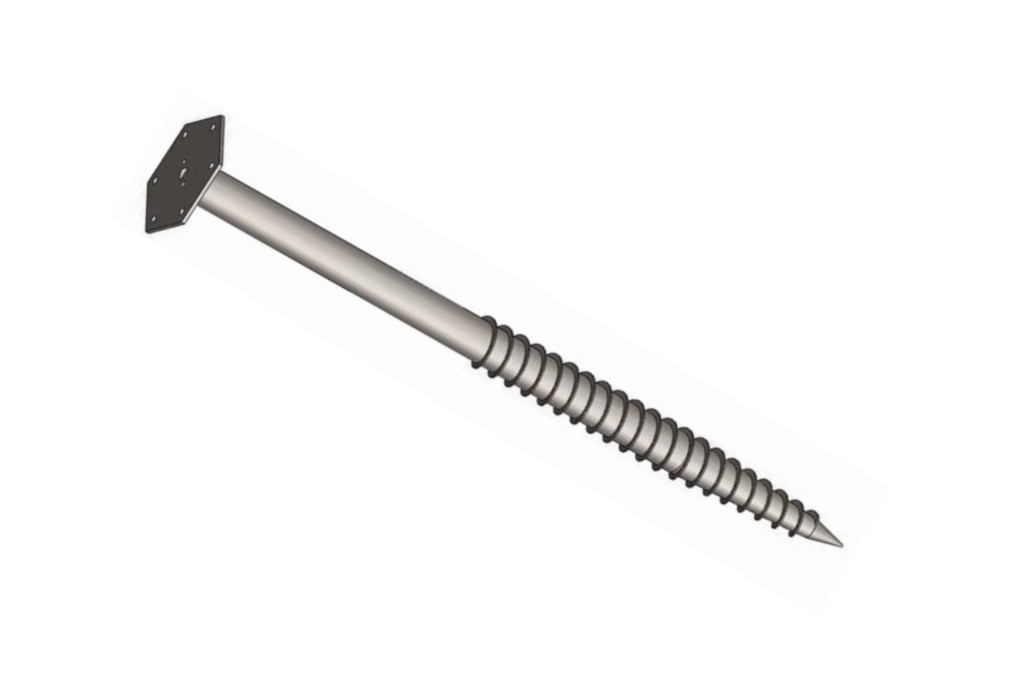
Procurement questions that expose hidden risk
- Which ground report, structural reaction schedule and design standard control the proposal?
- Who owns geotechnical and structural design, and who approves changes after trial installation?
- What pile or footing geometry, material, corrosion system and connection revision are priced?
- Which verification tests are included, at what frequency, and what are the acceptance criteria?
- How are refusal, low response, obstructions, groundwater and out-of-tolerance foundations treated?
- What manufacturing, installation and as-built records form the final handover dossier?
- Which exclusions could move cost or programme back to the buyer or EPC?
A controlled selection workflow
- Freeze inputs: issue the reactions, interfaces, serviceability limits, design life and ground information with revision status.
- Develop two viable concepts: size enough detail to understand quantities, equipment, testing and constraints.
- Run constructability review: involve geotechnical, civil, structural, electrical or mechanical interfaces, construction and HSE.
- Compare whole-system outcomes: evaluate installed cost, programme confidence, quality evidence, environmental boundary and residual risks.
- Trial the preferred route: where uncertainty warrants it, use preproduction installation or a representative foundation test to confirm assumptions.
- Release controlled documents: approve calculations, drawings, ITP, method statement and response rules before production.
Frequently asked questions
Are screw piles always cheaper than concrete?
No. They may reduce excavation, wet trades and waiting time, but material geometry, coating, specialist plant, testing, access and difficult ground can change the result. Compare priced, buildable concepts under the same scope.
Can screw piles be installed without a geotechnical investigation?
A preliminary concept may be discussed, but a project release needs adequate ground information. Without it, refusal depth, capacity, corrosion exposure and variability are unresolved and the commercial allowance is likely to be unreliable.
Does achieving installation torque prove capacity?
Not by itself. The project must define how torque is measured, how a relationship was established and what verification testing is required. Read our detailed guide to installation torque and ground screw capacity.
Which system is better for solar mounting?
Both can be viable. The answer depends on array reactions, terrain, geotechnical variability, alignment tolerance, corrosion exposure, installation access, tracker or fixed-tilt interfaces and the project risk allocation.
What should be sent for a supplier review?
Send the site location, ground report, topographic information, reaction schedule, layout, interface drawing, design life, corrosion assumptions, programme and required test or documentation level. East Baoyu can then identify the relevant product-data route and open technical questions.
Prepare a comparable foundation enquiry
Use the ground screw pile range to identify a preliminary family, then send the project inputs. The resulting proposal should state its assumptions, exclusions and required verification rather than presenting a generic catalogue selection as final design.
Foundation option comparison table
| Decision area | Inputs to confirm | Verification output |
|---|---|---|
| Site constraint | Access, excavation, spoil, groundwater and reinstatement | Constructability review based on the actual site |
| Design verification | Actions, soil model, durability and connection behavior | Engineer-approved calculations and field testing |
| Programme and recovery | Plant, curing, removal, reuse and end-of-life route | Project programme and lifecycle requirements |
Use this table as an enquiry and review checklist. Project design, acceptance criteria and released records remain project-specific.
References, disclosure and change record
References and further verification
- ICC-ES AC358: Helical Systems and Devices
- FHWA GEC 5: Evaluation of Soil and Rock Properties
- East Baoyu Ground Screw Piles
Disclosure: East Baoyu manufactures and supplies products discussed on this website. Structured drafting tools may assist research and editing, but technical claims, project inputs and release decisions require human review.
Version 2.0: Rebuilt as a project-selection guide with a direct answer, common design basis, decision table, QA routes, programme and environmental boundaries, procurement questions, FAQ, internal links and reviewed visuals.
View the public Content Change Log · Corrections: info@baolaipipes.com